


Volume 65 December 2026-January 2026 : Art & Culture
Eight Days in September: The Removal Of Thabo Mbeki
Author : Frank Chikane
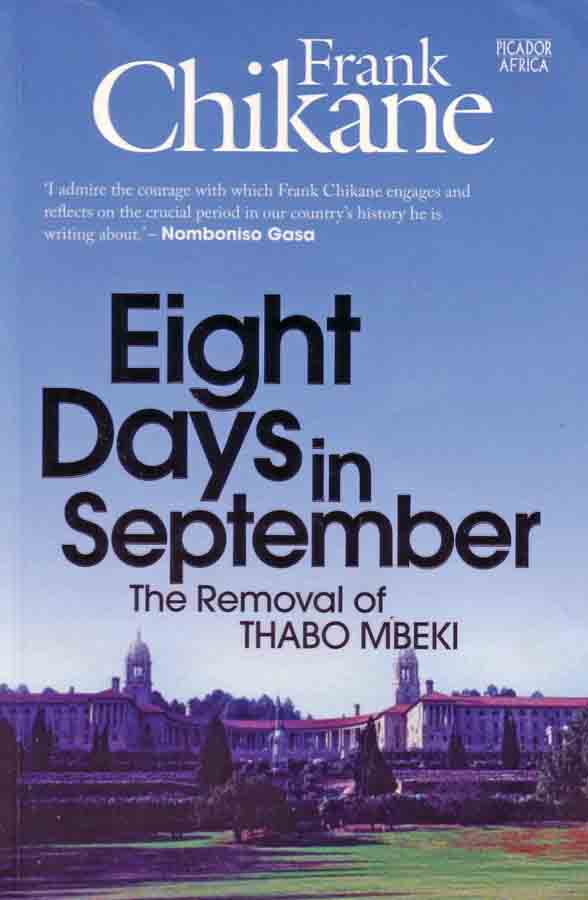
Title: Eight Days in September: The Removal of Thabo Mbeki
Publisher: Picador Africa/Pan Macmillan South Africa
Reviewer: Pako Lebanna
Former anti-apartheid activist, Frank Chikane gives a behind-the-scenes account of the removal of Thabo Mbeki as President of South Africa. He gives an analysis of the events that took place in the fateful eight days in September 2008, and goes further to analyse Mbeki’s political legacy.
In his capacity as Secretary of Cabinet and Head (Director-General) of the Presidency, Chikane, was tasked with managing the transition from Mbeki to Kgalema Motlanthe and then on to Jacob Zuma.
The book is one of the most talked about in the region. It has elicited interest from many quarters. It is certainly a well written documentation of contemporary southern African history.
Chikane picks out a number of key issues - that South Africa was nearly plunged into a constitutional crisis in 2008 when Mbeki was recalled by the ANC National Executive Committee (NEC) led by Zuma.
In the book, it is rightly pointed out that constitutionally, Mbeki had been given a mandate by the South African people who elected the majority of ANC Members of Parliament (MPs) in the 2004 general elections, who in turn elected Mbeki.
It is parliament which had the constitutional right to remove Mbeki, not the ANC NEC. Had Mbeki refused to be recalled, South African society could have been plunged into a constitutional crisis.
Already the country was polarized by having two centres of power, one being the national presidency led by Mbeki, the other being the ruling party leadership that had defeated Mbeki’s group at the 2007 ANC Polokwane elective congress. The second theme is that a coup de tat of sorts was taking place, as the Zuma group was forcing their way into power, by hook or crook, with scant regard to some of the sensitive matters of the state and without giving time for the commander in chief of the armed forces to even bid farewell to those in charge of the national security apparatus.
Chikane feels that a civil war might have even erupted given the level of sensitivity that was taking place at the time.A well written book but one whose main problem is the author being too defensive of Mbeki, ignoring the factors that led to so many in the ANC wanting to see to the removal of Mbeki.
The former president had alienated the ANC traditional allies - the unions led by Zwelinzima Vavi, South African Communist Party (SACP) led by Blade Nzimande, and the party youth led at the time by Fikile Mbalula, with Julius Malema heading their student body, as well as other stakeholders who then rallied around Zuma.
The book also glosses over one of Mbeki’s major policy failures. He and then health minister, Manto Tshabalala Msimang, took time arguing over semantics when many people were dying of HIV/AIDS, when the state could have provided antiretroviral therapy in due time, as to ward off the pandemic.
Sadly, “Mbeki does not think there is a causal link between HIV and AIDS,” and “Manto believes beetroot and garlic are the cure for HIV,” became the media tag lines that would define the Mbeki presidency.
Chikane promises to deal with these issues in his forthcoming book, “The Things I Could Not Say, from A(ids) to Z(imbabwe)” due to be published in September. Too many in the media and SA body-politic focused on the negative aspects of Mbeki’s leadership style when he was recalled - being regarded as aloof, focusing on jetting around in world capitals when he had domestic and regional issues such as HIV/AIDS and Zimbabwe to deal with.
While slightly biased, the good thing about Chikane’s book is that it gives the reader a reminder of Mbeki’s positive legacy - his management of Africa’s most sophisticated economy, pan-African outlook and conflict resolution (DRC etc). That he chose to immediately step down graciously when there was no constitutional basis for the party to recall him, proves that he remained a dignified statesman to the end.
A must read for those interested in contemporary history.