


Volume 65 December 2026-January 2026 : Art & Culture
Advocates for Change: How to Overcome AfricaÔÇÖs Challenges
Author : Moeletsi Mbeki
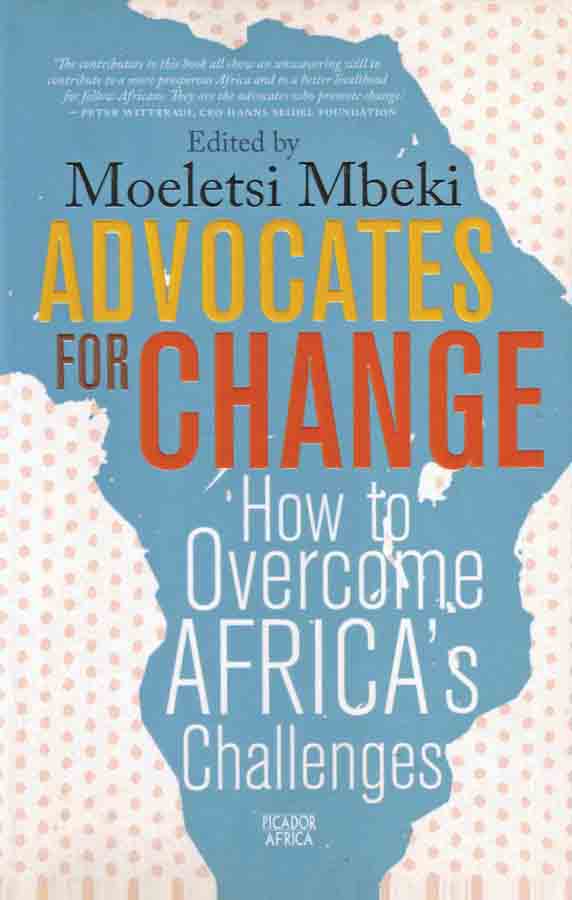
Title: Advocates for Change: How to Overcome Africa’s Challenges
Publisher: Picador Africa/Pan Macmillan South Africa
Reviewer: Pako Lebanna
This is a follow up to Moeletsi Mbeki’s first book “Architects of Poverty: Why African Capitalism Needs Changing,” where he had argued that African people comprise the world’s poorest because of poor political and economic leadership that lacks innovative foresight.
In this new book, Mbeki - a journalist, private entrepreneur, and author, also the son of former South African struggle hero Govan Mbeki, and younger brother of former president Thabo Mbeki
examines how Africa can get itself out of the quagmire.
Mbeki brings together some great African thinkers to look at a variety of subjects, such as education, entrepreneurship, mining, education and social affairs, to look at solutions to different problems, using their research and experience in these fields.
Mbeki himself feels that part of the problem is that Africa has always been dominated by elites, with a passive citizenry. He gives an example of his own country, South Africa, which he says has been ruled for century by four types of elites - the indigenous African aristocracy, British imperialists, Afrikaner landowners and the Black upper class.
He quotes a November 2009 study by South Africa’s leading market research company, Ipsor Markinor, which revealed that South Africa’s dominant party, the ANC does not get votes for ideological or policy reasons.
According to the study, 67 per cent of ANC voters do not work, and of the third that vote, nine per cent do not work full time. Only eight per cent of ANC supporters have higher education qualifications, only 23 per cent have graduated from high school, and 69 per cent either have no education at all or have not completed high school (Mbeki 2011:9).
Mbeki feels African elites take advantage of their voter’s lack of knowledge. He feels that the solution is the people taking on their leaders and demanding the political stability, social and economic development that can lead Africa out of its malaise.
Authors such as Seeraj Mohamed (on how to overcome negative trends in the South African economy), Paul Jordan (on how Africa’s mineral resources can be made drivers of development), Jonathan D. Jansen (on education), Mike Herrington (entrepreneurship), look in detail at how Africa can improve its position. Other issues addressed include healthcare and agriculture. A highly informative book.