


Volume 65 December 2026-January 2026 : Art & Culture
Makgabisanaga: Art exbition washes away dust of life
Author : Pako Lebanna
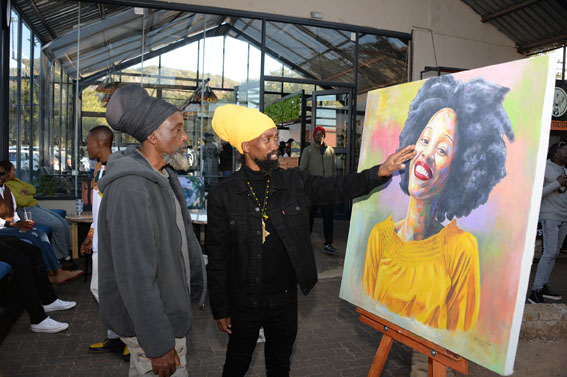
“Art washes away from the soul the dust of everyday life,” legendary Spanish painter, sculptor and theatre designer, Pablo Picasso once famously said.
As a hip gathering of young and middle aged Gaborone art aficionados braved the winter cold to attend the Makgabisanaga Art Exhibition held at Game City in Gaborone in late May, those words of Picasso, one of the most influential artists in modern history came to mind.
On that night, at the foot of nature’s own imposing Gaborone landmark, Kgale Hill, the artistic work of young Batswana indeed breathed life into attendees’ daily routine.
Seven artists, four visual artists (two male and two female) and three photographers (two male, one female) presented their exhibition to the event curated by art dealer and exhibition manager, Thabo Kgatlwane, Director of Cellar Door Arts.
Kgatlwane explains to Kutlwano Magazine that Makgabisanaga has been some years in the making before it came to fruition.
The name Makgabisanaga, Setswana for ‘beautifiers of the world,’ in reference to nature’s flora and fauna, is a word he first heard in 2006, when his grandmother asked the family to start calling her using that name. “Those words stayed with me for years. My grandmother, in her grace and wit, coined a term that embodied more than just her joy; it reflected the core essence of what artists do.
They beautify the world, using colour, texture, perspective, and light. For years, I held onto that name, knowing deep down that when the time was right, it would inspire something far greater than just a family memory, it would become a platform to celebrate creativity, collaboration, and community,” Kgatlwane reveals.
Kgatlwane handpicked the seven artists to bring to life the Makgabisanaga exhibition.
“Their pieces speak of vision, storytelling, and a relentless pursuit of beauty. Curating this exhibition is for me, a joyful experience, made even more rewarding by their enthusiasm and openness. It is a celebration of artistry, not just in content, but in collaboration,” Kgatlwane says. Kanye photographer, Sentle Baaitse tells Kutlwano that she is presenting her very first exhibition, and her artworks are based on the mental health of men.
“For me, banna ba kgabisa naga (men beautify the environment), and they deserve to have their voice heard. My work explores the mental, social, and cultural struggles faced by the boy child, by men, emphasising the importance of healing them just as we strive to heal and empower the girl child,” she adds.
Her presentation, “Lesedi la Pholo,” (Light of Healing), is a piece that explores the emotional and cultural weight carried by most men, reflecting their journey toward healing and self-expression through the use of Botswana colour and traditional elements.
“Through this palette, Lesedi la Pholo becomes a space where men are reimagined not just as providers or protectors, but as whole beings, capable of love, grief, tenderness and regeneration,” Baaitse says. She uses white to represent light, symbolising men’s strength, purity and growing desire to be heard and emotionally present.
Also, there are black and dark tones to reveal the weight of shame and cultural teachings that discourage vulnerability; as well as vibrant colours to highlight creativity, softness and feminine energy that balance masculinity; qualities often suppressed but essential for healing.”
As for Wabepo Sedimo, he presents photographic images of the environment, wildlife and nature captured through the lens to express various emotions traversed in life, that is grief, depression, sadness and joy.
His photographic artwork, “Gorata, the Pelican Feather” was captured in August 2019 at Nata Bird Sanctuary, a tribute to the love, compassion and resilience expressed through compassion during grief.
“Earlier that week in August 2019, my dear friend Gorata Mannathoko buried her mother in Masunga. In the heavy silence that often follows funerals, I invited her to take a drive, not to escape, but to breathe. We reached Nata in the afternoon and stayed until the sun bowed out behind the salt pans,” Sedimo discloses.
The picture was captured at that moment, when Gorata held the pelican feather with the gentle sunset in the background.
And for Sedimo, the feather embodied her, delicate yet enduring, worn yet dignified.
The frayed edges conveyed pain, of what had been taken, the irreplaceable loss of a mother. And yet the feather was not broken. It still held form.
Captured in August 2018 at the Chobe National Park, another piece, “Grey as a Colour of Life-Zebras,” Sedimo expresses sadness, the photographic work reflecting the despondency he felt at the time.
“With camera in hand, I drifted into the stillness of Chobe, surrounded by life but feeling disconnected from my own. When I saw a dazzle of zebras moving with quiet grace, unbothered by my presence. I clicked the shutter instinctively. Zebras are a paradox of contrasts; black and white, bold, clear. But when they stand together in a blur or when light hits them, they become grey, an undefined middle space between clarity and confusion, between joy and despair,” Sedimo explains. Another piece, “The End of Depression-Sunset” was photographed in June 2021 at the Sedimo family farm close to Matlagatse village near Letlhakeng, six months after he had survived COVID-19.
“Though I recovered physically, the virus left a quiet devastation in its wake. My lungs, once strong and steady, turned against me. Even laughter, that naturalmonths, something inside me had shifted.
That, despite everything, I was still here. Still watching, still breathing,” he notes.
Young female Motswana visual artist, Kelebogile Marope presented what she described as a “deeply personal body of work.”
Titled “An Ode to my Father,” her collection had five paintings, which she says explore a reflection of her father, who died during the COVID-19 pandemic.
“My father is the one who introduced me to the world outside the home. From childhood to early adulthood, he drove me and my sisters everywhere-to school, the salon, grocery store, the gym, the mall, even the movies.
These routine journeys were not just acts of transport, but acts of devotion. He was always there, waiting in the car, or on his way to pick us up,” Marope says. She adds that through these drives, she experienced the broader landscape and outdoor beauty of life and her ‘Makgabisanaga’ experience was thus lived through her father’s devotion to the family.
Marope proceeded to use the medium of painting to express the spatial and emotional resonance of roads and movement.
“The paintings take on the visual language of road surface markings-lines, edges, thresholds-rendered in a limited palette of black, yellow and white.
They appear abstract at first glance, yet remain strangely familiar, echoing the visual cues of the roads my father drove (in),” she adds.
It was a day that displayed the creativity of Batswana artists fostering artistic appreciation and engagement from the beholden audience. ENDS