


Volume 50 Issue 6 - June 2012 : Politics
MbekiÔÇÖs heart stays put in Gaborone
Author : Pako Lebanna
“I am an African. I owe my being to the hills and the valleys, the mountains and the glades, the rivers, the deserts, the trees, the flowers, the seas, and the ever-changing seasons that define the face of our native land.
My body has thawed in the warmth of our sunshine and melted in the heat of the midday sun. The crack and the rumble of the summer thunders, lashed by starling lightning, have been both a cause of trembling and of hope.
The dramatic shapes of the Drakensberg, the soil-coloured waters of Lekoa, iGqili noThukela, and the sands of the Kgalagadi, have all been panels of the set on the natural stage on which we act out the foolish seeds of the theatre of the day.
A human presence among all these, a feature on the face of our native land thus defined, I know that none dare challenge me when I say- I am an African.”
The now popular poetic speech recited by the then South African Deputy President, Thabo Mvuyelwa Mbeki, on the occasion of the adoption of South Africa’s first democratic constitution in May of 1996, no doubt stirred some emotion.
But most importantly, it acted as a call to arms for the African intelligentsia and civil society to give an awakening to a hitherto oppressed continent.
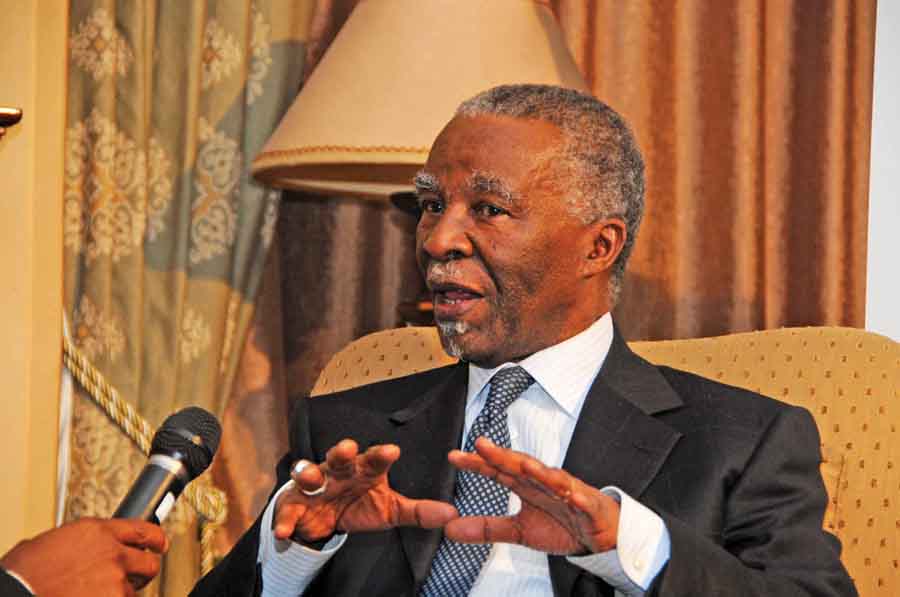
The words could not help ringing in one’s mind as Mbeki gave a stimulating speech, on a chilly evening of Friday May 11, 2012 in Gaborone.
Former South African head of state, Mbeki, now an eminent African statesman, had graced the occasion of the Sir Ketumile Masire fundraising gala event, giving a stirring speech.
He paid tribute to Botswana’s role as a frontline state during the struggle against apartheid.
This is part of the African Renaissance philosophy Mbeki subscribes to, and alluded to in ‘I am an African.’
This is a school of thought, whose principal aim is the unity of the different countries on the continent, developing a reawakening of Africa, reviving positive cultural values, and modernising existing institutions.
That night, Mbeki related his historical relationship with the city of Gaborone and by extension the people of Botswana.
He told the tale of how, as a young freedom fighter in September of 1962- a good 50 years ago- he was part of a group of young South Africans on transit “through the then so-called Bechuanaland Protectorate,” en route to study Economics in England.
Mbeki recalled the tribulations they experienced under incarceration for a month at Bulawayo Prison in the then Rhodesia, before being deported to Bechuanaland.
“Thus, 50 years ago, Botswana established itself in my own consciousness, even before its independence in 1966, as a vital bridge between apartheid South Africa, which was part of the African colonial construct, and liberated Africa,” said Mbeki.
One of the things noted by the elder statesman on this particular night, was how Gaborone had developed from the “Gaberones” of 1962 which “consisted of a railway station and an attached station hotel, and some distance away what was called The Village, which, among others had a police station and magistrate’s court, and absolutely nothing in between.”
Mbeki noted that his own development pattern as a person to maturity “has mirrored the development of the Gaberones of 1962 into the Gaborone of 2012.”
Because of the role the city and country played in the liberation of South Africa, perhaps most signified by the Gaborone Raid of June 14, 1985, during which the apartheid South African Defence Force (SADF) army attacked the capital in the dead of night, killing 12 South African exiles and Batswana.
“Thus, I will forever refuse that anybody should separate me from this city and the sister African people of Botswana who constructed it, who, therefore, made it possible for us to achieve our liberation, giving me the possibility of life and work across your border as a free human being and African,” said Mbeki.
Giving details, Mbeki paid tribute to the late Kgosi Linchwe II of Bakgatla, whom he said had been involved in the African National Congress (ANC) underground machinery that had been established in the country, before the formal setting up of an ANC Representative in 1974.
He said Linchwe enabled the ANC to pass weapons and to carry out military operations in South Africa, which were part of the ANC’s struggle to end apartheid, a racist system universally condemned and international instruments such as the United Nations.
In 1992, Mbeki says he personally relayed to Kgosi Linchwe that the ANC no longer needed the weapons of war, which had been “a necessary part of the just struggle for the liberation of South Africa,” as they were negotiating a peaceful settlement for the attainment of a democratic dispensation in South Africa.
One striking piece of information that Mbeki revealed is that the late ANC president, the iconic Oliver Tambo, attended the 10th anniversary celebrations of Botswana’s independence, at government’s invitation.
“We decided to take advantage of Oliver Tambo’s presence in Gaborone to arrange for him to meet Steve Biko (the South African Black Consciousness leader), who at the time was restricted to the magisterial district of King William’s Town in the Eastern Cape,” said Mbeki.
However, the operation was aborted after Biko told a confidant not realising that the latter was an officer in the South African Security Police.
Mbeki stated that arrangements for Biko’s plane to land in Botswana and for him to be transported to a ‘safe house’ to meet Biko, had been made by the then Botswana Police Commissioner, Simon Hirschfeld.
“Even as the June 1985 Gaborone Raid of the South African Defence Force, and as was the case in 1973 when South African patriot, Onkgopotse Tiro, was murdered in this city through a letter bomb, the government of Botswana led by President Masire refused to be intimidated,” said Mbeki.
He noted that the Organisation of African Unity (OAU), forerunner to the African Union (AU), and the Southern African Development Community (SADC), deployed Sir Ketumile Masire to chair the panel of eminent persons to investigate the 1994 Rwandan genocide, facilitate the Inter-Congolese Dialogue and to assist in the Lesotho elections impasse.
Mbeki described Masire as “a very humane and understanding African leader,” and said that the work of the Masire Foundation has to be given support by Africans from across the continent.
He urged the various foundations established by former African heads of state and government to establish a formal network, as to pool their resources and capacities together, and advance a common agenda for Africa’s renaissance.
Sir Ketumile reciprocated by paying tribute to Mbeki, saying he met the latter when he was secretary to the ANC President, Tambo, and Masire the Botswana Vice President.
“When I was assigned to be the Inter Congolese Dialogue Facilitator, Mbeki spared no effort to help me during those hard talks that lasted for a good part of three years. When we eventually assembled at Sun City, he was always readily available as and when his presence was required,” stated Sir Ketumile.
One got the feeling that there was hope for an Africa’s Renaissance, listening to two great elder statesmen recount their efforts at internationalism.
For Washington Okumu, author of “The African Renaissance: History, Significance and Strategy,” the reference to Africa as ‘undeveloped’ and the countries in the global north as ‘developed’ is a form of reductionism.
This, he feels, implies that aspiring to modernity means Africa wishes to mimic Britain or America on issues like divorce rates and treatment of the elderly, reducing the concept of ‘development’ to a modern form of colonial domination.
Okumu draws attention to African positive cultural traits worthy of preservation and continuation, and states that a more satisfying terminology would be a reference to ‘low-income’ countries and ‘high-income countries’ omitting a reference to development altogether.
As Mbeki disembarked the Gaborone International Conference Centre podium, his famous words from 1996 echoed through the early winter Gaborone night…
I am an African
I am born of the peoples of the continent of Africa. Whoever we may be, however much we carry baggage from our past, however much we have been caught by the fashion of the cynicism and loss of faith in the capacity of the people, let us err today and say- nothing can stop us now!