


Volume 65 December 2026-January 2026 : Business
Botswana China explore investment options
Author : Ludo Chube
As Botswana continues to search for more investment opportunities with China trade with the Asian country is expected to grow soon.
Thus, investment opportunities in the agricultural sector between the two countries appear to be headed for greater heights if a recent Chinese delegation visit is anything to go by.
During the two-day visit, headed by China’s Vice Minister of Agriculture, Niu Dun, the two countries discussed issues of capacity building, prospects for exporting Botswana beef to the Chinese market, and commercialisation of the country’s agricultural sector.
The aim of the interaction, which Botswana championed, was aimed at finding the best way the two countries can strengthen their bilateral relationship, particularly in the agricultural sector.
Botswana’s interaction with China is certainly deliberate and cannot be overemphasised bearing in mind that, with a huge population of 1. 3 billion China is able to feed its citizens sufficiently.
During a guided tour of Sedibeng Farms in the Borolong Sub-district, Botswana’s Minister of Agriculture, Christian De Graaf, said: “We are a small population of close to two million and with a national demand of roughly 200 000 metric tonnes, we still have to import roughly 50 per cent.”
Encouraging local farmers, De Graaf said if China could be self-sufficient with such a big population, so Botswana can with a population that is way too small.
Minister De Graaf explained that with ISPAAD in its third year the programme was now due for review to see how best it can be improved to respond to the country’s agricultural needs and investment opportunities.
The Chinese vice minister, Niu Dun, in turn promised an exchange of information about agricultural policies, agricultural science technologies and agricultural projects between Botswana and China.
He said: “We have planned an agricultural technology training course in Beijing in December this year, and we would like to extend an invitation to agricultural experts and farmers from Botswana to participate in the course.”
In addition, he promised to invite Chinese agricultural enterprises and businesses to set base in Botswana to develop the agricultural sector.
One of the issues that were also discussed during the vice minister’s visit was capacity building. In an interview, Minister De Graaf said it was important that Botswana should have a skilled workforce.
He said China has offered some training opportunities for Batswana farmers, including the training of some experts in various agricultural fields.
Given Botswana’s de-listing from the European beef market the country has been searching for new markets to export its beef and China presents ample opportunities. With that in mind, the visiting minister also toured the Botswana Meat Commission.
De Graaf revealed that in China they needed roughly 78 million metric tonnes of beef, and if one wonders what is in it for the small scale farmer, the answer is “if you look at China most of agricultural activities are in the rural areas like Botswana”.
As such it is important that small farmers are not left behind, particularly because 80 per cent of the cattle that go to BMC are supplied by small scale farmers, he said.
He said farms would be registered to ensure market compliance and improve cattle traceability. Statistics indicate that Botswana’s dairy industry is only producing 25 per cent of the national demand. As such the minister underscored the need to focus on increasing milk production.
For a country that has a cattle population that exceeds that of the citizens, it is quite an opportunity for Batswana to exploit the situation.
The Chinese visit has sparked hopes in De Graaf and his ministry so much that they hoped to open doors of fruitful interaction with China in the agricultural sector. “We intend to benchmark from each other,” the minister said.
De Graaf cautioned farmers who had been calling for the country to look for alternative beef markets instead of Europe, saying even in countries such as China the requirements were exactly the same as the European Union requirements.
“In fact these requirements become stricter and stricter by the day, and that is why it is very important for us to get our traceability system in place to make sure that we comply with market expectations,” he said.
He said even the cattle that are not for export markets but billed for local butcheries must comply as well.
Botswana is experiencing a drought this year because of sporadic rain patterns, which means that the country’s imports will shoot up. Already, the minister revealed that the nation had run out of sorghum although at one point there was a surplus.
To address this, the ministry is currently working on tapping water from the Zambezi River but since it was a shared resource, the minister said, Botswana’s water right or share of the river was only two percent.
Due to the recession, he said, the Zambezi Agro project had been put on hold. “However, eventually when we tap water we will only need 57 per cent of that two per cent to put 40 000 hectares of land under irrigation.
Once that has happened Botswana could become self sufficient, he said confidently, adding that his ministry was doing a re-structuring to work along agro-ecological zones where they would be concentrating on what could flourish in specific areas.
He said land would be availed along the Boteti River, where work on some 12 000 hectares of land is ongoing.
As for his first impression of the country after touring several projects, the Chinese vice Minister, Niu Dun, noted that there was abundance of agricultural resources. “I believe China and Botswana are both agrarian nations; therefore we must pay close attention for agriculture to be the top priority issue in our countries. I am sure we can learn from each other,” he said.
Areas of investments, he noted, were plant production. “In China we plant rice, wheat and corn, so we have some experience in that area. Therefore we should both promote commercial production for plant production to solve the food crisis in Botswana, China and the world at large. So we would like to specialise in plant production particularly grain production.”
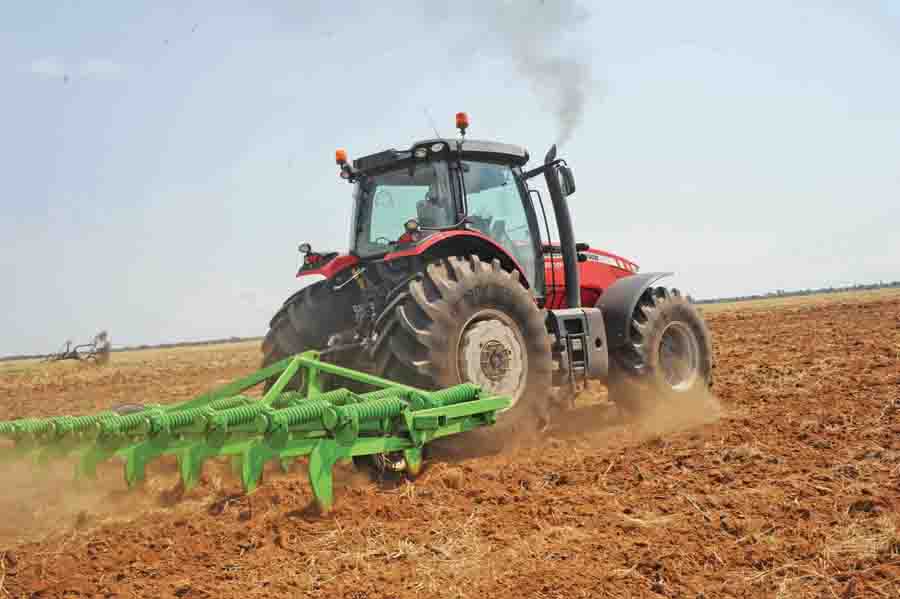
Local farmers have for a very long time decried the expensive prices of agricultural machinery which remains a challenge for many to buy and maintain. As a result Botswana is looking into luring some Chinese companies to set base here to manufacture as well as supply their products at reasonable prices.
Thankfully this is an area that China is also hoping to invest in, as they see it as a niche for them, Dun said in a subsequent press briefing. He promised that their markets were also open for exploration by Batswana farmers and investors.
While here the Chinese delegation visited horticultural projects in Glen Valley, arable farming in Sedibeng, Botswana Meat Commission and Sunny Side dairy farm.