


Volume 50 Issue 3 - March 2012 : Heritage
The ox wagon and reflections on power and motion
Author : Sandy Grant
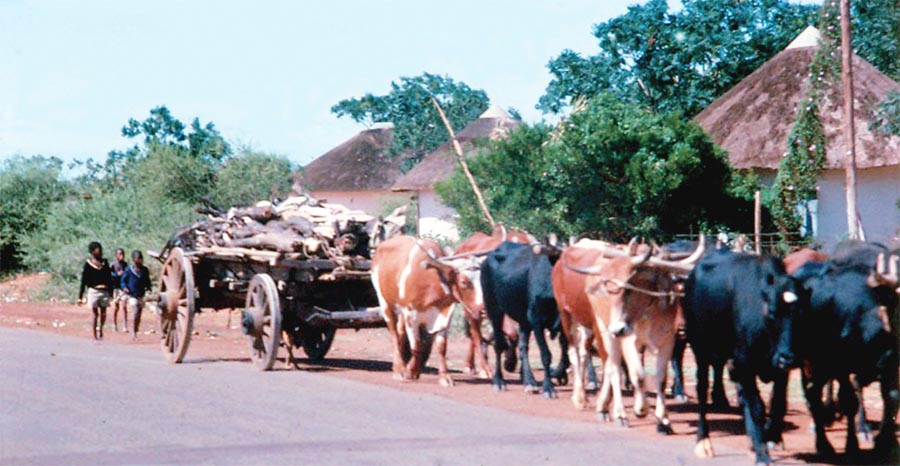
The ox wagon and reflections on power and motion
The ox wagon age in this country would have begun fairly slowly with the intrusion into it by the first European travellers, traders, hunters and missionaries in the first part of the 19th century. Because of the economic circumstances of the country, it would have lasted longer, in all probability, than any other country in southern Africa- let us say, about 150 years orso-butitcametoanend ungraciously and with a quiet startling abruptness in the mid-1970s with the advent of the diamond economy.
Batswana, like others in the world, were (and still are) great acquirers and great ‘copiers.’ They may have envied Robert Moffat’s possession of the ox wagons they saw as he passed by on his extraordinary trips to see Mzilikazi, but they would have known only too well that even had they possessed such beauties, they lacked the skills to keep them moving. Those
first European travellers were able to travel only because they first had to acquire those skills. If they were unable to make difficult repairs, they would perish. None of them had cell phones and there was no one they could call to come and give help. But as the situation in the country stabilised and trade developed, wagon repairers from South Africa realised that there was a continuing need for their services and that they could make a living if they settled in key places along the old missionary road, most notably at Shoshong.
With hundreds of these wagons moving up and down the country there must have been many opportunities for Batswana to do trade deals, exchanging elephant tusks or ostrich feathers for an ox wagon or simply acquiring the possessions of traders who had succumbed to black water fever or other hazards.
With ox wagon repairers now locally resident, they themselves had no need to learn how to repair a broken axle, because they were now able to pay for this particular service. What they could not buy, however, were the oxen trained to pull those wagons. But they were cattle-people and were able to meet that particular need. Bit by bit Batswana therefore, became owners of a very significant number of wagons.
Today, it needs an effort of imagination to fully understand the situation that existed between let us say, 1890 and 1960. The roads were terrible and barely usable by motorised transport. The one form of transport which could be used
almost anywhere; however, was the ox wagon – oxen because neither horses, mules nor donkeys had the strength and staying power to pull the huge weight of a wagon through sand. Those who owned wagons automatically gained for themselves major social and economic status.
They were big people. Watching a loaded wagon begin to move made it instantly obvious why this might havebeenso.Ateamof16or20 oxen are flicked and shouted into action. Dogs bark, people shout, the wagon massively creaks, the huge wheels begin to turn, chickens run all over the place, dust is churned up, and the mighty colossus is on its way.
The spectacle was uncannily similar to the departure of the old steam engine trains after prolonged stops at Gaborone, Palapye or Francistown. There was the first indication of movement, the transference of power to the wheels, the rumble of movement, the hiss of escaping steam, and, as with the ox wagon, the leviathan was hugely on its way, slowly disappearing into the distance.
I very much doubt that the younger generations have
Train at Pilane
comparable scenarios available to them although this may seem an absurd notion for those who believe that there can be nothing in the past to match what is available today. There is the Kgalagadi road race with crack vehicles accelerating when most of us would apply brakes. There may be sometimes the spectacle of super luxury BMWs, Mercedes Benzes and Ferraris disappearing at high speed in clouds of dust. But what is always missing is the visible, wonderfully exciting, slow generation of the power needed to achieve that ‘lift off.
Five, four, three, two, one, bang may be the nearest modern equivalent of the first movements of the ox wagon and the coal powered train engines – but this is a very different kind of ‘hang on to your seats’ involvement. One of the attractions of the first movements of the ox wagon and the railway steam engine was their massive inevitability, their huge effort to get moving and then not the slightest chance that they would be stopped. Modern mechanisms are so much smarter and so unlike their elephantine predecessors.
Much of their appeal may lie in their success in disguising their power rather than in displaying it. The power is hidden but is suggested by the appearance and design. And it is the latter which is so important. Those, now few of us, who have had the luck to witness the starting up of an ox wagon, a steam railway engine, a top class modern car and a plane are extraordinarily privileged.
It is always maintained that like of one age should never be compared with like of another; because, sensibly, it does not work. But if I am to set aside the old ox wagon and the coal driven steam engine in a search for some sort of a modern equivalent, there can be no doubt about my preference.
There was a time, how many years ago? – when the British Caledonian and Air France 747s flew routinely in and out of Gaborone. Because, perhaps, the times were more relaxed, it was possible for people like ourselves to come close to the security fence and to marvel there at the spot- lit extraordinary beautiful shape and silhouette of the amazing, enormous Caledonian plane.
And then we were able to watch the departure of those planes, the slow gathering of pace along the run way, and then that extraordinary moment when the plane lifts its head and, incredibly becomes airborne. Sights of this kind are now so commonplace that probably no one even wonders at them anymore. I suspect that a degree of innocence, perhaps naivety, may be required if we will wonder about anything in future.