


Volume 50 Issue 3 - March 2012 : Social
Behind the scenes
Author : Ndingililo Gaoswediwe
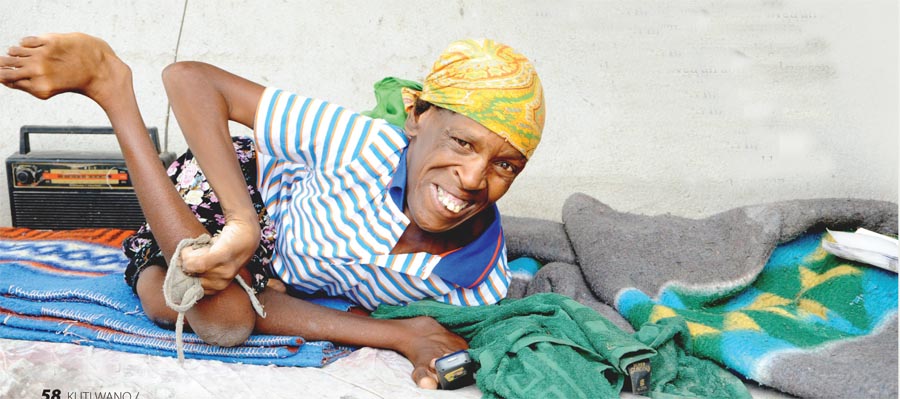
Had it not been for a young and enthusiastic Botswana Television (Btv) journalist itching for something “extra-ordinary”, Oaitse’s story would have, most probably, remained just a village gossip. Kefilwe Mokgaotsane retraces her steps back to Lecheng and shares her experience.
Most people will remember the riveting but heartrending tale of Oaitse Nkgaswe, a 42-year old Lecheng woman with multiple disabilities.Tucked some 30Km south of Palapye in the Central District, Lecheng is just a small village with nothing much to write home about except for its unique water feature (pan) that receives its waters from the mountains where it is believed the gods (Badimo) reside.
Apart from stories about badimo, there is nothing much to talk about in Lecheng hence for the past 42 years Oaitse’s plight must have perhaps endured the Nkgaswe relaxing same reality. Therefore, finding and meeting Oaitse can be described as a chance encounter.
It was the result of a newsroom brainstorming session which ultimately metamorphosed into a story that would captivate the nation and remain etched in their minds almost a year later.
During the editorial meeting, it emerges that we are itching for something “extra-ordinary”.
Thus, nothing surpasses the fulfillment and satisfaction that one gets when they see their work making a huge and positive impact on other people. The emotion is sometimes overwhelming as one is either overcome with joy or a sense of purpose.
Therefore, the idea of doing Oaitse’s story was something pitched from a colleague and it goes like this: “There is this house in
Lecheng that we grew up being told that there lived an abnormal person whom we never got to see. Some people want to raise money for her, so can we go there?” My colleague, Kgomotso Mmoloki, a Radio Botswana (RB1) journalist, concedes that not once had she laid eyes on this woman, yet she always passed by her house during her daily trips to and from school. Now that sounded scary!
Admittedly, we all have these little scary stories from our childhood about certain household that always gave us that eerie feeling. However, the eerie feeling that we seemingly develop during our brainstorming session does not stop us from pursuing the story!
Interestingly, the real inspiration and true motive behind doing the story is to highlight the view that Batswana still hide or lock up people with disabilities in their homes. We want to highlight how such defeats government efforts and programmes designed specifically to empower such people.
Our hope is also that the story will be our little contribution towards bringing stories about disability into mainstream media. So April 21, off we leave Selebi Phikwe for Lecheng.
The 200Km journey is, therefore, full of anticipation. Besides, we all harbour mixed feelings and blurred images of our potential interviewee. But we are also determined to meet this remarkable woman who has been stigmatized all her life.
We are met by the social worker, Molefhe Teme, the village Kgosi and some residents who escort us to the woman’s house. As we approach her abode, surprisingly everything seems normal - a well-kept house, full of life all around it. I cringe with anxiety but I tell myself, I have to be strong.
None of my colleagues lets out a word as we trudge slowly towards the house. Suddenly a small multi-disfigured woman crawls out towards us.
I hold back tears, my colleagues somewhat freeze, as Oaitse exchanges some pleasantries with the social worker. She laughs heartily as she is introduced to us and told that she would soon become a celebrity when her story is broadcast on tv. We bow down to exchange handshakes with her. She immediately notices my blood red nail polish and bold black studded ring. Her remarks sound disarming and suddenly I feel so relaxed.
“O ngwanyana wa tv tota, bokgarebe jwa gago mma!” says Oaitse with a charming smile that betrays nothing but a body full of life and hope.
As we settle down for the interview she chats with me like a “normal” person who has been exposed to both the beauty and harshness of life.
Immediately, Oaitse shares with me stories that any woman her age would want heard - her dreams about owning a home, having a child, her fears about being in a relationship and the usual family dramas. As our conversation unfolds, I feel more motivated and inspired to do the story.
I have interviewed all kinds of people in all my professional life, especially women of all classes and most if not all always have one concern, their image.
Oaitse is no exception and like the many women I have met, she is also concerned about her looks when her image is beamed to the nation.
She hurriedly crawls back to the house and stands in front of a mirror fixed to the wall to her height, ties her braids into a neat pony tail and glosses her lips in Vaseline. I find this remarkable and emotions overwhelm me. I join in to assist her pick the right posture for the interview, motivated by her free spirit.
The recurring theme in all her tales is that she wants a house of her own, where she can do things her way. Oaitse pleads with the nation to help by donating to a fund set-up by her village folk to build her a house. The result of the broadcast interview featuring Oaitse is a flood of phone calls to our office in Phikwe and Gaborone as well-wishers pledge support.
Her free spirit, self-drive and determination have endeared her to Batswana and inspired the nation to be part of her dream of one day owning her own home. Soon after our interview, government helps her get a plot and the groundbreaking ceremony towards fulfilling Oaitse’s dream sets in motion in October.
Oaitse was born with a condition called Cerebral Palsy. It left her with multi-disabilities. Apparently the condition causes a “group of permanent disorders of the development of movement and posture, causing activity limitations that are attributed to non-progressive disturbances that occurred in the infant brain”, according to www.scope.org.uk.
Oaitse lost her mother when she was still a young girl. She has a younger brother who is trying to make a living somewhere in the city.
She spent most of her life in her grandmother’s household. When her grandmother also died she was left alone in the house, her condition notwithstanding. However, she did not resign herself to fate and had to master the art of household chores like any young woman raised in a typical traditional home.
Oaitse is an embodiment of the word determination. Her spirit of self-reliance is supreme. She strove all her life to lead as close to normal as possible a life despite her circumstances. She was pushed to become self-reliant by circumstances in which she finds herself in - being a loner in her grandmother’s house.
Thus, she has developed incredible cooking and cleaning skills, using her left leg. In fact, her left leg is her main asset. She crawls with it, holds things with it, cooks with it and eats with it.
Since her grandmother’s home is built for people with “normal” body structures it is cumbersome for her to maneuver around it.
The door handle is too high for her hence most of the time leaves it open. She cooks with a prima stove positioned to her level and notwithstanding that she does this with natural ease, the truth is that she exposes herself to more danger.
The plan, therefore, is that Oaitse’s new home, which is almost complete, will have all the convenience that will make her life much easier than she had pushed it all her life.
I tell her that I have not made any financial contribution towards construction of her house and ask her what she would like me to contribute at this stage. As usual she throws in a puzzling demand. “Mosadi go raya gore wena o batle di curtain,” she challenges me.
That aside, Oaitse is a remarkable woman who has shown the nation that indeed, disability is not inability, pushing herself to levels where even able-bodied people have never reached. It remains to be seen what “stunts” she will pull once she moves into her own house, where she will have recourse to celebrate because for Oaitse, there is no stopping her!