


Volume 65 December 2026-January 2026 : Business
Not just Tourist
Author : Leatile Chamo
Today we meet Justin Basiamang, a 32-year-old professional tour guide with the Seronga-based Okavango Polers Trust. Justin is actively spelling out safety tips to a group of foreign tourists who are about to venture into the mighty Okavango. As he announces the “dos” and “don’ts” it becomes clear that while the adventure in a mokoro may be pleasurable , it could turn into a risky affair as well.
The ‘full briefing’, as the session is called in tour guide lingo, is taking place at Xau Boat Station, under a leafy tree as big as an elephant. Xau Boat Station or Mokoro station, sprawls some 15km from Seronga and nearly 2000km from Gaborone. Here, many mekoro remain docked, for as long as there is a mokoro trip.
Tourists are transported by safari vans from Mbiroba Camp in Seronga to the boat station, where they board the hollowed tree trunk “vehicles”. Justin and colleagues peddle them over to Kau Island, a place teeming with wildlife from the big five family - lions, elephants, buffaloes, and giraffes.
By now the tourists have internalised the “dos” and “dont’s” - the proscriptions that define the line between life and death. The tourists know by now that they may no shout; walk alone without a tour guide; play music; litter; or feed animals. These are only some of the rules. Some animals such as elephants, buffaloes and lions, can be extremely dangerous if people are not careful, he warns. So a mokoro tour guide must ensure that all the people in his team follow instructions to the letter. This will safeguard their lives, his and also protect the environment. The trips often become an emotional binder between tourist and guide.
That should be expected, for a mokoro trip can last up to 10 or more days. On any given day, Justin’s camp can have between three and 50 tourists. The probability of making friends from among such a huge group, most of whom literally depend on you to live, is great. A mokoro can take up to four passengers including the poler who normally does his job standing and a single trip can consist of as many as 17 canoes.
“It is hard to forget some of these people because they treat us well and give us valuable things,” he says, “ but, we treat them well too.” He is especially fond of one German tourist he simply calls Jan, who is a regular visitor to Botswana. Jan likes Justin especially for his good manners and skill with the mokoro. “He also respects me for my knowledge of the delta,” boasts Justin.
One day the German tourist took Justin and a fellow tour guide on an unforgetable all-expenses paid trip to Durban, South Africa - as a sign of gratitude to the tour guide. “We stayed there for five days, [and saw] Durban’s glamour, [but] it was seeing the ocean for the first time that blew our minds,” Justin says with a sense of nostalgia. Jan has also bought the two polers some fine camping equipment, and often offers food hampers and clothes to their families.
Are you a critic who believes that global tourism only benefits tourists at the expense of local people? Now there is solid evidence to the contrary. The benefits are not only material. As tourists visit to experience a different Botswana culture, they also pass theirs on to Batswana, and together form a cultural interface whose kin can only be found in France’s winning multi-racial World Cup team.
And as Justin will attest, the cultural benefits that come with every mokoro trip are immense. During these trips, polers and tourists carry their own food and camping equipment to set up in one or some of the the multiple islands that characterise the delta. In the camp they share experiences around the fire, tell stories, sing and dance and get to know each other better. They discover how different peoples cook, make fire, organise a bath, or make a bed, among other things.
Either side is ever eager to taste the other’s food. For a while each person gets lost in the other’s culture. The Frenchman forgets his strict French grammer and precise dishes and delves into the African’s seswaa and Tswii or papa. Similarly, the German may get to know how the Filipino does it, until they have all had a chance to learn from each other’s culture. At this time there is no rich or poor guy, educated or uneducated. The arrangement is beautifully captured by one Robert Taylor who writes in one internet site: “I interact with the locals as an equal, and not just as a tourist.”
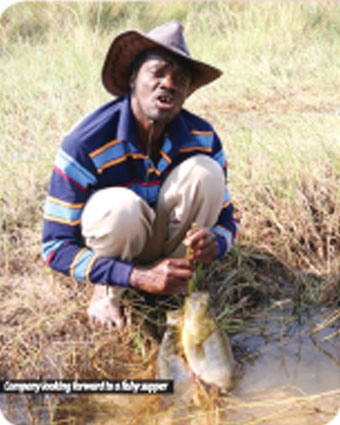
Taylor is also affectionate about a guide he once travelled with through the delta. When Company - that is the name of the guide - made a fire during a camping interval, and Taylor naively asked him if the fire was meant to keep the wild animals away, the answer was; “No, I want a cup of tea!”
One good cultural lesson for the tourist was that firewood is fuel for cooking in this part of the world, especially if one happened to be in the bush. “It seems like it’s going to take me a while to learn the ways of the bush,” he says in mock helplessness. You could bet Company was well aware that the tourist would be curious when he saw the fire and so decided to make it - to teach the visitor how to make a cup of tea in the wilderness.
One thing that fascinates the tourists even more is the impressive local knowledge the tour guides possess. The visitors simply would not know what to do in this jungle without the tour guides. It is the locals who know how to avoid trouble with the most formidable animals in the delta: the buffalo, the lion, the elephant, and snakes. The buzz word here is safety. The guides’ very carreers lie in how they articulate and live out the word.
“If we go wrong our credibility will be ruined as tourists get injured, or lose their belongings through theft or damage, or, worse still, die,” says Justin. Taylor says of Company and the other guide he once travelled to Jedibe with: “My guides grew up in the delta and so knew its twisting waterways intimately; I would have to rely totally on them and their local knowledge.”
When they came across some animal marks on the ground, Company was able to identify them as those of a lion and that the predator could still be in the area. “I had a sinister foreboding but C seemed to relish the prospect of a meeting with this killer animal,” says the tourist on the website.
And so Justin, Company and friends continue to peddle the canoes and show the visitors the wonder that is the Okavango Delta. They are Botswana’s ambassadors, to every nation that comes visiting. And so it shall be, that when the annuls of history are opened, these men’s and women’s names shall be remembered as among those who made nations fall in love with our Okavango. ENDS
WHAT RESEARCHERS SAY
Researchers note that as global tourism rises, so does the number of face-to-face interactions between people of different countries (Giddens 2009:274). Thus, as tourists visit to experience a different culture in Botswana for instance, they inadvertently pass theirs on to Batswana. This supports Legrain’s (2003:62-65) view that “tourism is an interface for cultural exchange…many of the best things have come from cultural mixes.”. In short, as Legrain (2003:62) puts it: “Just because someone was born in France does not mean they can only aspire to speak French, eat French food, or read French books.” Although it is obvious that America and Europe have made their mark globally in terms of cultural influence, Giddens (2009:139) and Legrain (2003: 65) say globalisation should not be seen as a one-way process or street, but a two-way flow of images, cultures and cultural products, influences, and experiences.