


Volume 65 December 2026-January 2026 : Social
Odd times No rain...more pain
Author : Baleseng Batlotleng
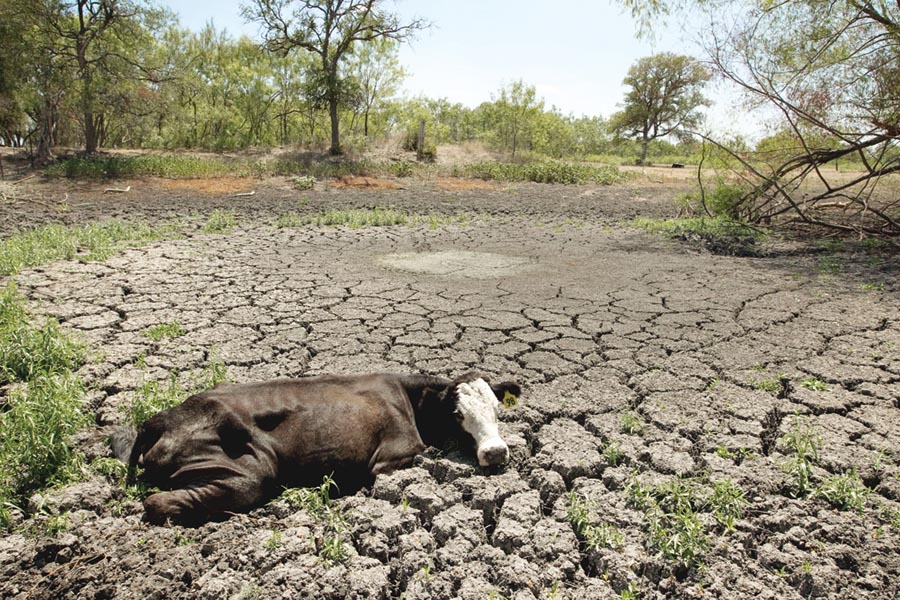
It is just past midday and cicadas (senyetse) or nyeza, as they are known in the Bokalaka area, sing melodiously from adjacent mophane trees. It is as if they are competing for attention with cranking noises from livestock bells in the vicinity. The days of doom might be here again if the traditional belief that the presence and the plangent sound of the cicada signal an era of dry and very hot conditions is not mere superstition.
Not that the signs are not discernible. From a distance stray dogs can be seen sniffing hungrily at an ailing calf. And, as they do, one is convinced that old, sick, and very young animals are easy prey for the opportunistic canines.
In the village, while the residents are going about their normal array of domestic chores, a watchful eye is on the skies above as if appealing to God for a few drops of rain to avoid the reality of an impending drought.
For Lindani Ncube, the day starts at 5am when the dark spring night slowly gives way to yet another long and tedious day. The new day is usually signaled by early risers, amongst them melodious tweets of blue wax bills (Rralebiibii).
Good-for- nothing village folks are among the early risers too as they hop to the nearest drinking hole to impress the moneyed fellows from the city with recycled jokes so they can earn a pint or two of the much fancied ikaranjo brew.
As daylight gathers slowly, Lindani and her grandchildren join the growing beeline to the nearest standpipe to fetch water. “Taka fanila kuti ti be tili kudzi pompi masikwana, vula i sa thu ika khwa (we have to be at the standpipe early, before it dries up),” she tells Kutlwano in IKalanga.
Often those who arrive late at the standpipe, perhaps due to other pressing domestic chores, often return home with only half-filled buckets, or worse, empty-handed. Patience is the order of the day to fill up a 20-litre bucket; and often the women disappointedly make another beeline back home to face another dull day as no activity is taking place at the ploughing fields.
“There is simply no rain this season, and we are going to die of hunger,” Lindani is quick to point out. The strikingly hot temperatures, the cloudless sky, and stuffy atmosphere, can only mean there will be no ploughing of zengwe, chimanga, manongo,nyimo, nyemba, or mabisi, some of the staple crops in this part of the country.
Nswazwi village in the Central District is dry, and the once beautiful creeks from Maibe and Mashawi streams that used to feed into the Shashe River system have shriveled to a shadow of their former wet selves.
It was from these two natures’ beauties that livestock used to streak to for a quench of thirst and lush green vegetation nearby. Today, whether it is the work of nature or not, the persistently cloudless sky has become unbearably cruel and unforgiving.
Sadly, only hued dry sands that snake down where the water used to run, once upon a time, characterise the two streams. Cattle and goats have been forced to turn to tree leaves as there is no single tuft of grass standing. Not even a strand!
In the art of adaptation, the livestock seems to have developed prehensile tongues so they can pick leaf after leaf from mophane tree branches. The bottom branches of the trees now have a common graze-line that looks like a schoolboy’s fresh haircut.
The teaming wildlife has not been spared either. A few kudus and monkeys usually trickle to the village standpipe to have a sip of the lifesaving liquid. The latter have mastered the trick of human survival and when the going gets tougher, they inhabit the nearest homestead and feel comfortable at home. At the end of the day life goes on.
However, despite the harsh reality on the ground, sometimes when lady luck has smiled their way, Lindani and her family relocate to Nkome lands where they put a few seeds to the ground.
The elderly woman’s life exemplifies rural life in a community looking up to any means to put food on the table. The period of the much sought after delicacy in Bokalaka – phane - are certainly not in sight, and Lindani is not happy.
On the other side of this vast track of dry land, Adam Gaorekwe struggles to provide for his herd of donkeys .While farming provides a lucrative route for economic success to a lot of his age mates in the countryside, the 54-year-old Gaorekwe struggles to make ends meet.
In this blistering heat he has to endure long hauls on his aging black Humber bicycle to find a water source for his donkeys before riding back to the village again to ask his nephew to help take the animals to an identified water hole.
Compared to other species, donkeys are a very important means of transport for Gaorekwe and other rural residents who cannot afford more expensive modes of transport. They enable them to integrate into social and economic processes around.
In this part of the country donkeys are preferred to other animals because of their affordability, endurance, and compliant nature. The ability of a donkey to thrive on poor quality feeds has also made them popular in environments where grazing pastures can be critically poor.
Donkeys have been reported to survive better under drought conditions than any other livestock species due to their small body size and low dry matter intake requirements, thereby minimising their water and maintenance needs in arid areas. No wonder, then that Gaorekwe owns some of the donkeys that can be seen in and around the sprawling village of Nswazwi.
Despite the fact that they are experiencing one of the driest seasons in history, the residents here still have a strong feeling that once they visit the sacred mwali shrine, where rainmaking spirits dwell, all will be well.
Rainmaking ceremonies are some of the rituals respected by the Kalanga community as they never failed to bring rain in the past. One of the village elders, who only identified himself as Tobokani, attributes the evolving drought in the region to lack of dignity and respect for ancestral spirits. “Nothing goes right when we do not respect the existence of our ancestors,” he says as he is led by his partially blind wife away amid deafening noises of nyeza. ENDS