


Volume 50 Issue 6 - June 2012 : Heritage
Houses of the Dikgosi (2) Mochudi
Author : Sandy Grant
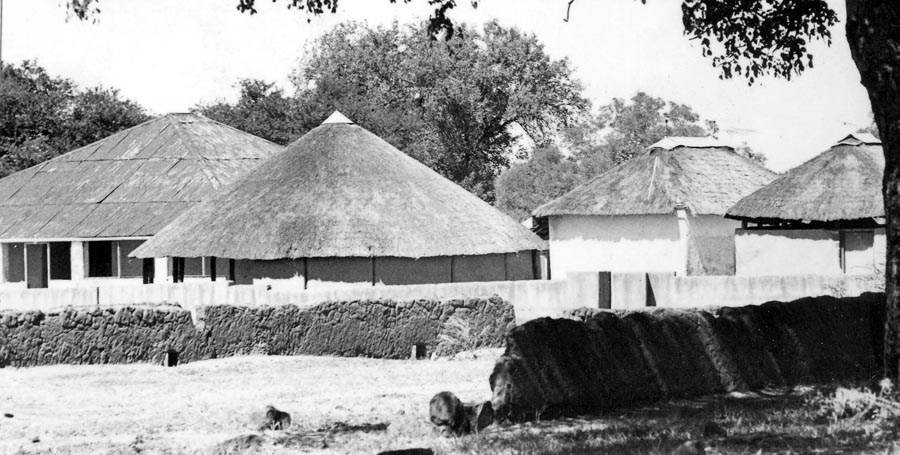
In the absence of any written record, it is usually extremely difficult to determine the date when some event occurred. The usual means of overcoming this problem is try and relate the event in question to the year when a particular mophato was initiated. But this approach is only useful in respect of historically important buildings if one or more mephato were involved in their construction.
If they were not involved, there is a problem. In Mochudi, however – which I know better than other places - it seems obvious that the year when a particular house was built can be taken as dating from the year when a relevant marriage took place.
Newly married Chiefs, even as heirs apparent, invariably needed a new home. It has taken me a long time to fully grasp this obvious point about Mochudi and it is only now that I begin to believe that what is true of one place is likely to be true of another.
It is of course strange, even disconcerting, to have to accept that what ought to be blindingly obvious was never at all obvious to me. For instance, it took me years to wonder in Mochudi where Kgosi Kgamanyane’s 50-60 wives could have lived? Looking at the place as I first knew it, I simply couldn’t work it out.
Yet the answer, when it finally occurred to me to ask Amos Pilane, could hardly have been more obvious.
They had lived in a circle around the kgotla – something which was easily achieved in 1872 when Kgamanyane (1850-74) occupied what was an entirely new site.
But today, because almost nothing remains of that startling social and physical pattern it is extraordinarily difficult to match what it was then with what is today.
But let me use Mochudi as a test and see if the same approach can be usefully adopted in other places. Starting from today and working backwards, we can safely assume, I hope, although I can provide neither date, that Kgosi Kgafela’s marriage and the building of his new home at Mokatse, occurred more or less simultaneously.
Prior to his marriage in 1965, Kgosi Linchwe II (1963-2007) lived in his father’s lelapa at Sethobong but built himself a new house on Phuthadikobo Hill, utilizing the site previously occupied by his great grandfather, Linchwe I (1875-1924).
The house was built in 1964/65. Kgosi Molefi (1929 variously until 1958) was married in 1933 and he too must have grown up living in the lelapa of his father, Kgafela, who had died in the influenza epidemic of 1914.
I will now assume, I think safely, that the still dominant house in this lelapa was built around 1933 for the use of Molefi and his new wife, Moatlhodi. Pushing back a little further, we can note that Kgafela was married in 1905 and around that time created for himself and his new wife and members of his mophato what was then an entirely new settlement at Sethobong.
This settlement included at least three giant rondavels each having a radius of give or take six metres and a kraal (lesaka) whose scale points to the possession of an extraordinary number of cattle.
The extent of Kgafela’s own lelapa, which must have been extremely large, is difficult to envisage today.
Because of the existence of a sefala which must have dated from around 1905, it would appear that this embraced a part, or perhaps even the whole of what became Kgosi Molefi’s lelapa, today’s road and what must have been a large area on its further side.
Pushing on, we can note, as mentioned in the May issue, that Kgafela’s father, Linchwe, presumably after marriage, built himself a house on Phuthadikobo Hill and that Kgamnyane had a home adjacent both to the kgotla and to his many wives.
Two other members of the immediate Kgatla royal family built houses for themselves which still survive. Isang), Linchwe’s eldest son who was variously Regent and Acting Chief between 1921 and 1929 was married in 1911 and built for himself and his new wife an entirely new lelapa adjacent to the Chief’s kgotla.
The year of his marriage, 1911, is in accord with those I was long ago given for both the handsome central house in Isang’s lelapa and his one , Kgafela sized rondavel. Isang also possessed a fully fledged house at his tsimo at Seboeng which was once, by definition, well outside Mochudi but is now very much absorbed in it. The rectangular house, of unplastered burnt brick, was undistinguished and has presumably been demolished.
The really remarkable feature of the lelapa was, though, the seboa, the threshing floor, which was of enormous size thus giving some idea of the scale of Isang’s farming ventures. I assume that it no longer exists.
Not far distant from Isang’s lelapa is to be found another , also of extraordinary historical importance, which belonged to Segale Kgamanyane, fourth son of Kgosi Kgamanyane.
My previous assumptions about the buildings in this lelapa have been that they were likely to have derived from the years during and immediately following the end of the 1899-1902 Anglo-Boer war.
Those assumptions were based on the fact that Segale and his brother Ramono, had been Kgosi Linchwe’s military commanders , and that the Bakgatla, having gained control of most of the area towards Rustenburg, would certainly have looted whatever they could find.
My assumption was that abandoned Boer farmsteads could well have provided Segale with all the building materials he needed and that captured oxwaggons would have enabled him to get everything back to Mochudi.
When I eventually find out when Segale was married, it is possible that this theory may need to be moderated – but I doubt that it will need to be dismissed. Segale’s main house was built sometime after 1902, and an adjacent, smaller, thatched building, during World War I (1914-18) We can only presume that the still surviving and very large and beautiful sefala dates from the same era as would the now demolished stables.