


Volume 65 December 2026-January 2026 : Art & Culture
An Inconvenient Youth: Julius Malema And The ÔÇÿNewÔÇÖ Anc
Author : Fiona Forde
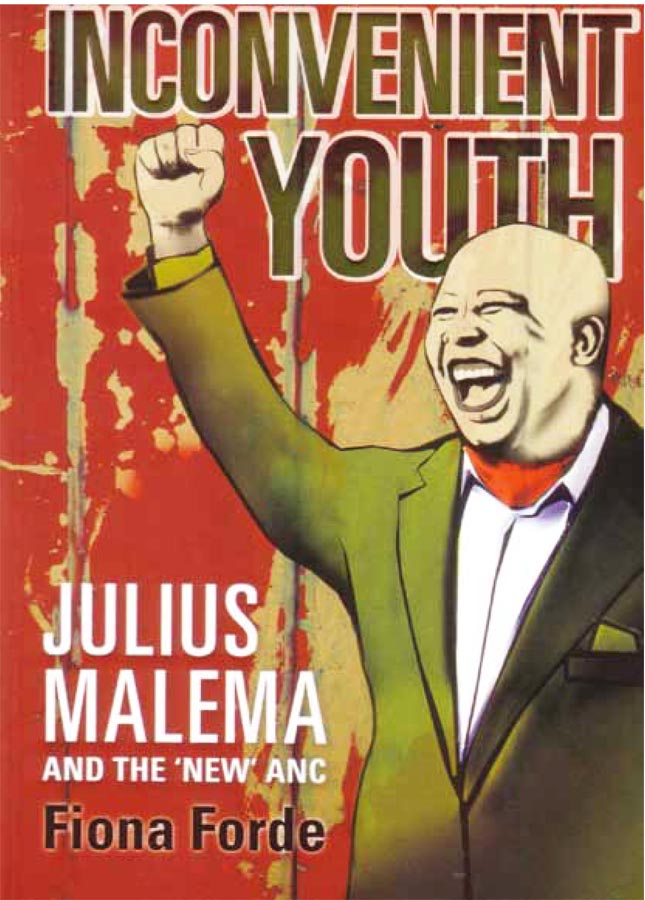
Title: An Inconvenient Youth: Julius Malema And The ‘New’ Anc
Publisher: Picador Africa/Pan Macmillan South Africa
Author: Fiona Forde
This book succeeds in giving the reader great insight into the life of Julius Malema, one of Southern Africa’s most talked about political figures, and the politics that have inspired his thinking. Forde traces Malema’s meteoric rise from being raised in a crowded household in Seshego Township in the capital of South Africa’s Limpopo Province, Polokwane, inspired by the squalor around him to become a political activist who became a national figure.
The author locates Malema’s struggle within a historical context, giving glaring similarities between the post-1994 youth led by Malema to the original ANC Youth League of Anton Lembede, Walter Sisulu, Oliver Tambo and Nelson
Mandela. They were radical African nationalists who challenged the party’s authority but differed in terms of strategies and tactics with their alliance partner, the Communist Party. Similarly, Malema and his generation have sought a radical response to the fact that after almost two decades of majority rule, South Africa is still a society with a rich, largely white minority, and a poor, largely black majority. According to Forde, Malema and those who adhere to his line of thinking are pushing for policies such as the nationalization of the country’s strategic resources such as mines, in line with socialist thinking but in terms of tactics are still hostile to their alliance partner, the South African Communist Party (SACP), much like the youth of the 1940s and 1950s, the generation of Mandela. Forde gives a well written account that informs the reader about Malema the person, and the politics that surround him. Forde paints the picture of the ANC being an organisation that has lost the radical nature of the period between1948 (when the National Party formally introduced apartheid) to 1994. Rather, the organisation has gone back to its original 1912-1948 roots, when it was led by educated elites such as Pixley ka Isaka Seme, John Dube and Solomon Plaatjie, an African crop that failed to transform the ANC into a broad based movement, failing to register even 1000 members during those early days. They were, Forde notes, more concerned about being excluded from the Union of South Africa of 1910, and wanting to create an environment where they could flourish as an African elite. This is something that is happening with the contemporary ANC, which serves the interest of the black bourgeoisie who have joined the white rich in dominating the black majority. According to the book, Malema’s struggle is in two parts. In rhetoric, it is about empowering the black masses but in practice is about joining the elite, as evidenced by his own lavish lifestyle. Forde’s effort is well written book that is well worth a read.