


Volume 50 Issue 12 - December 2012 : Others
Khurutse Primary: A School Situated Nowhere
Author : Aron Moreeng
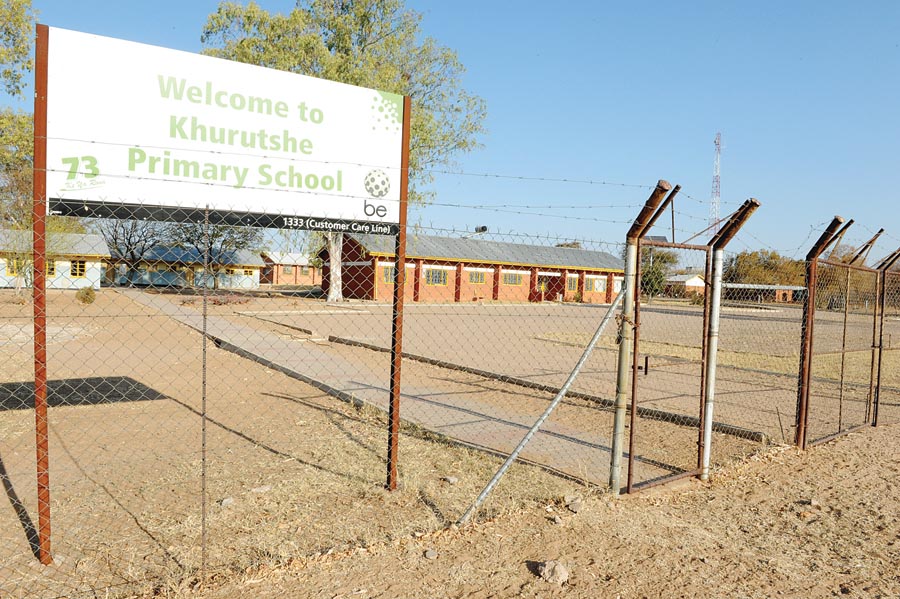
Children from as far as Ramotlabaki, Oliphants’ Drift, Leshibitse, Dikgonnye and Kgomodiatshaba came to this school. Fast forward to 2012, and each one of these villages has its own primary school.
Curiously all these are recognised settlements, while Khurutse is not. It is a place whose status is only in the minds of its residents - a place that sits in the balcony of uncertainty.
For with only 130 residents, Khurutshe does not qualify for a recognised settlement, and that means it cannot be included in the the Kgatleng District Development Committee (DDC) plans.
“Khurutse is neither a recognised village nor a permanent settlement,” says Kgatleng District deputy council secretary, Jason Sechele. And while it is not recognised as such, it has basic infrastructure found in permanent settlements, a sign that the Kgatleng DDC does include it in its plans.
To that end the district council built and manages the primary school. It also sees to the running of the health post. The intention is to cater for the needs of rural area dwellers in the area, mainly children whose parents stay at the cattle posts.
Hidden in the bushes some 39km north-west of Artesia village, and 14km away of Kgomodiatshaba, the school would be useless to children had it not had boarding facilities.
Today, the enrolment at the school stands at 49 pupils, out of which only 13 are not staying in the hostels. Three stay with their teacher-parents whilst 10 stay within the vicinity of the school with their families. The boarding children are from as far as Lephepe and Boatlaname in the Kweneng District, as well as neighbouring cattleposts in Kgatleng District such as Bodungwane.
The children are treated to four meals a day - one meal during school hours and three meals at the hostels. The school has no Standard Five pupils, says the school head, Christinah Nkala.
The highest number of pupils in a classroom is found in standard six with 14 pupils. In one standard four class, there are only four children, she says, adding that despite being few in number, the children are not doing well.
“These children have profound learning difficulties especially because they miss their parents,” she declares. Last year the school registered a 66 per cent pass rate for Primary School Leaving Examinations.
Today, because of the seeming lack of utilisation of the school, questions have been asked why the school was built in this area in the first place. At one point, assistant minister of Local Government and Rural Development, Botlogile Tshireletso, suggested the transfering of all the children at the school to Kgomodiatshaba Primary School, which also has boarding facilities.
While Sechele, the deputy council secretary, admits that Khurutshe is not a recognised settlement, and therefore does not qualify for services, the council spends over P85 000 per term on hostel services and over P39 000 on private security every four months.
Not that there was no reason for erecting the school where it is back then. This, Sechele says is because Khurutse came before the adoption of the National Settlement Policy which is now used as a guide in the provision and rationalisation of developments.
“The council by then saw the need to cater for the educational needs of school-going children from around the cattle post area,” he says.
In that case the council will continue providing for the educational needs of children from around the area as long as there is need, he says.
In the meantime, the general duty assistant and the family welfare educator at the health post can hope that one day they will secure a vehicle for their area and not rely on the unpredictable one from Kgomodiatshaba.
Similarly, teachers can stay with the hope that one day someone will appreciate that they should be drawing the Remote Area Service Allowance (RASA) like their colleagues in better developed settlements such as Kgomodiatshaba. ENDS