


Volume 50 Issue 12 - December 2012 : Heritage
The day the Boers Occupied Gaborone and Lobatse
Author : Sandy Grant
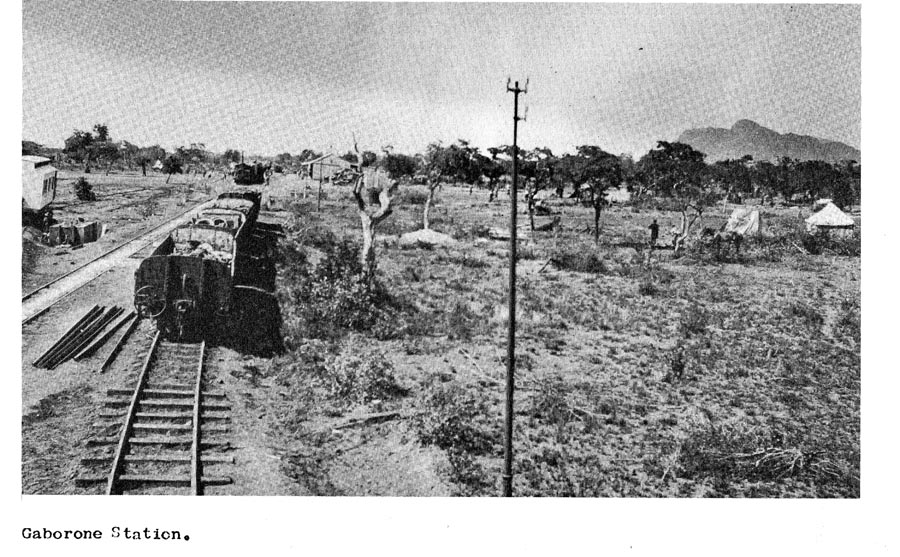
In 1895 the three Dikgosi made their famous trip to the United Kingdom to try and ward off Cecil Rhodes and his British South Africa Company. It seems to have escaped popular interest that within four years of that famous visit, which is supposed to have determined the history of this country from then until 1966, the Boers, not Cecil Rhodes, occupied both Gaborone and Lobatse.
Had they held on to those two towns, and indeed had they won the war – a war which is usually regarded here as a white man’s war, indeed those two places as a white man’s, a Boer Protectorate might have replaced the British Protectorate. Possibly, this country could today be an integral part of South Africa.
Unsurprisingly, it was to be Rhodes’ railway line so soon after it had been constructed, which was to be the cause of this country’s involvement in the war. When war broke out, the Boers had already concentrated their forces around Mafikeng but had also positioned four Commandos along the Protectorate’s eastern border ready to take control of the major drifts across the Limpopo.
In the north, the Zoutpansberg Commando with 1 287 men faced the Rhodesia Regiment at Fort Tuli. Further south, the Waterberg Commando with 732 men, confronted Kgosi Khama. At Deerdepoort, the Rustenberg Commando with 2 536 men, faced Kgosi Linchwe and the Bakgatla whilst the Marico Commando with 1 265 men based at Gopanistad, opposite Ramotswa, were expected to break the British control of the railway between Fort Gaberones and Mafikeng.
Simplistically, it might be said that the British could only relieve Mafikeng by way of the railway line whilst the Boers’ chances of taking that town depended on their ability to destroy that link.
In addition, it can be claimed that the British had only to secure the railway link from Maputo through Rhodesia to Gaborone and Lobatse and thus Mafikeng and they had thereby stopped the Boers from breaking out of their established territories.
Were they to be successful in doing this, they would have helped to fix the Protectorate’s still new eastern international boundary as a durable fact. In the first days of the war, there was minor skirmishing in the north east around the British forts at Tuli, Macloutsie and Eloff. In the south, Mafikeng was effectively encircled.
On October 14, the Boers surrounded Lobatse and took it over the following day. The British promptly sent an armoured train from Bulawayo to join one which was already at Gaborone and took control of Crocodile Pools.
Expecting an imminent attack, Francistown organised a small defence force, the small contingent of troops at Old Palapye was strengthened, and the church there, curiously, was fortified.
The fortifications at Mahalapye were also improved. This supposed threat to the north, was, however, never realised. There then followed a period when the British would push forward along the railway, be driven back and then re-group and again advance.
On the 23rd, the Boers, for instance, who were positioned on Sepitse Hill across the border facing the British at Crocodile Pools, forced the latter to retreat first to Gaborone and then to Mahalapye. On the 25th, they occupied Crocodile Pools and on the 26th, Gaborone itself.
Within a few days, however, the British under Col. G.L. Holdsworth with 120 troops, were at Malotwana and Mochudi and on November 25, with 200 to 300 Bakgatla irregulars, crossed the Madikwe River and launched a night time attack on the Boer positions at Deerdepoort.
For several reasons, the battle proved to be the most controversial of the entire war. The Boers were appalled that the British should have linked up with Linchwe’s Bakgatla irregulars to launch this attack. They were also appalled when they heard stories about the way the Bakgatla had supposedly treated Boer women who they had captured and taken to Mochudi.
In turn, the Bakgatla believed that they had been betrayed by the British who had held back and left them to carry the brunt of the attack. They lost 14 dead in the battle and had many wounded whilst the Boers had six dead and one wounded.
It can only be a matter of speculation as to whether the action at Deerdepoort affected the Boers ability to push more men into Gaborone and then to hold on to it. A similar question can be asked about Lobatse. Had the Boers taken control of those two towns, it is probable that the British ability to use the railway to bring men and supplies from the north would have enabled them to recover both.
But it might have taken time. In the meantime, would Linchwe have wanted to recover Gaborone and would he have the means of doing so? What can be safely assumed is that Linchwe’s later drive into, and eventual control of the entire Rustenburg area, would have forced the Boers to relinquish Gaborone.
But what about Lobatse? Whilst Bathoen, as with Khama and Linchwe, were ready to back the British, would he have been willing to go it alone and launch his mephato against the Boers there? And if he had, what would his chances of success have been, not least against superior fire power?
That painful question did not arise, of course, and he was left with an undoubtedly invaluable role in enabling Col. Plumer’s British forces to adopt the Boer’s own tactics, and to anticipate Lawrence of Arabia’s later strategy of disappearing into the desert’, in this case at Sefitili in Ngwaketse territory, to defend it rather than attack it. From there they emerged to relieve Mafikeng.
The interest of many people, has to date focused understandably on the geographical piviot at Crocodile, south of Gaborone, where road and rail were obliged to squeeze through a narrow gap which would be controlled by whichever side, Boer or British, which could muster the greater fire power.
It was here that Captain Gough French, from Queensferry, Ireland, the most famous casualty of the war, was killed. Perhaps his ennobled death and the prolonged gunnery duel has served to distract attention from the many questions which should long ago have been explored. ENDS