


Volume 65 December 2026-January 2026 : Politics
Human resource development beacon of hope
Author : Keonee kealeboga
ccording to various speakers at this year’s tertiary education conference in Gaborone last month, a nation’s economic growth depended to a large extent on its human resource base.
Thus, size, quality as well as how the workforce are generally being used play a key role in determining, among others, the nation’s technological advancement, which in turn has been found to be pivotal to economic growth.
One of the speakers at the conference, Tertiary Education Council (TEC) executive secretary, Dr Patrick Molutsi, highlighted the need for all stakeholders to play a role in driving the growth of tertiary education in Botswana as the sector had potential to propel the nation’s human resource base to greater heights in terms of growth in both size and performance.
He observed that the strategic role of tertiary education in contributing to the creation of an effective and highly efficient workforce could not be ignored.
“Over the past 20 years, tertiary education has been elevated to a strategic position in society,” he said. “Today tertiary education is seen as the key driver of development.”
Molutsi said some countries were also moving with the times as one by one they had begun to embrace tertiary education with the view to enhancing the capability of their workforces.
“The effectiveness of the tertiary education sector is synonymous with great technological advancements, and as such no country would want to be left behind,” he pointed out.
As a result, he said, many countries were creating a positive policy environment and investing in new institutions of higher learning, citing in Botswana’s case the establishment of BIUST, the country’ second university.
The growth of the tertiary education sector is not without challenges though. Molutsi cited among the problematic areas, poor quality in some tertiary education institutions.
Such a state of affairs, he said, could be attributed partly to excessive pressure from increased demand for tertiary education. He noted that the use of some institutions’ resources, both human and material, has far exceeded what they were capable of handling.
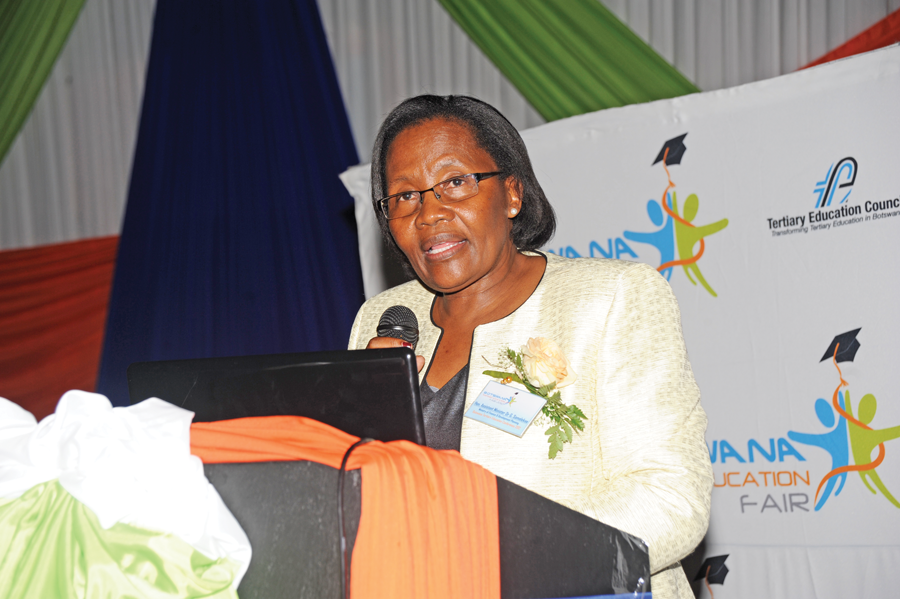
Officially opening the conference, Assistant Minister of Finance and Development Planning, Dr Gloria Somolekae, called for alignment of education to the job market to avoid the situation whereby some graduates were considered unemployable.
“I need not remind you that it is the lack of alignment between education and development which has landed us with graduate unemployment,” she observed, emphasising the need for institutions of learning to train students with the needs of the job market at heart.
Somolekae implored institutions to also do their best to ensure that they produced well-rounded graduates who would not only fit well into the job market but would also be in a position to create new jobs.
She equally challenged everyone who went through the tertiary education system to play an active role in helping address the unemployment situation in Botswana by creating jobs for other Batswana.
Concurring with other speakers on the importance of tertiary education in driving the economy forward, Somolekae underscored the fact that tertiary education remained the greatest asset there was to transform the economy and develop the country.
“We feel that our past strategies for rural development and provision of basic services in education, health, water and electricity supply have reached a stage where we need to intervene more aggressively to create jobs and sustainable livelihoods for all but particularly for the most deprived sections of our population,” she indicated.
A guest speaker at the two-day conference, Prof. Damtew Teferra from the USA decried the brain drain that was hitting most African countries hard.
Teferra said currently, about 23 000 highly educated people left the African continent each year, adding that at the moment about 30 000 Africans with doctoral degrees worked outside the continent. Such as scenario, he said, continued to work against the efforts of African countries to develop themselves.
However, he expressed enthusiasm about the fact that higher education had begun to be recognised as critical for development.
Such recognition, he noted, was evident in the expansion of open and distance learning as well as the diversity in the mode of delivery where ICT was being embraced and widely used as a mode of delivery by most institutions of higher learning.
Teferra also touched on the mushrooming of private tertiary schools, opining that such was an effort to respond to the escalating demand for tertiary education and the growing need for highly skilled labour.
Yet another speaker, Abel Modungwa, acting CEO of the Human Resource Development Advisory Council, lamented the state of Botswana’s work force, which he said was characterised by among others, a poor work ethic, low productivity and the fact that the workforce was inadequately educated.
He said it had become the norm among some employees, especially those in the civil service to hide behind rules and regulations, under the guise that their departmental policies did not allow for certain things.
“Think outside the box,” he challenged. “Don’t hide behind rules and regulations. Policies are meant to enable you to deliver; they are not and should never be seen to be a hindrance.”
Modungwa called on tertiary institutions to endeavour to produce work-ready graduates, saying the issue of ethics ought to be highlighted from as early as pre-school to ensure that the education system generally produced ethical and well-rounded individuals.
The conference, which preceded this year’s tertiary education fair, was held under the theme Reflections on tertiary education contribution to Botswana’s development.