


Volume 50 Issue 12 - December 2012 : Entertainment
When Rustling Became an Art
Author : Pako Lebanna
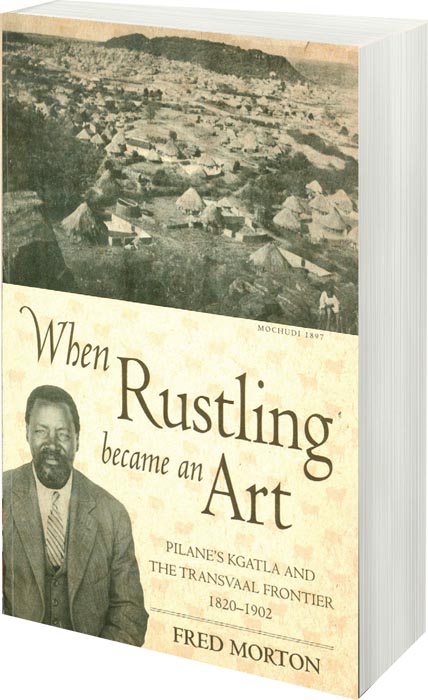
This is a historical account of the 19th Century struggle of the Bakgatla people, under the leadership of Pilane, and later his son and grandson, Kgamanyane and Linchwe, part of a lineage that still reigns amongst the Bakgatla ba ga Kgafela of Mochudi/Kgatleng, Botswana and Moruleng/Pilanesberg, South Africa.
Pilane (after whom South Africa’s Pilanesberg area is named, where the world famous Sun City resort is located), a son of Pheto, was born into a lineage of the rulers of the Bakgatla people.
Pilane would give way to his son Kgamanyane, followed by the latter’s son Linchwe I whose son Kgafela was never enthroned (otherwise he would have become “Kgafela II”). The latter Kgafela’s son Molefi, would take over before his son and grandson, Linchwe II and Kgafela II (the current mornach), would continue the dynasty.
This book focuses on the struggle over land and labour. The Bakgatla needed access to land, which had been rendered a contested assert by both the movement of the Boers inland (the Great Trek) and the internal ‘Difeqane/Nfecane’ wars. The Boers needed access to labour, and they looked to indigenous communities to supply it.
A young Paul Kruger (later the leader of the Transvaal Republic and the Union of South Africa), had been involved in the slave trade from an early age, purchasing child slaves during hunting expeditions in Swaziland.
Later, as a Boer Commander, Kruger was part of raids on the BaPedi of Sekwati (1849), Mosieleele’s Mmanaana Bakgatla and Sechele’s Bakwena (1852), Montshiwa’s Barolong (1852) among others, where slaves were captured.
Kruger developed tactical alliances with leaders of the Tswana groups around Rustenburg, in particular Kgamanyane of the Bakgatla and Mokgatle of the Bafokeng, and these ‘kapiteins’ (captains) sent some of their regiments with Boer commandoes, being involved as auxiliaries in Boer raids on the groups such as the Ndebele, who had notorious earlier on raided the Tswana.
While “in only a few years as Kruger’s kapiteins, Mokgatle and Kgamanyane had increased their wealth and authority dramatically,” the exploitative nature of Afrikaaner-Bantu relations inevitably led to a major fallout.
After a fallout between Kgamanyane and Kruger over tax, and Kruger forcing Kgamanyane to provide Bakgatla labour for the construction of a dam at Saulspoort, Kgamanyane was publicly flogged and Bakgatla labourers endured humiliation.
In 1971, a section of the Bakgatla under Kgamanyane moved to Mochudi in Bechuanaland, a territory of the Bakwena of Sechele. After initial cordial relations, a territorial battle ensued between the two tribes, with the Bakgatla under Linchwe I annexing what is now the Kgatleng District.
In the late 1800s, the Bakgatla would be involved in an assault on a Boer encampment in Deerdepoort, during the early years of the Anglo-Boer war. Morton’s book is a well written, historical account, well researched but written in accessible language.
While the title refers to the age-old leaders’ skill in acquiring cattle through unscrupulous means, the book itself is a far more comprehensive historical account of a people’s struggle over land and labour.