


Volume 50 Issue 1 - January 2012 : Social
Boon or Bane? Headphones
Author : Ludo Chube
It is a Friday night and as usual this taxi operator is contentedly working late, commuters to their respective places around Gaborone. He happy that at the end of the day he will have something to show for his efforts.
As he hustles through street after street and theheavily populated Gaborone West residential area, a female passenger suddenly asks him to stop and drop him at a certain house. A strikingly tall woman, seemingly in her twenties, alights the yellow taxi and turns around as if to hand the driver his money. Instead, she quickly implores him to wait while she dashes into the house to collect it.
The taxi man is not happy but obliges. After all money is the only reason he is in this business, so wait he will. After the young woman had been gone for what seemed like 20 minutes he decides to check what could be keeping her for so long. He knocks on the front door.
In the house the occupants surprisingly deny any knowledge of the woman but nevertheless allow the taxi man to search around so that he can dispel any lingering doubts. The young woman is nowhere to be seen. In the mind of the taxi, it is one of those fateful days when lose becomes real. As in previous such encounters, he swearingly gives up. Once again he has been conned.
The yellow taxi man is not the only victim of such cheating by passengers. Infact, this is one out of many such nasty experiences that taxi operators have to time and again contend with.
They end up fooled by the very people they seek to help. This begs the question why would passengers, particularly women who are known to be very timid to such an aextent that one cannot fathom them committing such crimes, want to defraud taxi operators. Is it because they truly do not have money or they are merely habitual fraudsters? There are many various instances in
Which taxi operators were cheated out of their hard earned cash. Some such stories are so funny that it is hard to believe they are true. One such incident which sounds like a fairy tale goes thus: a male taxi passenger asks to be dropped next to a graveyard in Gaborone. When the taximan asks him to pay, he brazenly asks: “A le dipoko di a duela?” Thus, “do ghosts also pay?”
The poor taxi man got the shock of his life and frantically sped off thinking that he had actually given a ghost a ride. It was in fact just a trick by a passenger who want to avoid paying. In other instances, a passenger may look stressed and desparate so much that the taxi operator may be expected to deal with such a situation.
Olefile Rankowa, 24, is one of the taxi operators who have had to deal with similar misfortunes from time to time as he transports people around the Gaborone. “The customer is always right and you just have to put him/her first”. He says Christmas holidays are always the worst because this is when such crimes reach their pick.
Shaking his head but smiling, Rankowa shares one nasty experience in which he was fooled by a seemingly innocent woman. He had taken the woman on a ‘special fare` to Game City shopping centre. On arrival, the woman requested that she be allowed to go and withdraw money from a nearby bank. Unfortunately, according to the taxi man, there was an uncomfortably long queue at the bank. In his imagination, he could not wait for that.
“I had to give up and go without the P30 I had expected,” laments Rankowa. Yet another Gaborone-based taxi operator, while appealing to women to give up such bad habits, says he once had an encounter with a woman who was visiting her boyfriend from Selebi Phikwe in the Central district.
Apparently the boyriend failed to turn up while the woman waited without any clue about her next move. Any help that would come her was all she needed. “I had to help her with transport, as well as organise accommodation for her,” says the taxi man who preferred anonymity. Worse still, the miserable woman didn`t even have enough money; “just imagine how much I lost on that day alone.”
The taxi operator also accuses male clients of spending too much on hiring taxis, saying they have a tendency of booking a taxi to take them to clubs around town. And “this can be expensive, and when it is time to pay they cry foul,” he says.
The risky nature of the taxi industry is not peculiar to Botswana. For instance, Simon Mkhize, a taxi operator in Zimbabwe, says one day he picked up a wheelchair-bound elderly woman who wanted to go to Gold Hill in Shaftesbury.
On arrival he kindly helped the old lady and her wheel chair off the taxi. “I pushed her down to her house where there was no one to pay for her fare as she had expected,” says Simon who had to transport the old woman back to where he had picked her up. In cases like these, it is not hard to see how much time and money taxi drivers can actually spend on just one client.
Richard says, while transporting one young girl from Witherspoons to Gillingham, the girl stopped him several times on the way so that she could relieve herself because she was sick. “Eventually she passed out and I took her to the police station who called an ambulance,” says the taxi man.
Taxi drivers go through a lot on a daily basis to the extent that some of them play the role of psychologists or social counsellors. Twenty-five year old Bafana Macheng, says often passengers confide in taxi operators. He says: “I remember one day as I was dropping one woman in Block 5, there was emptiness in her and immediately she told me how she had just been divorced with three kids.” Macheng says he comforted her and that made a great difference.
For taxi operators being cheated at night or at any time has become part of their business and they have learnt to live with it. However, one of the operators says he has decided to be smart by collecting the money before the journey starts to avoid people playing silly pranks on him or arguments.
Time was when a simple “Dumela” to anyone you met on the streets marked us as a community with common values and a single sense of purpose. Back then itwould have been strange to sit next to someone and fail to strike a conversation with them. Such acknowledged the other`s presence and even made strangers seem long-time friends.
But times change. Many of us find themselves thrust in a cosmopolitan environment characterized by an inversely mobile society. What then looked strange is now an accepted norm.
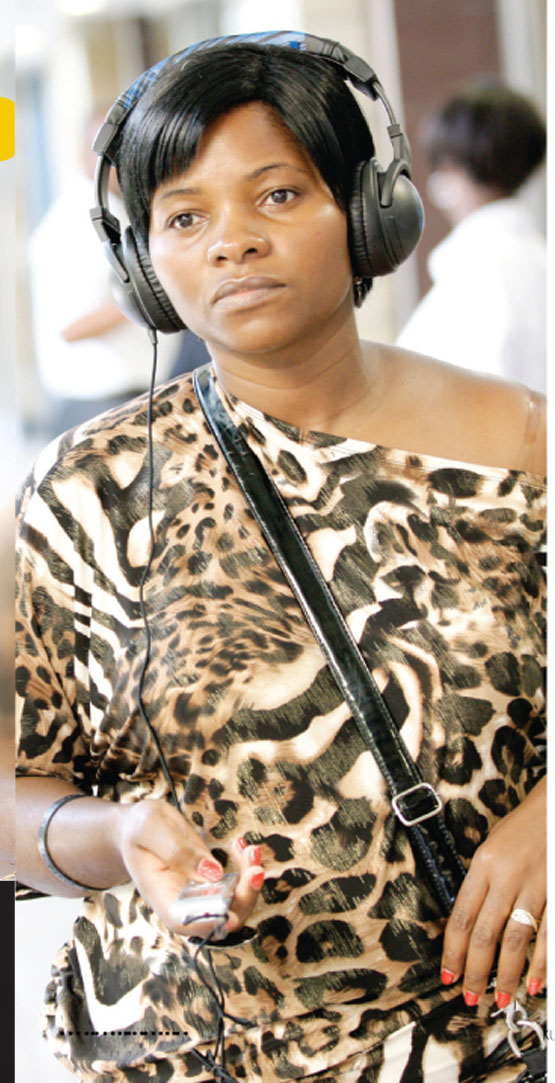
Consequently, the advent of the ‘i`s, as in iPhones, iPads and iPods, to some individuals literally translates into I as in ‘me time`. Thus, in a world where social intercourse and the socialisation process are advanced through social media, headsets or earplugs have become in vogue accessories touching differently on many aspects of life.
In other words books are not only read in that one can listen to an audio format downloaded from the internet anytime, anywhere, thanks to the headphones or earplugs.
Communication or interaction has been reduced to a touch of a button. However, such conduct has its own downside deriving from the fact that though a necessity, inversely these electronic gadgets cultivate antisocial behaviour or narcissistic tendencies. They breed stereotypes, social exclusion, isolation or ‘selfabsorbedness`among others.
Notwithstanding, there is a developing trend of people walking past each other like zombies in public spaces such as malls. It`s a “mind your own business” sort of thing as most people get hooked to a world of their own far from what is going on around them. A virtual existence connected through earplugs or headsets.
Headphones, headsets, earplugs, call them what you may but these little items are stirring a lot of anxiety among urbanites.
Don`t be surprised when you greet someone and they seemingly ignore you. They are caught up somewhere else – a world of music or deeply engrossed conversationally with a colleague in another part of the world connected through these small electronic gadgets.
However, one cannot also escape the countervailing view in terms of what the gadgets offer as convenience and what they engender in relation to certain social values and expectations. In as much as they are easy to use they also expose one to certain hazards especially in public places in that they make one oblivious or completely detached from their immediate environment.
For instance, to some people it may appear irritating or distracting to speak to someone with their headphones on. They take time to hear or understand what you are trying to convey to them. The next thing they shout at the top of their voice because their headphones volume is too high. Another heart rending example is that of a 15-year old Australian girl who got killed by a train in October last year after she failed to heed warnings because she was wearing headphones.
Unpluggd.com states in a piece titled “Headphone etiquette for the office, sidewalk and Bus” that when on the sidewalk keep the volume kind of quiet because “you don`t want to be bothersome with too-loud tunes”. “But a considerate walker also needs to be listening for outside noise—like cyclists coming up behind you or somebody trying to return your dropped $20.”
Writes Margaret Mason of the Morning News in an article titled IPod etiquette “You should also avoid using mp3 players in restaurants (because the waiter needs to
interact with you), waiting rooms (so you can hear the receptionist call your name), and group exercise classes (so the instructor doesn`t single you out for a mildly humiliating demonstration)”.
Its unsurpri sing, therefore, that some people have described the use of earplugs in public settings as rude and hostile. Conversely, one may wonder isn`t the whole idea of using headphones a simple gesture of respecting other people`s space? That is, playing music to yourself without disturbing those around you.
Would it not be rude if that music were to be played in loudspeaker format?
“Keep the volume moderate. No one else should be able to hear your music. That constant buzz emanating from your headphones is only slightly less irritating than your tendency to hum “Like a Virgin” whenever Madonna comes on,” writes Margaret Mason.
Such illustrates the big debate around what should be the level of volume for headphones. Again, there is also a question of whether taking out only one earplug when someone wants to talk to you would not be considered rude. Interestingly, headsets or earplugs have made their way into offices. In newsrooms for instance where there are pressures of deadlines and hardly a minute of silence, headphones can aid in blocking out all the chaos for one to focus.
Notwithstanding, at times excessive dependence on headsets deprives one of a chance to develop interpersonal skills that Justice Motlhabani says are very crucial in a work environment.
“I am an extrovert and love socialising and interacting with other people and objects in my environment. So I don`t use headsets to block people away. I find that I learn so much from people across the social divide,” quips Motlhabani Unlike in Botswana where people can strike a simple conversation at any slightest opportunity, experience elsewhere suggests otherwise. Maipelo Tshepo, a Motswana student in Sweden, says people in that country hardly talk to each other on buses or trains. Therefore, it is normal to see almost everyone with their earphones on.
This is basically to say ‘I choose to keep to myself and I am comfortable with it.` One blogger stretches it further, arguing that as a result there is no need for “Do not disturb” signs anymore, earphones say that better and louder. But is this always the case? Do people really want to convey such messages or is it something they communicate unintentionally? Could it be that perhaps people use headphones or headsets as a form of escapism?
For Motlhabani, it is about trying not to make noise and disturbing other people. For him such should not be viewed negatively or anti social. This is notwithstanding the fact that in some instances it may inadvertently or otherwise send the wrong message about the individual.
As for Tshepo, she prefers headphones in the mornings and evenings on the train. She avoids them whenever she travels with a colleague since she considers that to be rude. “The only time I put on them is when I travel alone by bus or train. When I get off or enter a restaurant or shop I take them off,” she says.
“Here in Stockholm almost everyone uses earphones or tap on their smart phones when they travel by train or bus. So I am not worried about what people might think about me whenever I have mine on,” she enthuses. Meanwhile, there is also an element of age in terms of the size of the headphones. The young generation mostly prefers fancy big ones which they wear around their necks.
In Sweden, according to Tshepo, the younger the generation the bigger the size of headphones. She says the older generation on the other hand prefers the smallearplugs hat stick right into one`s ear.
In Botswana the opposite is the case. Most people including the younger generation prefer small earplugs. The extravagantly big ones have not hit the scene quite yet.