


Volume 51 Issue 1 - January 2013 : Heritage
The Country’s Transport Heritage
Author : Sandy Grant
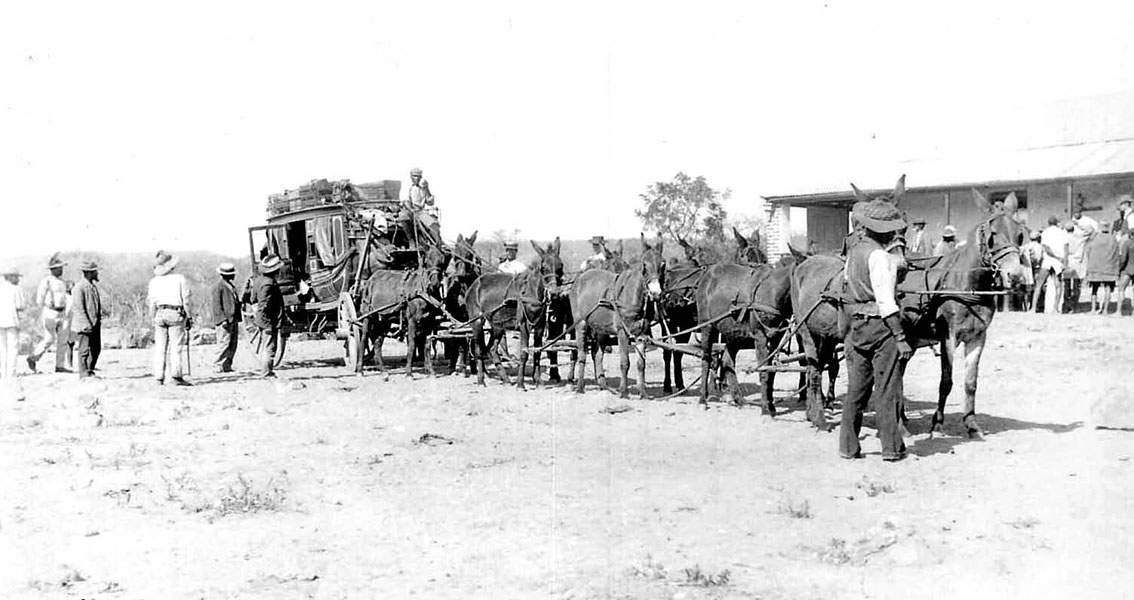
In many parts of the world changes that have occurred in its forms of transport have been dramatic. Most have occurred within the life time of many people. At first sight, therefore, this country may seem to be no different from many others.
But it is different precisely because change here happened long after it had occurred elsewhere. For instance, people in this country were still dependent on animal power to propel their varied forms of transport long after most parts of South Africa had adopted and become reliant on mechanical power.
The animals that were used to provide traction were varied – oxen, mules, sometimes horses and even zebras which were once tried but without much success. As varied were the forms of carriage that these animals pulled, the oxwagon, of course, coaches of different kinds and, not least, the pre-historic sledge.
In the early days, it was the ox wagon which enabled European travellers, missionaries and hunters to make incredibly lengthy journeys - but perhaps by the 1920s and 30s the wealthier Batswana were themselves purchasing their own wagons from South African suppliers. By the time of Independence there were probably hundreds scattered around the country.
A peculiarity of the transport scene was that rail transport regularly ran through this country for a hundred years whilst many people here were still dependent for their transport on animal power. It would have been perfectly possible then to see one of those giant Garret locomotives side by side with a wagon and an inspanned team of oxen at, say Palapye station Rail transport came, of course, as a result of investment from outside which was justified by the traffic, material and human, which it generated between Bulawayo and Harare and beyond them the Congo, and Johannesburg and Cape Town – with this country benefiting considerably from its transit role.
Transport by road offered nothing in the way of comparable investment opportunities so that for most of the 20th century there existed here a strange dichotomy – a modern railway system which existed side by side with a road transport system that could only be described as still extraordinarily primitive.
But as the railway age here collapsed, certainly as far as passenger transport was concerned, road transport, triggered by new found diamond wealth, suddenly found new forms of life. The first indication of change came with the tractor which very quickly knocked out the oxwaggon and when the ox wagon went the blacksmith went too.
As roads were improved there came too a steady shift from the truck to the saloon car and eventually a change from the old privately owned garage which both repaired vehicles and sold fuel to the one dimensional company owned fuel station.
The transformation of air transport has been equally dramatic.
Before Independence there were a great many airstrips dotted around the country but probably none that were tarmaced, the one possible candidate being the Wenela airstrip in Francistown. Some idea of this situation was provided by the Daily News which in early 1966 reported that after recent heavy rains, the ‘Gaberones` Airport was waterlogged and damaged.
It was therefore decided that signals would be displayed showing the state of the surface and whether or not it was safe for planes to land. By putting down gravel in the worst places it was made possible for Seretse to return to Gaborone after the Independence talks in London!
Planes at that time were inevitably small, the majority being the ubiquitous Dakota. Older people when travelling to and from Gaborone may often reflect that they are passing through its third airport terminal.
But then they may also reflect that within their own lifetime they have boarded both a DC3 and a 747 in Gaborone. In contrast, the experience of younger people is bound to be very different. They may never have boarded either a 747 at the SSK Airport in Gaborone airport or a passenger train at Gaborone railway station.
The mail and mixed goods trains were a central element in many peoples` lives for over a hundred years but both have now gone leaving only the very curious sign to the Gaborone railway station at the giant Molapo road junction. Does sentiment or merely habit explain this oddity because for a certainty there can be no one around who really does believe that they can still board a train there to Francistown or Lobatse.
If the contrasts of transport on land have been so striking, the situation regarding transport on water has been no less extraordinary.
Water transport is, of course, to be found only in the Okavango and Chobe areas where the traditional hand crafted mekoro, the cousin of the selei, moves around the same waters as the tourist sunset cruise launch. It is even more extraordinary that the mekoro is being used at the very same time that a company in Maun is producing manufactured boats for sale around the world. It is likely that the permanently functioning commercial ferry at Kazangula is the only one of its kind.
On the other hand, periodic attempts must have been made over the years, using pontoons or boats of one kind or another, to cross the Limpopo when in flood. Whilst this must have happened, my only evidence for making this assumption is witnessing a ramshackle, clumsily put together ‘ferry` being used to cross the hugely flooded Notwane River in Mochudi in 1966. Mike Main has given us a fascinating book about the Zambezi River.
Now, either he or someone else needs soon to give us a history of the Marico-Limpopo and its Drifts, a river which in so many ways is more important to this country than the Zambezi-Chobe. For most people those Drifts are remote and almost inaccessible. Buffels, now behind privately owned security barriers, has already gone.
But research on those that remain would enable us to view the history of this country in a totally different way. These tantalizing Drifts with their curious names have histories that are still out of our reach. We do know that Moselekatse crossed into today`s Botswana at Sikwane/Deerdepoort. We also know that the Jesuit tree at Oliphant`s Drift still marks another major crossing point.
But how much we still need to know about Buffels, Parr`s, Sherwood, Martin`s, Zanzibar, Baines`, Platjaan and Pont – names which should resonate with all of us. If only we could bring history and tourism closer together!