


Volume 65 December 2026-January 2026 : Entertainment
Botswana: A Historical Anthology
Author : Sandy Grant
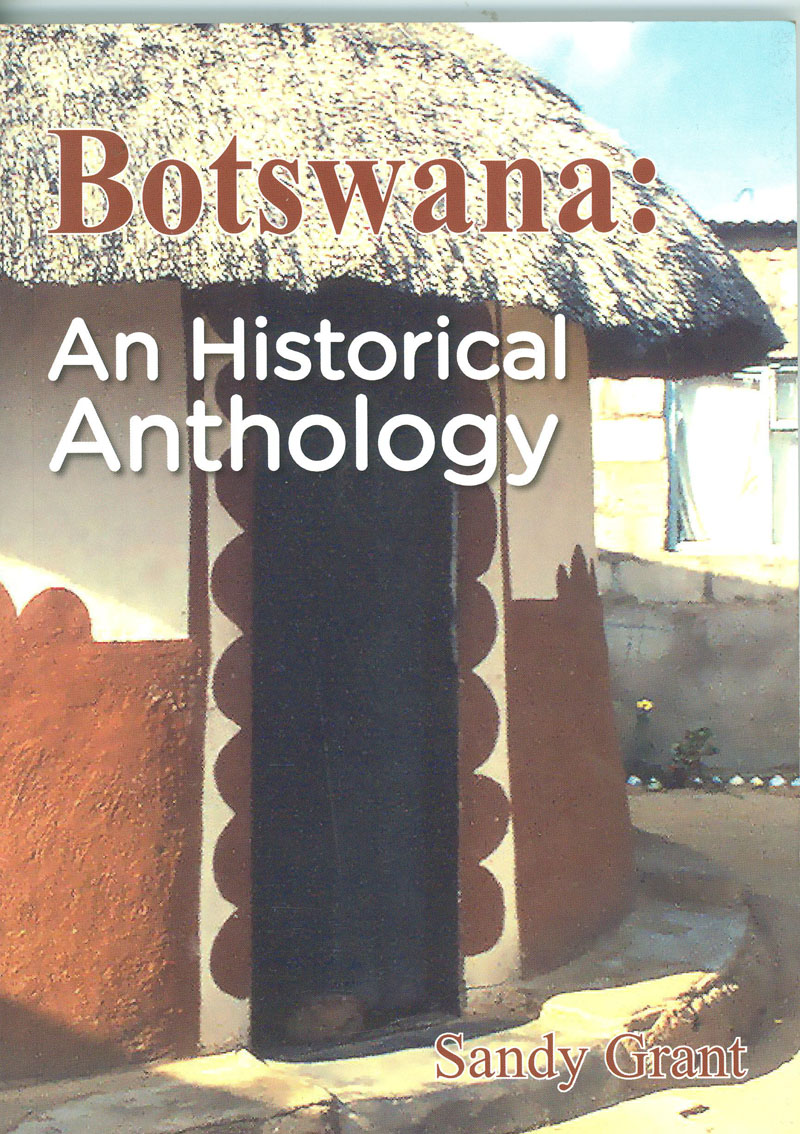
Title: Botswana: A Historical Anthology
Reviewer: Pako Lebanna
Publisher: Melrose Books
Author: Sandy Grant
But Grant`s ‘Botswana: An Historical Anthology` published in 2012 by Melrose Books in the United Kingdom still offers a refreshing look at the nation`s history, rehashing a lot of what has been written before by Tlou and co, but in an alignment that is highly accessible to the ordinary reader.
Grant, who holds an MA History from the University of Cambridge, and an MSc in Conservation from a Herriot-watt University in Edinburgh and has lived in Botswana for close to 50 years, has written an easy to read historical account of the nation`s evolution from the 1800s to the 2000s.
Grant notes that “the discovery of diamonds in Kimberly in South Africa in the later 1860s, followed by the discovery of gold in the South African Rand area of Johannesburg, had an immense impact on the Tswana peoples living in those areas. The Southern Tswana were the most immediately affected, being virtually overrun by land-grabbing Europeans.”
It was these conditions, plus the establishment of South West Africa (Namibia) as a German colony, and the efforts of Cecil Rhodes, “Prime Minister of the Cape Colony, Chairman of the British South Africa Company, magnate, colonizer and entrepreneur,” (Grant 2012:4) that would shape the modern boundaries of Botswana.
Rhodes had constructed a railway line from Cape Town to Vryburg, and decided to take in further to Mafikeng and across Botswana to Bulawayo in Rhodes` newly acquired state. Rhodesia. According to the book, Rhodes had an interest in taking over Bechuanaland Protectorate (colonial Botswana) as well.
“The Batswana chiefs were well aware of the fate that had befalled the southern Tswana at the hands of the (British South Africa) Company. They also knew that the Matebele and Shona in the new Rhodesia were experiencing the same fate, and three major Tswana chiefs, Khama, Bathoen and Sebele went to London to state their case,” (Grant 2012:5).
Grant notes that, Colonial Secretary, Joseph Chamberlain rebuffed the dikgosi, but they took their case to a countrywide campaign across the UK, until they had an audience with him, and he agreed that the Tswana chiefs ‘would continue to rule their people as much as before.`
But it seems the British remained committed to handing over the Protectorate to Rhodes; but in late 1895, Rhodes` right-hand man, Dr Leander Starr Jameson, launched an unsuccessful raid from Pitsane in Southern Bechuanaland, with the eventual aim of capturing Johannesburg and overthrowing Paul Kruger`s Transvaal Republic, which would give Rhodes control over the Rand goldfields.
The Jameson Raid collapsed and Rhodes reputation was ruined, and the British, the “previously committed to handing over Northern Tswana territories to him, were left exposed, and the British commitment to the chiefs “became for them an unanticipated article of faith.”
The Book is divided into three parts, ‘Historical Background,` ‘The Protectorate Period 1885-1966,` and ‘The Independent State: 1966-2009.`
He quotes extensively from the different personalities that shaped modern Botswana; from Tshekedi Khama and Bathoen II in the protectorate era, to Quett Ketumile Masire and Festus Mogae in the modern republic.
Page 44 of the book has a 1958 letter from Moutlakgola Nwako, then a bursar at Moeng College, writing to childhood friend Kenneth Koma, then a student in Russia discussing the challenges the protectorate faced in the face of a changing Africa.
Pages 77-78 carry two June 17 1985 Daily News articles by Kebareng Solomon and Kwapeng Modikwe describing the aftermath of the June 14 1985 apartheid South Africa raid on Gaborone. Such pieces give makes the reader more privy to aspects of the nation`s history.
A worthy read.