


Volume 65 December 2026-January 2026 : Feature
Kumakwane land war...
Author : Calviniah Kgautlhe
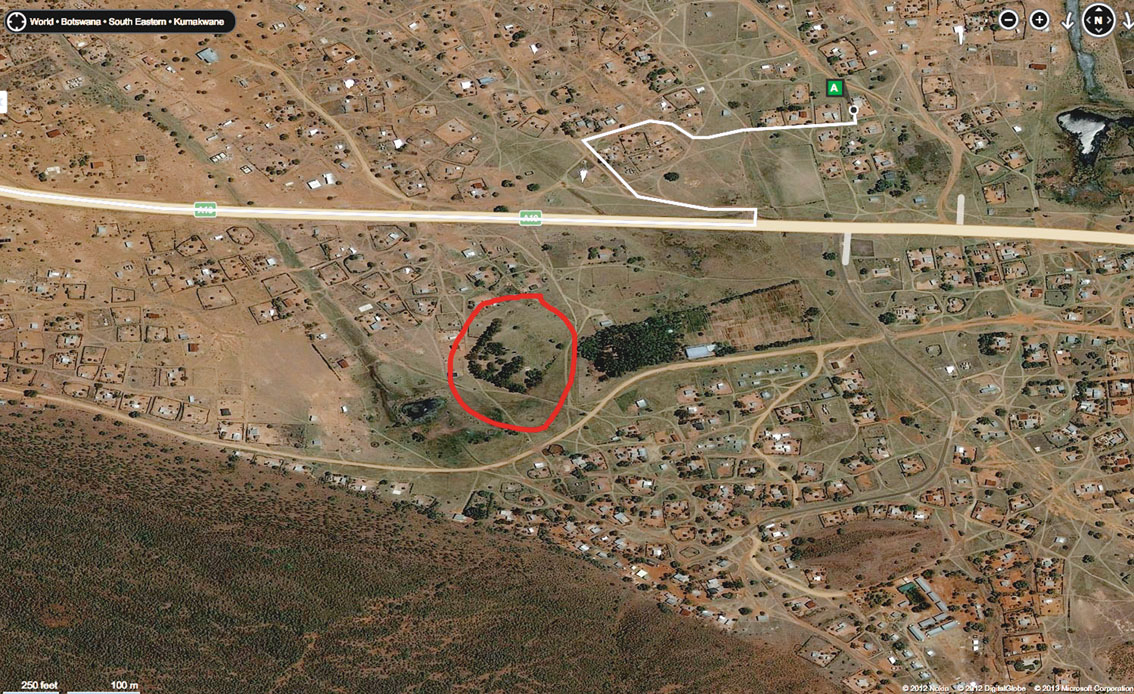
Located at the centre stage of the village next to the legendary Kumakwane signature woodland, is a breath taking piece of land which measures just over a hectare. Lost in its splendour, the drop of its emerald vegetation could be mistaken for a tourist area. The lush, quite greenery belies a simmering war over the very same piece of land. It is a war that has been going on for the last three decades. It is a different type of war, where instead of two foes, there are three, each fighting the other and each with diametrically opposed interests as different as the adversaries themselves. There is the Kumakwane Village Development Committee (VDC), Ian Martin, a United Kingdom citizen, as well as Bontlebotsile Maduma - a granddaughter of the initial inhabitants of the land.
The question of who owns this piece of land has left the village think tank – the silver-haired old men who need to balance on their walking sticks so they will not trip over the sandy roads of the village - scratching heads. Like a puzzle, the more they try to find out who the land belongs to, the more it gets tougher. Why? There are not too many people to help solve a 30-year-old mystery. Many who could are dead and most of the few remaining have old age amnesia.
Recently, Kumakwane residents, along with two claimants to the piece of land - the VDC and Maduma converged on the village kgotla to try and unravel the mystery. Tension smothered the air as none of the parties would budge.
The VDC remained adamant that the land belonged to the community. A village elder and former area councillor as well as land board member, Jemma Phaphe, says back in 1975 Kumakwane was affected by periodic flooding that destroyed residents` mud houses. Even post floods, water would continue to seep from the ground, collapsing the houses.
“Upon realising the predicament that had befallen the village, the late Kgosi Opelo Seboni Kgabo relocated his subjects in 1976 to other safer wards such as Botshabelo, Botlhapapelo and Newtown. This meant the land in question now belonged to the community and nobody had exclusive rights to it,” says Phaphe confidently.
Old Phaphe`s memory is as sharp as a razor blade as she succinctly remembers the dates and every detail of what happened.
“Kgosi then gave the land to Pelegano Village Industries Trust in 1980 under the leadership of Peter Mellington who used it briefly and handed it over to Ian Martin. It is unknown how this land was handed over to Martin,” she explains.
Martin used the land for eight years and came to the kgotla to hand it over to the VDC when he left for the UK, she says, adding “Since I was area councillor at the time, I was part of the team that went to Molepolole, Kweneng Land Board, to change land ownership in June 1987. However, we were not given a certificate at the time because we were told the board secretary was absent. Nonetheless, we went on to use the land and remained hopeful that we would get the certificate someday. Also present were Fisco Tsiane, former VDC chairperson, Keneilwe Piet as well as Ian Martin.”
“What now surprises us as the community and VDC is the fact that Ian Martin says he never transferred the land to us but that he was only lending us the piece of land - which is absolutely not true. This is shocking!” she says.
“Land, unlike in the past, has monetary value these days and I am not surprised at his claims. O ja semenogane ka rona, he is turning back on his word,” says Phaphe, meaning Martin had now somersaulted because back in the days there was no value attached to the land.
On the other hand Maduma, a granddaughter of the late Esther Dikupa Malunga, says she wants her grandparents` land back which her grandmother died fighting to reclaim back.
According to Maduma, her grandmother was the first inhabitant of the land before periodic flooding hit Kumakwane in 1975.
“This land remained hers as the late kgosi allowed her to keep her garden which she lent to Peter Mellington at the kgotla. The agreement at the time was that he would use it on condition that he fenced it and return it back to us when we wanted it but that was not the case.”
“He passed the land on to Ian Martin who got furious when we asked him to return the land to us when we heard he was leaving Kumakwane. Instead, he gave it to the VDC.”
She continues: “Upon realising there was stiff opposition from the local authorities and Ian Martin, my grandmother then went to seek assistance from Molepolole kgosi, Kgosikwena (Sebele) who wrote a letter to Kgosi Kgabo but he (Kgosi Kgabo) never called my grandmother to read her the letter. Fighting on, my grandmother continued to engage the VDC with no results. She was still fighting for the land when she died in May, 2008. I took over the matter and held a series of meetings with the local authorities and VDC but to date the issue has not been resolved,” she says with emotion threatening to take over.
Kutlwano contacted Ian Martin in the UK to understand the mystery behind the land better. “Pelegano Village Industries had been using the land and failed to make a viable business enterprise and so it was agreed that I could apply for the land in my name and I grew vegetables for over eight years,” explains Martin.
Relating how he acquired the land, he says the late Kgosi Kgabo was his signatory when he applied for the land in 1981 to be registered in his name.
“But the registration with the land board was progressing at a snail pace,” he says while expressing concern at land board application logistics.
He says Mogoditshane Sub Land Board visited him on a number of occasions to mark out the plot.
But Phaphe counters that there is no way Mogoditshane Sub Land Board can be involved since it was set up after board members were appointed in June 1992, some four years after Martin had left Botswana.
“Where did he get those letters, if they were written before 1992 then I suspect fraud,” she says boldly.
However, Martin remains steadfast that he never gave away the land to the VDC.
“In 1988 I spoke with the VDC to use the land and advised them verbally that it was still technically in my name,” he maintains.
Quizzed on how he got the land from the trust (Pelegano Village Industries), he explains thus: “Pelegano is a trust run by a board of trustees, I had come for a few weeks from Serowe to help on a project in Gabane called Tshwaragano. And the trustees told me they were having a problem with the land in Kumakwane. The idea was, I was to apply to take over the land in my own name. I was following these people`s advice.”
He says he handed over the land to the VDC because he did not want it to remain idle.
“The VDC had developed a woodlot and it seems the intentions for the village were good and it seemed a reasonable thing to do but now that they failed to develop the plot, the sensible thing is to take it back and make use of it.”
Martin says during the eight years that he used the land he grew vegetables, maize, herbs, medicinal plants and seedlings. Surprisingly, he asked for expansion of the land from the kgosi and the land board and it was granted.
“The land was originally something just over half a hectare and I applied for it to be increased to just over a hectare,” he says. That has also become another hot potato in the land saga.
“I do not understand why the land board went ahead and expanded a piece of land that had no certificate and was surrounded by issues,” wonders current village elder and VDC chairperson, Hill Bodika Sebobi. In fact, the whole thing is suspicious, he says.
Asked why the late Malunga might have queried what she obviously saw as dispossession of her land even though she was relocated to Botshabelo ward, he says the old woman and her granddaughter were not knowledgeable about land laws of the time. In the past, respect was accorded to the person who once owned the land, even if they were relocated. This led to some, like Malunga, believing they owned the land.
“Dilo tse tsa bogologolo ke gore e ne e re le fa o ntshitswe golo go bo go santse go na le respect ya gore golo hale ke ga motho, le jaana batho ba santse ba re golo hale ke ga ga mma Dikupa,” says Sebobi.
He explains that even though the VDC claims proof of the land it cannot “produce proof that can convince lekgotla gore setsha ke sa yone, only Martin has correspondence with the land board. Bontle says she has documents from previous inhabitants of the land and witnesses but she refused to give them to us a re re tlaa tloga re mo tsietsa,” says Sebobi. Meanwhile, Martin`s wife, Theresa, has applied for a lease of the area and recently put up beacons in the plot in question. The plot though still does not have a certificate.
There is no doubt this matter is far from over, and that pretty soon it may reach the High Court considering the potential value of the piece of land. Whatever the outcome, it will no doubt be a very interesting case and may just set a precedent in our case law. ENDS