


Volume 51 Issue 4 - April 2013 : Heritage
Gaborone Trinity Church - A Brilliant But Brief Flowering
Author : Sandy Grant
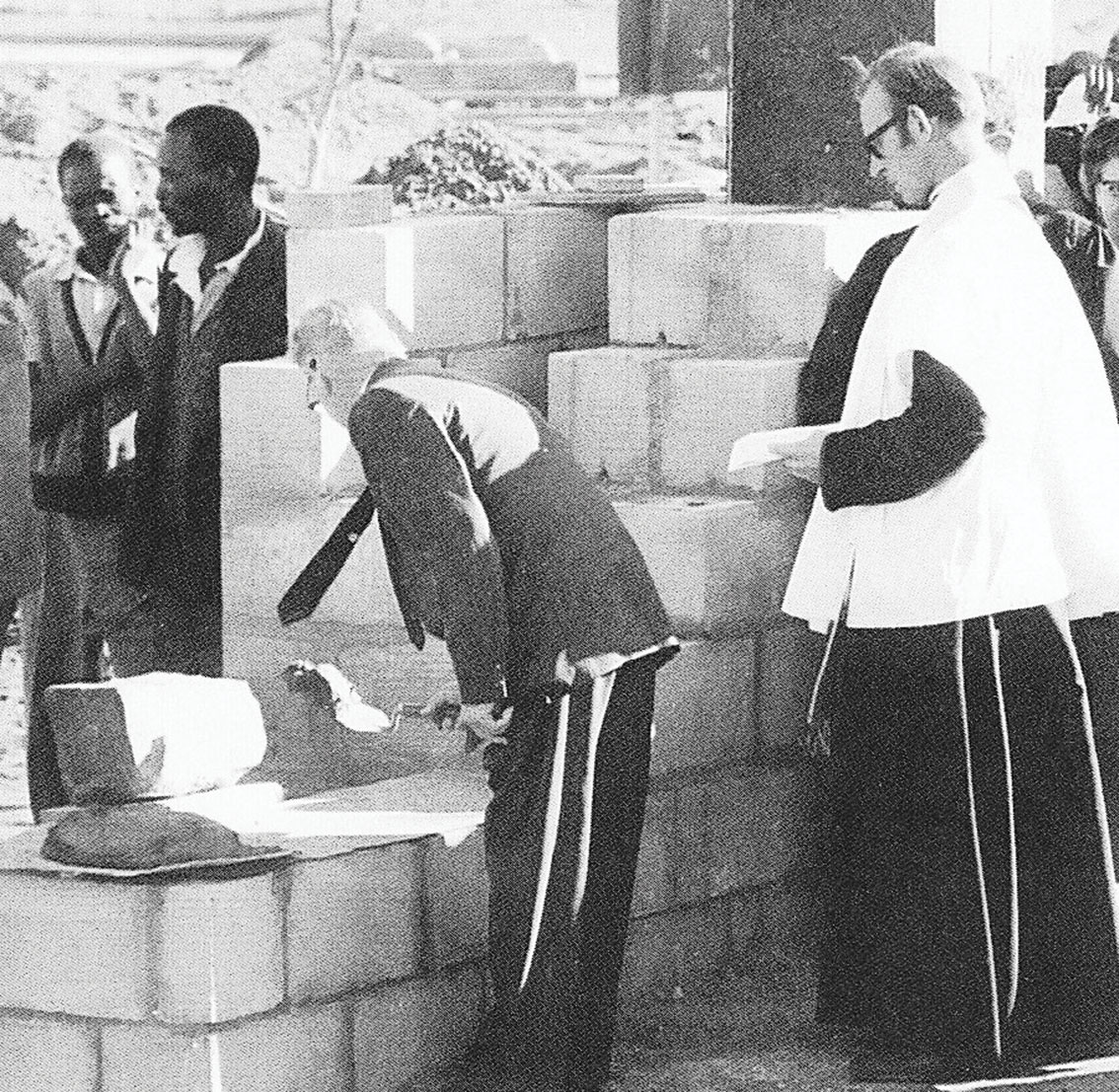
With Independence in 1966 came a new country, a new capital and a new kind of society. The way that the country`s local churches reacted to this new situation, and the background to their response, was described by Rev Alan Butler in an article in Pro Veritate in January 1970. ‘Gaborone`, said Butler,` was itself was a symbol of the new nation`s determination to overcome divisions and find the unity that is essential to political and economic progress. It became clear to church leaders that they had a duty to help this process for theological as well as social reasons….
In 1964, ‘the Congregational Church took the initiative and called a meeting to discuss the challenge that faced it. The result was that, ‘a union of the (very small) Presbyterian, Methodist and Congregational Churches was formed with the Rev. J.D. Jones as minister, and this Union Congregation and the local Anglican Parish planned the erection of a single church , and covenanted to worship and work together in the new town.` These churches which had so remarkably committed themselves were self evidently, English speaking.
Two other, important churches, the Lutherans (German and Setswana) and the Dutch Reformed Church (Afrikaans and Setswana) held back as did the Assemblies of God. The Catholics were never likely to be involved. In 1965 the Anglican, Fr. Butler was sent to join the Congregationalist, Derek Jones in this new joint Ministry. The two were to enjoy a special relationship, sharing the same remarkable dream. Although both were British and of a similar age, their personal backgrounds were different. Jones, the reserved intellectual, was at Oxford University whereas Butler, the unabashed journeyman, left school at 15, was apprenticed to his father in his interior decorating business and learnt sign writing. Both did their compulsory national service, Jones in the Air Force in Egypt, Butler in the Military Police, presumably in England. Both were drawn to the idea of mission with Jones being sent by the LMS to Maun in 1954 and Butler to Kuruman. It was there, that he developed ideas of a shared, united church which were to match those of Derek Jones.
One of their first initiatives was unfortunate and ironical. It involved clearing the site for the new church only to discover when they had finished that it belonged to the Catholics who were about to build their new Cathedral! The appeal document for the new Trinity church picked out three characteristics of ‘Gaberones` describing it as i) a new capital ii) for a uniting people and iii) in an awakening country and then matched those themes with its dream of i) a new church ii) for united service iii) in a spirit of obedience`.
The architect who they chose to design the building which would accurately reflect their shared vision was Francis Green who was then living in Swaziland. Green was to give them a building whose originality and quality was to be unmatched in Gaborone for many long years. As Green was a prohibited immigrant in South Africa, Jones and Butler had to travel there to describe their needs. According to Hilda Butler one of Green`s first questions about the church was, ‘why do you need windows?` – which begins to explain one of the building`s key characteristics, its unusual use of diffused light. Jones was to describe the new Trinity Church building, ‘as being composed of blocks of space and with a plan conceived on massive and austere lines.` ‘It was`, he said, ‘versatile and controversial – which it should be.` (Gaberones Broadsheet February 1968).
Accommodation between the two traditions and beliefs was reflected by many of the church`s features. With no nave, the congregation could be seated around the table/altar. The church possessed a lectern but no pulpit. A large, but simple, open metal cross dominated the background wall overlaying the Setswana text from John 15 which was painted by Alan Butler whose inspiration for the idea he drew from England`s Coventry Cathedral which was destroyed in the 2nd World War. Recreated in exciting new form by Basil Spence, the Cathedral`s emphasis on re-birth and a new awakening would have special meaning for Butler at Trinity. In particular, it was the famous Eight Tablets made by Ralph Beyer for the rebuilt Cathedral which he took as his model for his own special contribution to the new church building.
In November 1966 the church was opened with a dedication service which was attended by the President and Lady Khama. In the same month the two Ministers explained in their Broadsheet that, ‘it has been their guiding principle that we would do nothing separately which we can do together` and described some of the difficulties posed by their different traditions, such as the taking of Communion. We believe, they said, that the solution of such problems will be discovered by facing them in Christian love.`
Other dreams and needs were soon to emerge, however, and in his Pro Veritate article Butler sadly reported that already there were four other church buildings in Gaborone. He forcefully observed that separate buildings would serve as examples of Christian disunity and a denial of the Gospel`s ability to reconcile men`. In 1970, he left Trinity, being replaced by Rev. Theo Naledi who later, as Bishop, was to head an initiative offering a different kind of reconcilement.
In 1972, Anglican Botswana was made, for the first time, a separate diocese in its own right – it had previously been part of either the Kimberley or Bulawayo diocese - and in 1972 welcomed its first bishop, Rev. Shannon Mallory. Even though it had no more than six priests, the strongly felt conviction of the Anglican community was that a Bishop must have a cathedral. In the mid 60s, the LMS push for joint witness was underpinned by its understanding that no single church could financially afford to go it alone.
By the mid-1970s, however, the situation had dramatically changed and the Anglicans not least, felt that they should and could go it alone. With significant funding from Debswana – which had never been available for Trinity - it took little time for this new dream to become a reality. Within two years the new Anglican Cathedral was constructed and consecrated, and within a short period, the Methodists too had also built their own church. Trinity, designed as a church for united witness, was left to be used by the Congregational church alone, and its wonderful but in the end, unattainable early ideals, were soon forgotten and lost in yesterday`s past. ENDS