


Volume 51 Issue 4 - April 2013 : Entertainment
Colour Bar
Author : Susan Williams
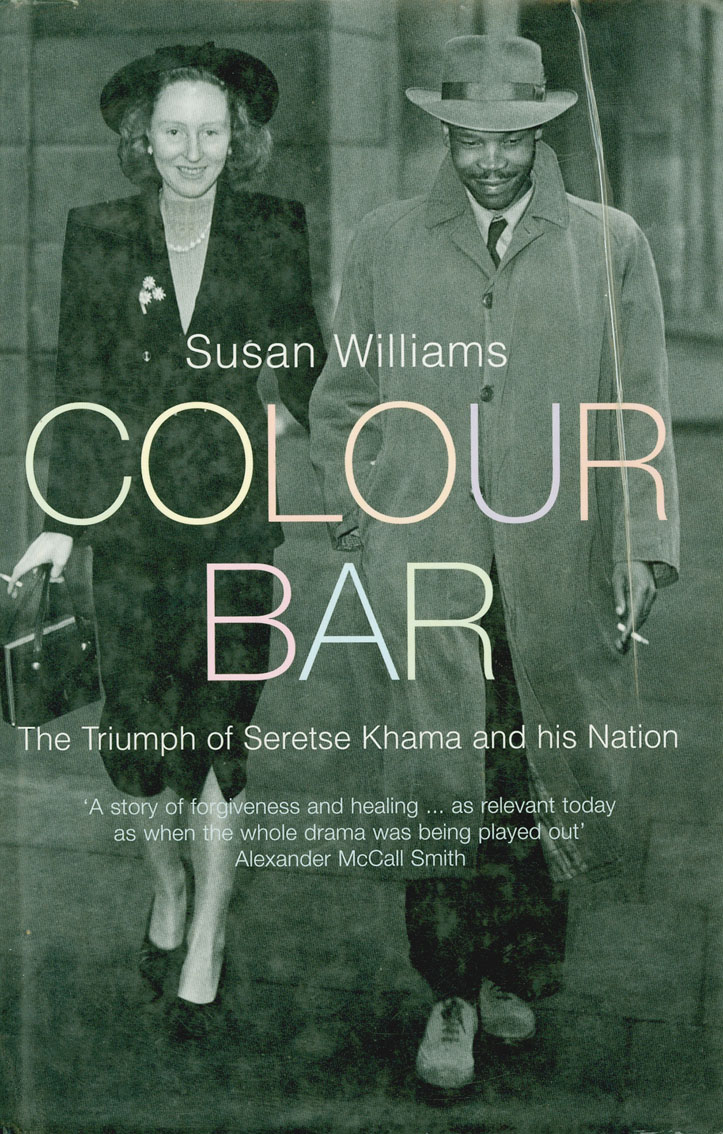
Reviewer: Pako Lebanna
Title: Colour Bar
Publisher: Allen Lane/Penguin Books
Author: Susan Williams
Published a few years ago (2006) this books gives the reader the fascinating tale of Seretse and Ruth Khama`s trials and tribulations, and thus remains relevant to the modern reader, especially as it draws on a history that shaped the manner with which modern Southern African states were founded.
The core of this book relates to a durable love affair between a black man and a white woman, in postwar Britain. Seretse Khama was the heir to the crown of the Bechuanaland Protectorate`s most influential tribe under British control; sent in 1945 to study law at Oxford by his uncle, the Bangwato regent Tshekedi Khama.
Seretse Khama would move to London, where he met Ruth Williams, a clerk in a shipping company in 1947, and within a few months they were married, despite racist attempts to block the marriage; the Bishop of London blocked their initial attempts to wed at a Kesington Church, they would eventually tie nuptials in a civil ceremony.
While the majority of his Bangwato tribesmen back home supported Seretse`s marriage, both his uncle, Tshekedi and the British administration were totally against it. Neighbouring South Africa, which voted into power the National Party government in a white-all election in 1948, institutionalizing the apartheid system, would also put pressure to bear on the British not to support Seretse and Ruth`s wedding.
Seretse was banished to Britain for five years, and even offered an administrative post in Jamaica, as to keep him far away from Southern Africa as possible.
Portuguese-ruled Angola and Mozambique, apartheid South Africa and South West Africa (Namibia) as well as Rhodesia (Zimbabwe), had institutionalised racism, and did not want a black Prince in neighbouring Bechuanaland setting the wrong example, especially at a period where there was heavy interaction between Southern African blacks, migrant workers in the bourgeoning mining and industrial sectors of South Africa.
Seretse would eventually be allowed back home, after heavy pressure on the British administration by activists, including the left-wing politician Tony Benn. The majority of the Bangwato insisted they still wanted him to reign as their leader, and he would eventually join party politics and be voted into power as Botswana`s first Prime Minister (1965-6), and president (1966-1980).
But this is ultimately as story of love, and triumph against the odds. It is also a well-researched and even-handed narrative; Susan Williams interviewed Seretse and Ruth Khama`s four children, Jacqueline, Ian, Tshekedi and Anthony, Seretse`s sister Naledi Khama, and her research took her to Kenya, to meet Seretse`s old friend from Fort Hare (South Africa) and Oxford, Charles Njonjo, and to Rhodes House Library at Oxford, among other places.
Williams also draws from existing literature, including Thomas Tlou, Neil Parsons, and Willie Henderson`s Seretse Khama (1995), Michael Dutfield`s A Marriage of Inconvenience: The Pesecution of Seretse and Ruth Khama (1990), and Gasebalwe Seretse`s Tshekedi Khama: The Master Whose Dogs Barked At.
This is evident in the manner with which the book instructive; it is extensively researched. This is a recommended read.