


Volume 65 December 2026-January 2026 : Feature
Peter Clark - Motshegaletau’S Missionary
Author : Baleseng Batlotleng
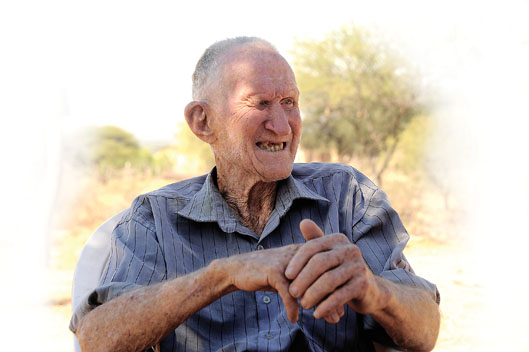
As we sit down on some makeshift chairs, Peter struggles to shut the windows of his derelict one roomed shack as they shake agonisingly due to a light breeze that is sweeping across the small village of Motshegaletau. A small rat, a rare sight by this time of the year, which had by chance found its way through an opening in the ransacked door, quickly dashes out of the ‘house`. “Kana mme yone ntlo e Seretse (Khama) o kile a robala mo teng. Ga se ya fano,” he tells me. I seem reluctant to respond to this subject but still interested in knowing what a popular figure like Seretse could have been doing here.
Whatever the Scottish missionaries David Livingstone and Robert Moffat did to Bechuanaland, the Clark family has done to the remote village of Motshegaletau. At least according to Peter, his parents devoted much of their lives to improving the living standards of “their people.” Ethnic chauvinism did not deter the Clark family from setting up a home away from their home Scotland. His grandfather was part of the 18th and early 19th Century settlers who came to Africa south of the Sahara.
There are few familiar names of these white settlers in and around the Central District who actually set up reputable business enterprises. In Serowe, one immediately remembers the Watson and Blackbeard families. Peter was born into one of these families, becoming the first boy child to be delivered at the only maternity ward of the historic Sekgoma Memorial Hospital in Serowe.
“Bona…. ke nna ngwana wa ntlha wa mosimane go tsholwa ko Sekgoma Memorial Hospital ko Serowe. Ke rakilwe ke basetsana e bile ke nna ke neng ka bitswa Rra Haile,” he says gratingly, the scraping of his chair informing me that I should brace for more from him. Peter was born in the winter of 1932 to a humble Scottish parentage. A product of one of the famous midwives Sekgoma maternity ward has ever had in its long history only known to him as Hailey.
Peter`s grandfather moved to Old Palapye around the 1900 and his mother was born there while his father was born on horseback when the old couple was travelling from Kimberly, the Northern Cape Province of South Africa. His father, Alfred Clark`s passport indicates that it was issued at Mafeking on the 18th day of May 1956, born on the 8th day of January 1889. The old man moved to Motshegaletau, the then masimo (cattlepost) of the small community of Thabala, a hamlet west of Serowe village. “Ntate o ne a na le dikgwebo mo Paje le Thabala…..benkele e e neng e tlwaelesegile ka go bitswa Tlotlo le Kwano,” he says.
The business venture was part of a string of shops that the Clark family had in Gammangwato. Khama III had advised the older Clark to set up in Motshegaletau to serve the entire population west of the main village -Thabala, Mogorosi, Moiyabana, Sehunou and Mabuo. Interestingly, the older Clark wanted to stay in Moiyabana but due to kgosi`s command, he obeyed and set up in Motshegaletau.
He grew up in Motshegaletau but schooled in Kimberly (South Africa) before retracing his steps back to Motshegaletau. He does not have a spanning professional career as a mechanic but only remembers that he worked for the Blackbeard family for at least 11 years.
Only three members of the family are still alive. His sister, Margaret Breadberry, lives in Zimbabwe while his brother, Russell James Clark, is also a popular figure in Thabala. Peter sadly lost his brother in a freak gun fire exchange between his older brother and the last born while the other sibling was bitten by a snake. Quizzing him about his own children, Peter decides to breach the subject and invites me to travel the length and breadth of his yard to show me some of his great grandparents` collection including some vintage car scraps they used to cruise around with - Bedford, Cruiser, Chevrolet Deluxe, amongst others. “I was married to Kesolofetse yo ke neng ke mo gorositse….ngwanake o ko Mabeleapudi yo mongwe ke nna le ene gone ha,” is all he can say about his own family.
Peter grew up knowing that he belonged to the Motshegaletau community. He did not regard himself as Lekgoa, contrary to how his mother wanted to raise him. “Ke ne ke dumela gore ke mongwato yoo jeleng ting….Mme o ne a batla go nkgodisa sekgoanyana mme ke se ko Ennyelane. Seretse Khama o ne a bitsa mme a re mme le ntate a mmitsa a re ntate, nna o ne a mpitsa a re nnake….Ian (Lt Gen. Seretse Khama Ian Khama) o itse ka ha mme aneng a le bogale ka teng mo baneng ba baneng ba le ditoutu…” adds Peter with a half sneer.
Amongst other public figures Peter was acquainted to during his childhood, was the late former Member of Parliament for the area, Bakwena Kgari. Kgari served in Seretse Khama`s Cabinet as Assistant Minister of Finance and Development Planning. He also served as District Commissioner at some point.
Incidentally, a dilapidated 1920 house still stands in the family`s compound just behind the room that Seretse lodged in when Peter was only 16 years. The family had a leather tanning business and the machinery from yester years is still kept in one of the rooms. Motshegaletau Clinic is named after Peter`s mother, Russell May Clark, because of her immense contribution towards upliftment of the lives of the poor community of Motshegaletau.
Peter now has one wish. To be buried in Motshegaletau. “Nna fa ke tlhokafala fela keletso yame ke gore ha go sena go tsewa death certificate a bo ke tsenngwa mo mmung. Ga kena keletso ya gore go dirwe mekete gotwe go bolelwa ka botshelo jwame. Go bolelelwa mang yo oneng a sena keletso ya go itse ka nna ke sa tshedile?”
Motshegaletau kgosi, Mogotsi Mosweu, explains that the village originated from the Pedi tribe, part of the many groups of the Sotho-Tswana people who travelled from Transvaal after the Mfecane debacle disintegrated many tribes in southern Africa.
The group settled at Khubulabopedi before parting ways with other Ngwato groups who went to Paje, Mabeleapudi and Mmashoro while they set up in Thabala. Motshegaletau, which was a cattlepost then, was almost a burrow of lions. “Fa re gola re utlwile gotwe go ne go na le monna mongwe yo o neng a thaisitse tau, erile e sena go tshwarwa ke selaga abo a e latela le babangwe. E rile ba tsena kwa ke fa e tlola mo selageng e mo tlolela abo e tsholetsa leroo e ntsha monyenyo. Ka Lesego mongwe o ne a e feleletsa ka segai mme rre yoo a tshela abo ba mmitsa leina ba re Motshegaletau,…” explains Kgosi Mosweu breaking down oral traditions of how the village came to be known as Motshegaletau.
Though some eco-social obligations forced some tribes such as Bakalaka and Basarwa to stay amongst the Pedi people in the village, the latter occupy a larger part of the village.
The Pedi people who relocated from Thabala found the Clark family having established their roots in Motshegaletau. Through the help of the family the community managed to build the Russell May Clinic and a dam. Some of the notable dikgotla in the small village are Mogadingwana, Makgane, Monyepele, Moitoi and Mokwena. An interesting natural feature of the village is the Mohitshane Hill range. A lot of stories are told about the hill being a place for the gods. Only the elderly who act as intermediaries between the gods and the community are allowed to cross over to the other side of the hill when the sun kisses the horizon.
There is a rumour that a sharp-tasting aroma of lebelebele (millet) is often smelt during such time. A 98-year old granny popularly known in the village as Ntharenyana, forms part of the intermediaries. Some of the cattleposts surrounding the village of Motshegaletau are Palapala, Motlopi, Hulapetsana, Monkgaphokoje, Saanakoma, Bolela, Kgamane and Xhootsha, amongst others. ENDS