


Volume 50 Issue 5 - May 2012 : Others
Breaking new ground
Author : Ndingililo Gaoswediwe
Inch by inch, row by row, Dikeledi Matebele is busy picking at tender bean leaves from her farm amid dreams of a bountiful harvest. This is part of her daily activities on the farm, and certainly an interruption of any sort may not be welcome. Yet, as she does so, she notices that a white vehicle has pulled off by her farm gate. Two of its occupants then walk in her direction, and they turn out to be journalists from Kutlwano magazine.
She stops momentarily to receive the visitors, though a lack of enthusiasm is discernible. During the interview that follows, it dawns on the Kutlwano reporters that Matebele is in fact not yet a fully happy person after all, although her farm appears to be prospering.
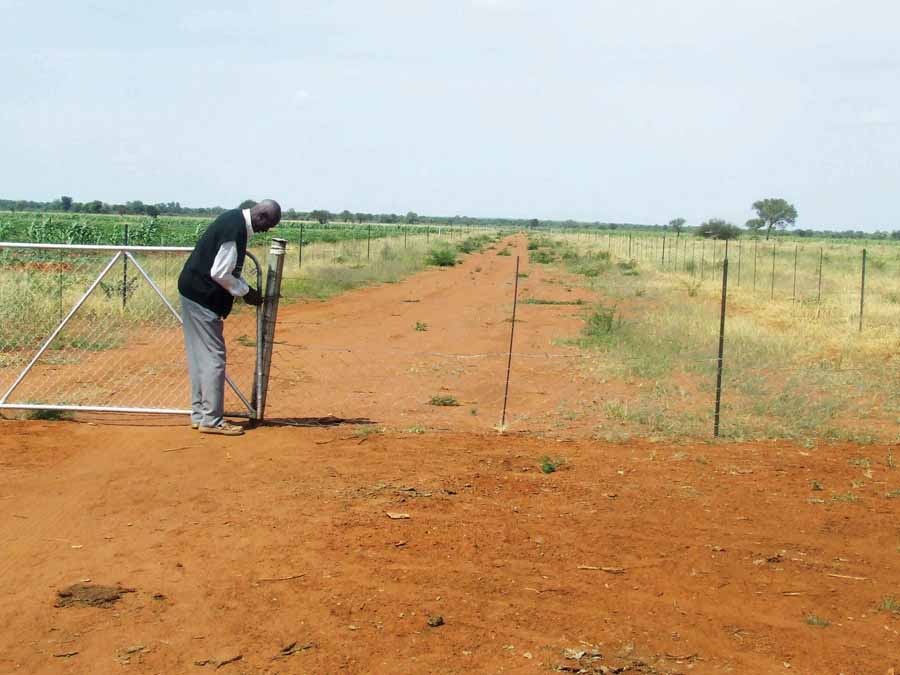
She complains that the fence that surrounds her farm may look well erected, but its height is so limited it is possible for animals such as cattle to jump over and eat her crops. Another problem, she says, is poor de- stumping, which usually angers tractor operators because of the damage caused to their ploughs. Now in her newly established farm, Matebele is in fact, one of 22 farmers who had to relocate their fields to make way for a coalmine project.
Thus, in Botswana issues of national importance take precedence over those of individuals or private interests. Incidentally, Mmaphashalala farmers had been cultivating their land oblivious of a hidden treasure underneath. As it turned out, the discovery of coal deposits in the area meant that the local farmers had to relocate so that the mineral could be exploited for the benefit of the nation, as per the country’s policy on mineral resources.
However, it was not easy for the mining company, CIC Energy and relevant authorities, to convince the farmers to move, a process that began in 2005. To them, coal and the promised compensation meant very little or nothing relative to the crops their land had been producing for a long time. Besides, they were not certain if they would be given alternative plots to continue arable farming. However, when they ultimately had to give way for the coal project, and were later allocated new farms as compensation, the farmers soon realised what a boon their relocation had been.
Therefore, as Matebele is busy harvesting from her new farm, certainly her complaints may be carrying little weight while happiness will soon replace her uncertainty. Fellow farmer, Dorcas Bagatiseng, chips in, revealing that farmers in the area have already formed a syndicate to take advantage of government’s fencing programme to erect a higher fence.
Beaming with an appreciative smile, Bagatiseng says indeed CIC Energy, the company that will be mining the coal, has improved her farming standards. For instance, she says her nine-hectare field has been completely de-bushed and de-stumped. For this reason, she says, she has started diversifying and planting a variety of legumes.
Despite the fact that it took Lesego Lekando four years to own a farm, she acknowledges the mining company made thorough consultations with the farming community. Like other farmers, she complains about the fence, saying, however, that “through the spirit of togetherness we will unite to solve the problem.”
Without delay, Lekando took advantage of the first rains of the seasons and planted. Still, she salutes CIC Energy for cultivating her field early, providing safe water and allocating farmers fields that are nearer to the village.Of the 22 farmers that have been allocated farms, only a few failed to plant due to shortage of implements, they say.
The chairperson of both the working group and liaising committee, Bernard Mudala tells Kutlwano that CIC Energy has fulfilled its promise despite the delay. He says of the 27 farms that were within the mining area, five opted for monetary compensation, while 22 got a share of both the land and cash.
Prior to relocating the farmers, Mudala says CIC Energy made sure that the new fields were well fenced, de-stumped, and cultivated. Besides, the company also erected a cluster fence, which surrounds all the neighbouring farms, separating them from pastures. “I appreciate it because CIC de-stumped all the farms without looking at the size of the field the farmer had previously de-stumped,” he says.
Regarding the farmers’ complaint that the fence is not high enough, Mudala accuses them of not taking their time to understand when it was explained that the fence would be similar to the one along the A1 Highway, which bars animals from encroaching into the road. “People were excited by the term A1 fence and never made further efforts to investigate, only to criticize after the fence had already been erected,” he observes.
For four years there was no ploughing in the area as negotiations on relocation continued. However, Mudala says the fact that the mine compensated the farmers every for ploughing season militated against any possible hardship. In the current ploughing season, Mmaphashalala farmers could be heaving a sigh of relief regarding their new farms but they are disappointed because of the ongoing lack of rain.
From an open well that farmers shared with domestic and wild animals, CIC drilled a new borehole that will provide potable water, not only to the affected farmers but the community of Mmaphashalala as a whole. Meanwhile, CIC Energy corporate social development manager, Kobie Du Toit, says extensive negotiations, studies, and soil tests were conducted prior to relocating the farmers.
Du Toit says after a structure was designed in November 2011, each farmer got a piece of land which was de-stumped and cultivated, adding that within the cluster fence, each farm is fitted with farm gate and smart roads that link farms. Unfortunately, he says, his company’s initial efforts to drill a borehole hit a blank, adding that the mine will nevertheless, continue surveying the area for further drilling.
The manager says although it was an expensive exercise, setting CIC Energy P1.6 million back, he is happy that the farmers will be in a better position to produce more to improve their living standards. In their quest to fulfill World Bank requirements, he says his company hosted a workshop with relevant financial institutions for those who got monetary compensation to teach them how to invest their money.