


Volume 51 Issue 10 - October 2013 : Feature
Living amongst the dead
Author : Ndingililo Gaoswediwe
Article: Ndingililo Gaoswediwe
Photos: Thompson Keobaletswe
She sits ensconced on a red couch, her demeanor betraying nothing but someone simply at ease with her environment. When she speaks, her voice commands authority and oozes confidence as she carefully explains each step as if her job is just but routine.
“Motho fa a sule ke mo fa last respect ka gore e kile ya bo e le motho jaaka nna. Ke mo tshwara ka lorato le fa a sa mpone or a utlwa ka se ebile ke tsetlana nngwe ya nursing codes,” says 58-year-old Princess Marina Hospital mortuary supervisor, Annah Nyamugure.
To Nyamugure, the dead are just as harmless and deserve respect and good treatment just like you and me. It is something that was instilled in her during her nursing career, she says.
For a moment it escaped my mind that I was in a place full of corpses. “Ke dipuo fela tse di thamilweng ke batho, ga gona moswi yo o kileng a tsoga kgotsa a poka…fa gongwe e a bo e le poifo motho a ithamela ditshwantsho mo tlhaloganyong,” adds Nyamugure as my mind wonders around trying to make sense of all the gothic tales I have heard about mortuaries.
One of the commonly held myths about mortuaries is that every morning an attendant pulls out a skeleton and faces it eastwards. Then in a strange voice they start calling out and this is believed casts a spell on people to die and be sent to the mortuary. That is why it was or is still taboo in some tribes for one to sleep with their head facing east since they believe only the dead lie with their heads facing east.
Another myth is that the corpses would sometimes gain consciousness and start moving about like zombies in the mortuary.
However, Nyamugure, who quit her nursing job in 2007 after 21 years of service and landed at the mortuary as a supervisor in 2009, dismisses this as just a fable. This is because she sometimes spends more two hours alone in the morgue and would barely notice that she is amongst the dead.
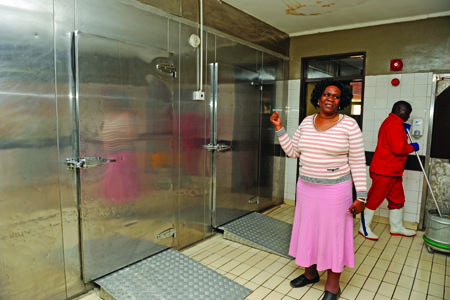
What makes her story more compelling is that, save for the two cold rooms on your right as you enter the premises and a block of silver trays, nothing suggest that there could be dead bodies around. The place feels so cool that you could be forgiven to think it is just another government office. Only the strong smell of disinfectants suggests there is something peculiar about the place but even then the two postmortem rooms that clearly distinguish themselves on your left from the adjacent hall do not evoke any fear.
Though employed as a forelady, Naymugure does not enjoy the luxury of just shouting out orders. Sometimes she is caught hands on, helping her staff in the mortuary due to shortage of manpower. The humble woman says her Christian faith plays a big role in her work.
Thus, they will be receiving corpses, registering and tagging them and then putting them in the cold room to either await postmortem or to be handed over to relatives for burial. During postmortem, an attendant also helps pathologists in autopsy procedures as directed.
Once the examination is done, the cadaver is bathed with a mixture of disinfectants, shrouded, labeled and shelved while awaiting collection by relatives. Time and again, Nyamugure keeps on checking the temperatures so that the corpse either in the shelf or cold room remains frozen.
It would seem by “spending time with the dead” Nyamugure would have developed a thick skin but she is just as human and at times she finds herself having to deal with emotional breakdown. The first incident that touched her to the point of breakdown happened on her first day at work.
“Di passion killing di setlhogo, mosetsanyana yo o ne a tlisitswe ke mapodisi a tlhabilwe ka thipa ebile e santse e le mo go ene. Mme fa ditlhotlhomiso tsa mapodisi di ise di wele o nna fela a le madi le thipa ga e ntshiwe. Ka jalo moso le moso ke tlhola gore a o ntse sentle…” reckons Nyamugure, bemoaning victims of passion killings as her mind harks back to a gory picture of a girl who was brought in with a knife still stuck into her body.
It stayed like that until the police completed their investigations but she got traumatized of always going to check if the body was still in good state.
At this point, our interview seems to evoke sad memories as she continues to narrate the story of a 12-year-old boy whose head was cut open with an axe and weapon remained attached to the head for days while the police continued with investigations.
“…fa go ntse jaana ga o tshware sepe ka o a bo o senya bosupi, go botlhoko, go tlhomola pelo, go a hutsahatsa…eish! Dikotsi le tsone di setlhogo, batho ba tla ba sogakane segolo jang banana,” says Nyamugure, meaning that as a mortuary attendant you are not allowed to remove the axe lest you tempered with evidence.
As her voice starts to fade, she again bemoans the cruelty of road accidents, adding that she has seen more than 50 bodies that were in a bad state. She says such incidents peak during public holidays.
As we take a tour around the mortuary, Kutlwano team was not at ease. As we part with Nyamugure who immediately rushes to assist customers, we start chatting about her job. This woman who has devoted all her love to doing a job that many would shun deserves credit.
Her job might seem inferior but society cannot live without. You can imagine a morgue without attendants…unclean bodies from wards or accidents scenes stuck in cold rooms!
Even though some individuals find themselves “stuck” in mortuaries day and night receiving dead bodies, recording their arrival, cleaning and preserving them to stop decomposition, the only appreciation they get is to be associated with evil spirits or morbid ideas about the dead. ENDS