


Volume 51 Issue 11 - November 2013 : Feature
Thema hoists Botswana flag high
Author : Calviniah Kgautlhe
We live in a strange yet exciting world. It is a world where technology and scientists are daily pushing for new and better innovations that make human existence worthwhile. And what great strides humanity has made through science and technology!
The existing untapped potential has hidden within it a mystery about humanity`s tomorrow, which promises to be a whole lot better than today`s. That potential though can only be awakened by the imaginative brave, prudent, sharp and inquisitive mind such as Force Thema.
An analytical chemist by profession, Thema is busy marching his way through a promising study of Nano-technology Sciences in South Africa. The pioneering study which seeks to harvest clean energy from the sun using Nano-technology as well as clean water using the very same technology, has been embraced in the scientific community and earned him accolades from across the world.
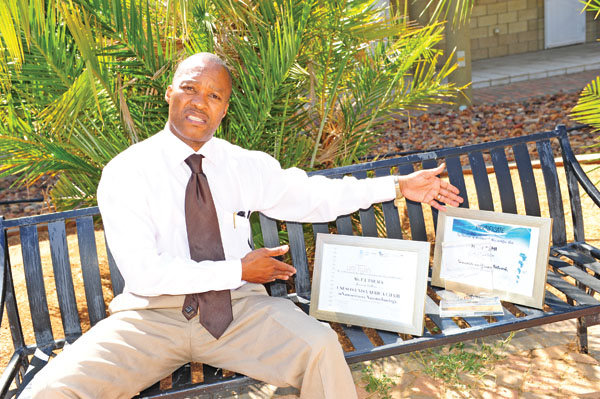
The three international accolades, all recent include two from the United Nations Educational, Scientific and Cultural Organization (UNESCO) and one from University of South Africa (UNISA) where he is currently studying for his PhD in Chemistry. The awards which he received within one week are simply a motivation for him and recognition of his work which symbolises that Batswana are capable in the scientific world.
“I hoist the Botswana flag high wherever I go, and this fills me with joy,” says Thema, his face radiant with joy “I have noticed that in Botswana, we have water and energy problem. Both are pretty scarce, and I am researching on coming up with novel, realistic techniques of cleaning water and harvesting clean energy from the sun. These will be achieved at low cost and in a sustainable way,” he reckons.
Thema who has already travelled the world, and raised high the Botswana flag, presenting his idea to the scientific community, has also been to Santa Clara, California, United States of America (USA) where his noble idea received thumbs up.
He tells Kutlwano in scientific terms that he is, “developing a low cost multi-purpose graphene based electrodes with superior detection sensitivity and limit relatively to standard carbon ones. A conductive and transparent graphene based nano-structures as potential transparent conducting oxides (TCO) equivalent for harvesting clean energy,” he says.
“My research is within the framework of the United Nations educational, Scientific and Cultural Organization-University of South Africa (UNESCO-UNISA) Africa Chair in Nano sciences and Nanotechnology and I will be leaving in December for Italy as part of my research,” he says.
The Ranaka born science fellow says in simple terms Nano technology is a powerful science with potential to transform the world as it cuts across all disciplines and can be used virtually on anything.
“Use of nano technology means lighter mass and yet more power, for example a light substance created using nanotechnology could be 10 times harder than metal. It depends on what you want to do really.
Another practical example is a nonstick surface pan which uses ceramic-based nanotechnology. The other example is the electrode that is used on laptops, on television sets and other digital devices. Nano technology could be used to offer better picture quality in that regard. However, for me my interest is to engineer a nanotechnology multi-purpose structure that can be used to detect impurities in water and clean it as well as harvest clean energy from the sun,” he explains.
According to Centre Responsible For Nanotechnology`s web page, “Nanotechnology is sometimes referred to as a general-purpose technology. That is because in its advanced form it will have significant impact on almost all industries and all areas of society. It will offer better built, longer lasting, cleaner, safer, and smarter products for the home, for communications, for medicine, for transportation, for agriculture, and for industry in general.”
Thema who is the first Motswana to be selected as the First junior fellow of the UNESCO-UNISA Africa Chair and also at continental level as an active member of the Nanosciences African Network (NANOAFNET), an African Union network of excellence, has had an illustrious career in chemistry which began at Debswana Diamond Mine in the early 1990s.
He is currently under the employ of Botswana College of Agriculture (BCA) and his research is sponsored by iThemba-LABS in Cape Town, South Africa. Ends