


Volume 50 Issue 9 - September 2012 : Social
Seamless Change Of Guard
Author : Pako Lebanna
At midnight, on September 30, 1966, when the Union Jack (the British flag) was lowered at the National Stadium, and Botswana’s new sky blue, black and white flag was raised, the country set out to chart a new course as a sovereign state. Four principles - Democracy, Development, Self-reliance and Unity - were adopted as the country’s national pillars, with a fifth, ‘Botho’, added 30 years later in 1996. The Pillars would be the bedrock that the country’s founders laid as a guide to Botswana’s direction.
Strict adherence to these principles has been the cornerstone of Botswana’s success since independence, especially because the country was a part of a world in which most new independent states were already experiencing dictatorships, corruption and maladministration.
One of the major problems in Africa and the world at large has been the misuse of military and policing institutions for the benefit of a few, with politicisation of these public institutions by the ruling elites.
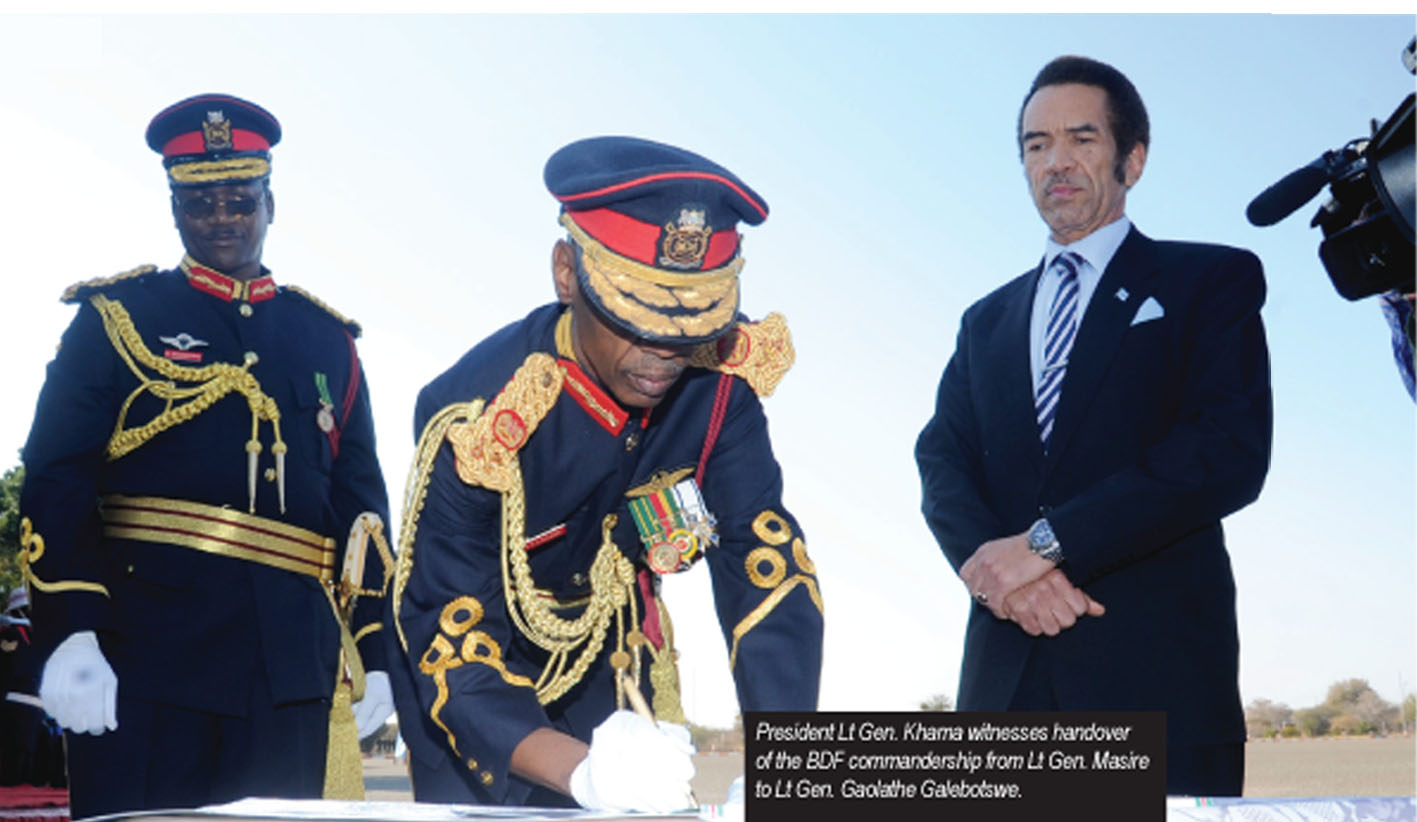
By contrast, Botswana sought to develop a professional army and police service that would be accountable to a democratically elected civilian government, and the institutions have thus stayed apolitical throughout. This has been evidenced by the refreshing transition on August 1, 2012, when the country had a new police commissioner and an army commander being installed to replace their predecessors on the same day. Lt Gen. Tebogo Masire was the last of a generation; the very last man standing of the first Botswana Defence Force (BDF) soldiers who pioneered the army in 1977. Having studied air traffic control in the 1970s, Lt Gen. Masire joined the BDF upon its formation in April 1977, a few months before turning 22 in July of that year. He was one of the only four officer cadets who were successfully trained to become pilots, along with Albert Scheffers, Ezekiel Rakgole and Jagamang Seduke.
They were commissioned as second lieutenants in 1978 and became the core of the initial BDF air arm. While Scheffers and Rakgole retired as Brigadiers and Seduke left as a Colonel, Lt Gen. Masire went all the way to become the commander of the army. Having been deputy commander since 1998, and commander since 2005, Lt Gen. Masire bade farewell to the army late July 2012, joining the tradition of previous commanders; Lt Gen. Mompati Merafhe (1977-1989), Lt Gen. Seretse Khama Ian Khama (1989-1998), Lt Gen. Louis Matshwenyego Fisher (1998-2005). Lt Gen Masire handed over to Lt Gen. Gaolathe Galebotswe. “The four transitions took place in a smooth manner that epitomised the country’s peaceful democratic nature and something Masire himself aspired to see continue,” writes Mesh Moeti. He also quotes him in a brochure entitled So Long General- Celebrating the Career of Lt Gen. Masire:
“I will forever be interested in the development and state of the BDF. I would like to see it get even more professional, be better equipped and continue to be hailed as one of the best in Africa.”
For many states in Africa, and indeed the world over, military coups have been symptomatic of the disconnectedness of the army and civilian rule, the sort of disharmony DH Lawrence depicted between teacher and pupil in his epic poem Afternoon in School - The Last Lesson. However, the harmony between the disciplined forces and civilian rule in Botswana is also exemplified by the seamless transition of the leadership in the police service. Established as the Bechuanaland Police Force in 1885, operating under the control of British colonial administrators, it was only in 1971 that the national police had a Motswana commissioner, Simon Hirschfeld, who succeeded Lt Colonel James Bailey. Hirschfeld (1971-1995) was succeeded by Norman Moleboge (1995-2004), Edwin Batshu (2004-2007) and Thebeyame Tsimako (2007-2012), who after five years at the helm since June 2007 decided to retire from the police, paving the way for the new commissioner, Keabetswe Makgophe. Committed to upholding fundamental rights and freedoms of individuals and protecting safety and security, the Botswana Police Service has also developed a strong rapport with the community and through efforts such as community policing, has further entrenched this relationship.
As the Speaker of the National Assembly, Margaret Nasha, said during an interview the day after parliament endorsed Ponatshego Kedikilwe as Vice President, “the peace and tranquility that is epitomised by the passing of the baton between the political and military leadership is very special within an African context; something Batswana should be proud of.” ENDS