


Volume 65 December 2026-January 2026 : Business
Ostrich farming lucrative business
Author : Ndingililo Gaoswediwe
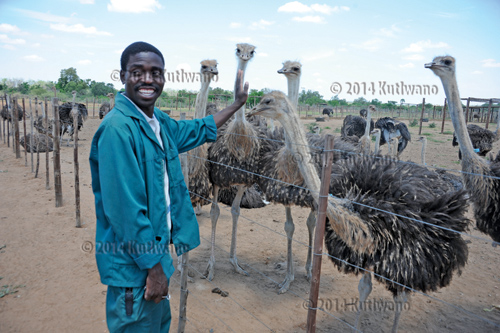
In business, the keywords are commitment and determination. And it has beautiful rewards.
The closure of the ostrich abattoir in 2010 due to inadequate supply of the birds saw many dreams collapse as many farms failed to survive the harsh market. The local market is way too miniscule and it would be expensive to market the bird`s meat locally.
Botalana Farm Production Manager, Wellington Chamboko explains that at some stage the farm was stuck with over six thousands birds.
The farm management refused to be disheartened. Where many were closing their farms, they decided to continue breeding more birds. Their faith in the resilience of our environment has been handsomely rewarded.
Soon after the Gaborone ostrich abattoir re-opened Botalana secured a market with the European Union. As a starting point they slaughtered and shipped 120 birds in the last slaughter season. This time around they will send over a thousand birds for slaughter.
He describes ostrich farming as profitable and urges Batswana to partner and venture into it. The market is unsaturated and Botalana is ready to assist where necessary, he says.
“In ostrich farming there is nothing to lose, you sell everything including feathers and the skin,” he says.
In total, from chicks to breeders, Talana boasts 2323 birds. Challenges are part and parcel of many businesses and here, predators and inadequate supply of feeds due to low production of maize locally are some of the hindrances. Because the business wholly depends on external markets, during outbreak of diseases such as bird flu the business is directly affected.
Advantages of ostrich farming
He says unlike cattle and sheep, ostriches do not require enormous amounts of land for pastures.
Ostriches breed extremely earlier and more regularly than traditional animals such as beef cattle. For example, the female ostrich may begin to produce eggs at the age of two, and can produce anywhere from 30 to 90 eggs per year, says Chamboko.
He says the potential for the ostrich market is enormous, in that the meat tastes almost like beef. However, it is much healthier than beef due to the fact that it is very low in fat and cholesterol.
Since this “red” meat has been proven to be quite healthier than traditional red meat, many health conscious consumers throughout the world, who are worried about the risk of heart attacks, high blood pressure, and heart disease, would rather go for it than for beef.
Another benefit to the ostrich rancher is that when an ostrich is slaughtered, very little is wasted in the slaughtering process.
“When an ostrich is brought to slaughter the meat is sold to distributors and restaurants, the hide is sold for the production of high quality leather products, the feet are ground into a fine dust and sold to the far east as an aphrodisiac, the feathers of the ostrich are sold to automobile manufacturers and are used in the final stage of painting new automobiles, and lastly, the eyes are sold to research facilities to perform studies to gain more knowledge on human cataracts”! Ends