


Volume 65 December 2026-January 2026 : Business
In Love with Goats
Author : Ludo Chube
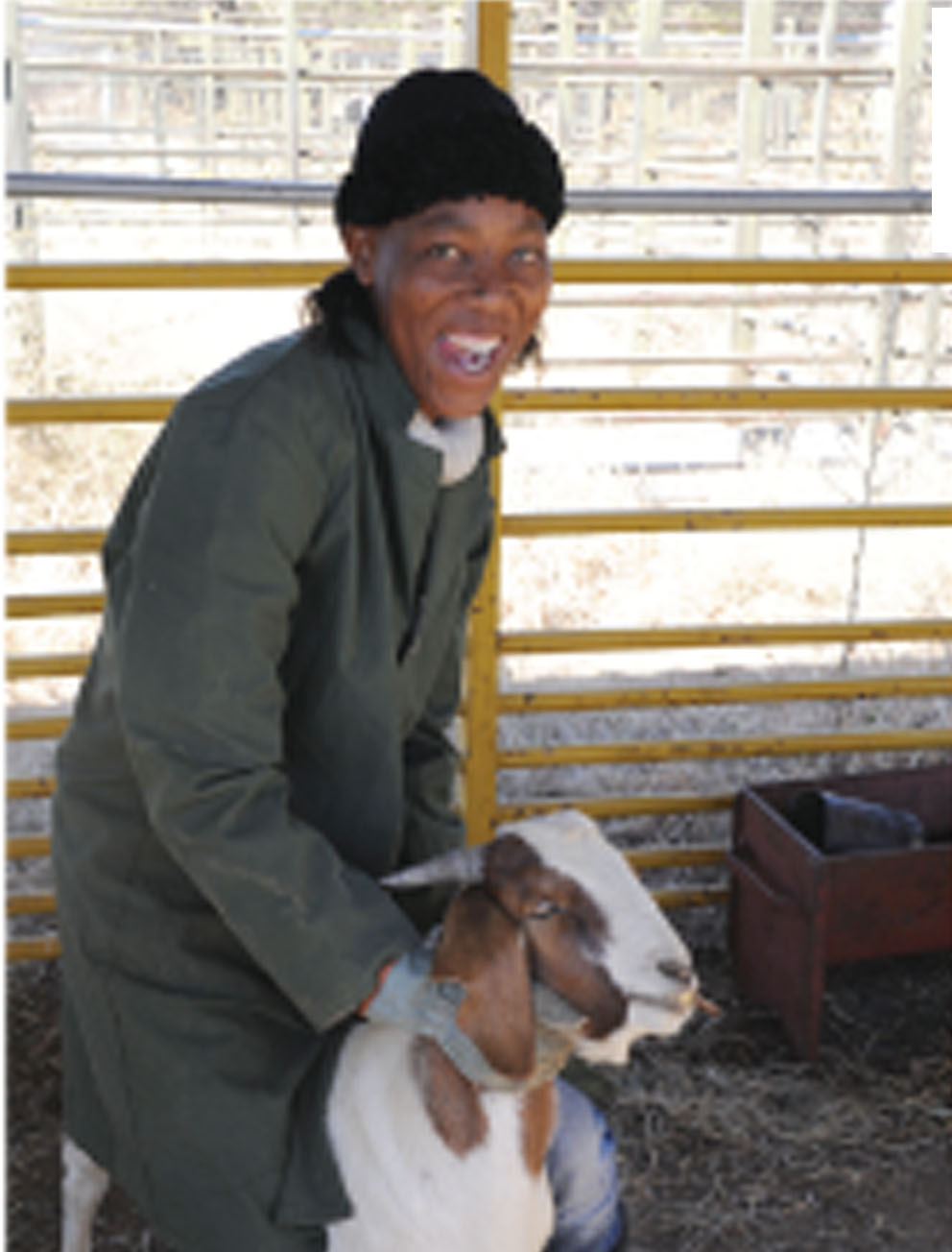
There is something about goats that has captured Nnanao Tladi’s imagination. Every morning she rises with the birds, not to go for the 7:30am to 4:30 pm shift as many women her age do but to tend to her goats at Khurutshe farms near Artesia in the Kgatleng District. Unlike other women her age who are still trapped in the 7:30am to 4:30pm work shift, the 30-year-old Tladi is self- employed and a proud owner of more than 60 goats, that is, if those that she frequently puts up for sale are excluded.
“Once at the peak of production, I had 124 goats,” unable to conceal her excitement, Tladi tells Kutlwano in an interview. For Tladi, goats are an admirable lot. She sees them as companions and comforters; more importantly, they are her life. “With proper care, goats can in turn feed, clothe and comfort you,” she asserts. Notwithstanding, the young but ambitious and determined farmer admits though that there are innumerable challenges. “I almost gave up when right from the beginning 15 of my goats died in a short space of time due to heart water disease,” she reveals ruefully. Without forgiving herself, Tladi says she entered the business with very little knowledge which inherently compounded her situation.
“Initially, I was kind of careless in my approach, and I think it was due to lack of farming skills on my part,” she says with a tinge of regret. With hindsight, Tladi remembers that she used to leave the goats unattended which exposed them to predators. This served as a wake up call in that she eventually acquired proper animal husbandry methods. As a Youth Development Fund (YDF) beneficiary in 2007, Tladi has never looked back as a goat farmer, having started with only 50 goats. Although at the time she was employed as a temporary teacher in Artesia, she says idle talk about small stock farming was enough to lure her into goat farming.
The several workshops she attended about small stock farming convinced her that this was the road she wanted to travel. Fortunately for her, land and water, the two most important resources for farming, were not an issue. “My parents have a big farm in Khurutshe with adequate water supply,” she says with apparent contentment. Tladi hit the ground running as soon as she got funds. Her winning streak in a number of small stock shows in the Khurutshe region only served to spur her on.
And that is how the Women’s Affairs Department came to know about her. They did not waste time inviting her to partake in their annual Women’s Expo to gain more exposure and network with others in the same field. She says her financier - Youth department - has turned out to be her biggest client, buying goats from her for some of their projects.
There were, however, some very tough lessons to be learnt before she could break even. For two years, she says, she recorded loses but perseverance kept her going. “I decided that I was going to love my animals and take good care of them, and money would follow, and that’s how it worked out for me,” she says. Although initially she was worried about market access, her partnership with the Kgatleng small stock grouping, Dihutshane Association, gave her a break- through.
“Whenever a young person was needed to showcase his/her business, I would get nominated. I have also been identified as a young successful female who has made a name for herself in the area of farming,” she points out. Tladi says there is a lucrative market for small stock because demand is very high hence her intention to expand her business. However, she regrets not being able to sell to butcheries and supermarkets because of the low asking price. Meanwhile, a relatively short distance away south of Khurutshe, is Rasesa village where 50-year-old Tidimalo Kaisara owns 150 goats. Kaisara’s farming project was established in 2008. “I love nature; I love the sound of nature in the morning; that is why I was drawn towards farming after I got my exit package from my former job at Debswana,” reveals Kaisara.
Initially, she reared both goats and sheep but has since switched to sheep only. “This is because sheep are not as fussy and vulnerable to diseases as goats,” she argues, adding that sheep also multiply much faster. She also argues that a lamb matures relatively faster. As such they are weaned much earlier to give the ewe (female sheep) enough time to mate and reproduce twice a year, says Kaisara. A self-funded farmer who started with only 30 sheep, the adult farmer says she has strategically been selling rams only because her target is to reach150 ewes.
However, just like Tladi, Kaisara is very skeptical about selling to butcheries and supermarkets because they offer “peanuts”. “Some offer to buy our animals at P30 per kilogramme, which translates into an average of P600 per head, and considering how much money we invest in our animals, it is a direct loss, really,” opines Kaisara, adding that otherwise on average her sheep can fetch P950 each.
Incidentally, like Tladi, heart water nearly wiped away all her hopes of becoming a successful small sock farmer after claiming 40 of her Boer goats and several sheep. The farmers also complain that high vaccine prices remain their biggest impediment as well. “When the Livestock Advisory Centre (LAC) runs out of stock, finding affordable medicines is almost impossible as private companies are very expensive,” laments Kaisara. Notwithstanding, the two women remain steadfast and determined to make it, come what may.
DID YOU KNOW?
The Kgatleng area is reported to be favourable for small stock farming. Research shows that on average nationally, small stock population increased by 16.4 per cent between 2007 and 2010. It also emerges from the same findings that Kgatleng District alone had the highest increase of 71.9 per cent. ENDS