


Volume 50 Issue 9 - September 2012 : Entertainment
Constitutionalism and the Rule of Law in Botswana
Author : Pako Lebanna
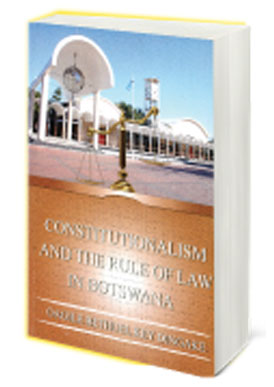
High court judge and one of the respected legal scholars of Botswana, Key Dingake gives a powerful overview of the country’s legal structure. The book gives an extensive insight into the country’s legal system, and could be useful not only to legal scholars, but also to ordinary citizens who come into contact with the law on a daily basis. For those interested in politics, the book gives greater clarity on the legal versions that are available whenever a particular political situation arises.
For example, Dingake reveals that in the event of death, resignation or the cessation of office by the head of state, the constitution stipulates that the vice president assumes the office of the president. While this is a well known clause to many political observers, Dingake gives broader insight, revealing that in the event of a situation where the vice president is absent or incapacitated, “the functions of the vice president shall be performed by a minister chosen by cabinet” (Dingake 2011: 164) Dingake covers such varied topics as ‘The Right to Vote and the Electoral Process,’ analysing the legal. framework covering such issues as franchise and citizenship.
He reveals that if a female citizen married to a foreign national living abroad leaves the country for more than a period of 12 months, she loses her right to vote, even if she chooses to retain Botswana citizenship and does not acquire that of another country. Dingake notes, “In so far as the same does not apply to an adult male citizen in similar circumstances, the effect of the law is to discriminate against female citizens. Such discrimination is open to constitutional challenge on the ground that it violates Section 15 of the constitution, which prohibits discrimination” (Dingake, 2011: 105) In his analysis, Dingake finds fault with the constitutional requirement that a person should be able to speak English in order to qualify as an elected member of the National Assembly. “The requirement was meant to ensure that members are able to participate in the deliberations of the assembly; however it is unduly restrictive. It is regrettable that for a period of more than twenty years after independence the National Assembly did not use Setswana as a medium for discussion,” (Dingake 2011: 116).
Dingake further encourages the use of multi-media and equipment that can perform simultaneous translations to enable those who speak local languages other than Setswana to understand parliamentary deliberations. In his book, Dingake gives comparative analysis of the constitutions of countries such as Canada, Namibia and South Africa, and offers lessons that can be learnt to improve our constitutionalism within a context that suits the Botswana condition. To his credit, Dingake gives the reader a comprehensive analysis of modern Botswana law, having started with a historical background of constitutionalism and the rule of law in Botswana, starting with the pre-colonial and colonial eras.
The book is written in a manner which contains legal jargon, but delivered in a manner that would not alienate those who have not studied law. That the book maintains a scholarly approach but is friendly to the average reader is its strong point. A well written book; a recommended read. ENDS