


Volume 65 December 2026-January 2026 : Feature
Under El Nino swipe
Author : Calviniah Kgautlhe
Article: Calviniah Kgautlhe
Photos: Phenyo Moalosi & Courtesy of Evelyn Dimbungu
Graph: Department of Meteorological Services
Evelyn Dimbungu wakes up to walk around her farm but this morning she nearly faints at the sight of her crops.
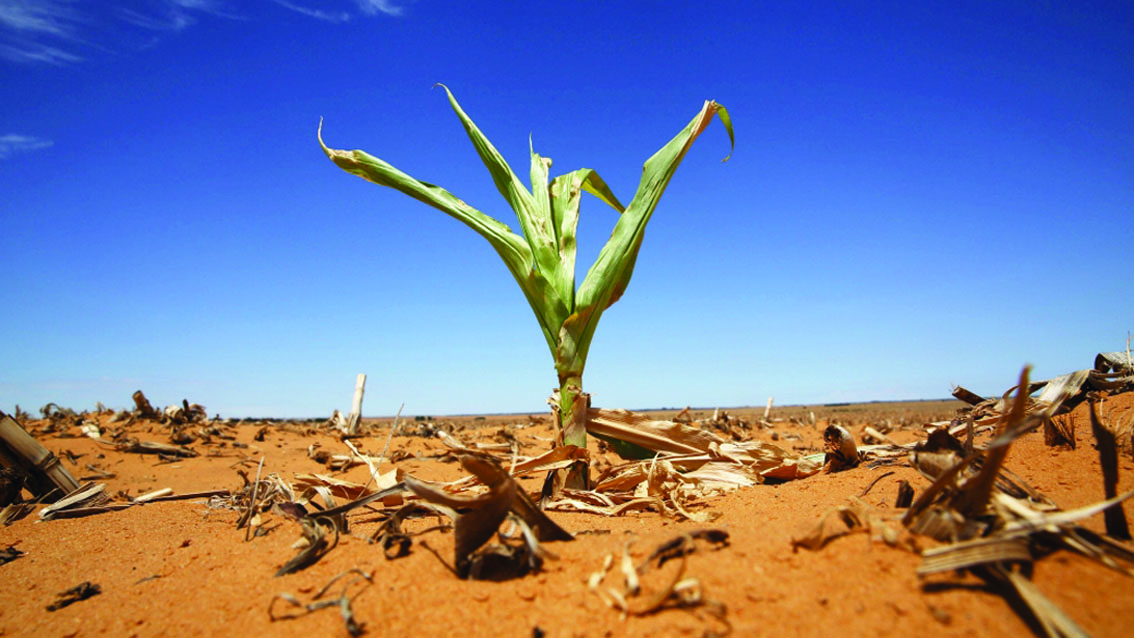
As if she is dreaming, her water melons have all shriveled. Her maize has lost its green luster and its leaves are dull and curled up. Her tomatoes are rotting despite abundant water in the nearby Thamalakane River.
“That fateful morning when I woke up, temperatures the previous day reached 43 degrees Celsius in Maun,” recalls Dimbungu sadly.
Her hopes vanished miserably overnight as there are no watermelons, mealies nor tomatoes to take to the market. “It is a painful disaster and I have since left the farm,” she says.
“The unfortunate part is that when we try to irrigate the crops the water that comes through the drip line is very hot as well, it is really-really tough, I can never forget this year,” she adds.
In the southern part of the country, subsistence farmer, Blom Lekoma who is also chairperson of Southern District Crop Farmers Association, says arable farmers in his region have not done well due to lack of rain and very hot temperatures.“Temo ga e a tsamaya sentle ka kwano, kana mo nakong eno go ka bo go jewa legwetla jaanong ke tlala hela, ba ba neng ba beile tema ga go a tswa le fa e le sepe. Mo go neng go dule go sule, mogote o kgaritlhile,”he says with a sorrowful voice.
For a long time, 2015/2016 recorded very high temperatures. “This is a very hot el Niño year comparable to the el Niño that we experienced in 1997/1998. We have registered very high record breaking temperatures, the highest being 44 degrees Celsius,” says weather scientist Radithupa Radithupa.
El Nino is a Hispanic term meaning a drought year for the fishing industry since high temperatures affect the process by which plankton (food for fish) is formed especially over the central Pacific Ocean where Radithupa says warm temperatures rise when surface waters warm to abnormal temperatures of about 0.5 degrees Celsius.
The weather scientist says in southern Africa, El Nino affects climate in various regions differently. “Here for instance we get dry and warm temperatures but in east Africa they get a wet year of floods,” he adds.
Radithupa says world temperatures continue to rise and polar ice caps melting as a consequence of industrialisation which started in Europe in the 1800s.
“What we are seeing now is the impact of those carbon emissions back then,” says Radithupa.
What causes the Pacific Ocean to warm up?
Radithupa says under normal circumstances trade and westerly winds form a belt across Africa called Intercontinental Convergence Zone. This means there will be an up whaling of the winds which then form clouds and then rain. He says when it is El Niño year, instead of getting westerly winds, we get easterly winds which blow the moist away from the continent.
Thus, in June 2015 President Lt Gen. Dr Seretse Khama Ian Khama would declared Botswana drought stricken following assessment which indicated that there was a significant decline in rainfall distribution coupled with scorching heat wave which resulted in low hectors ploughed.
The yield forecast for year 2014/15 had drastically declined with the national estimated production for cereals standing at 7 382 metric tons (mt) which was three per cent of the national cereal requirement of 300 000mt.
Furthermore, President Khama mentioned in his 2015 State of the Nation (SONA) address that the 2014/15 cropping season resulted in complete crop failure in many areas of Botswana. The total area planted during the 2014/15 ploughing season thus decreased by 28 per cent, while the total number of farmers who took part in arable farming also decreased by 37 per cent.
However, Radithupa assures that all is not lost since they anticipate good rains this year which were expected to begin last month (March) especially in Ngamiland region.
Meanwhile, the rise in global temperatures calls for more political will hence the 2015 United Nations Climate Change Conference otherwise known as the Conference of the Parties (COP 21) which adopted the Paris Agreement, where parties agreed to pursue efforts to limit the temperature increase to 1.5 °C.
Radithupa says noble initiatives such as the use of green technology for developing countries have been agreed upon.
“There are Trade Agreements that say Africa should be developed through new technologies which curb emission of green-house gases. There is need for a fund that will enable Africa to use of such technology,” he adds.