


Volume 54 Issue 10- October 2016 : Business
Tshele Hill Bulk Strategic Fuel Storage Depot
Author : Kwapeng Modikwe
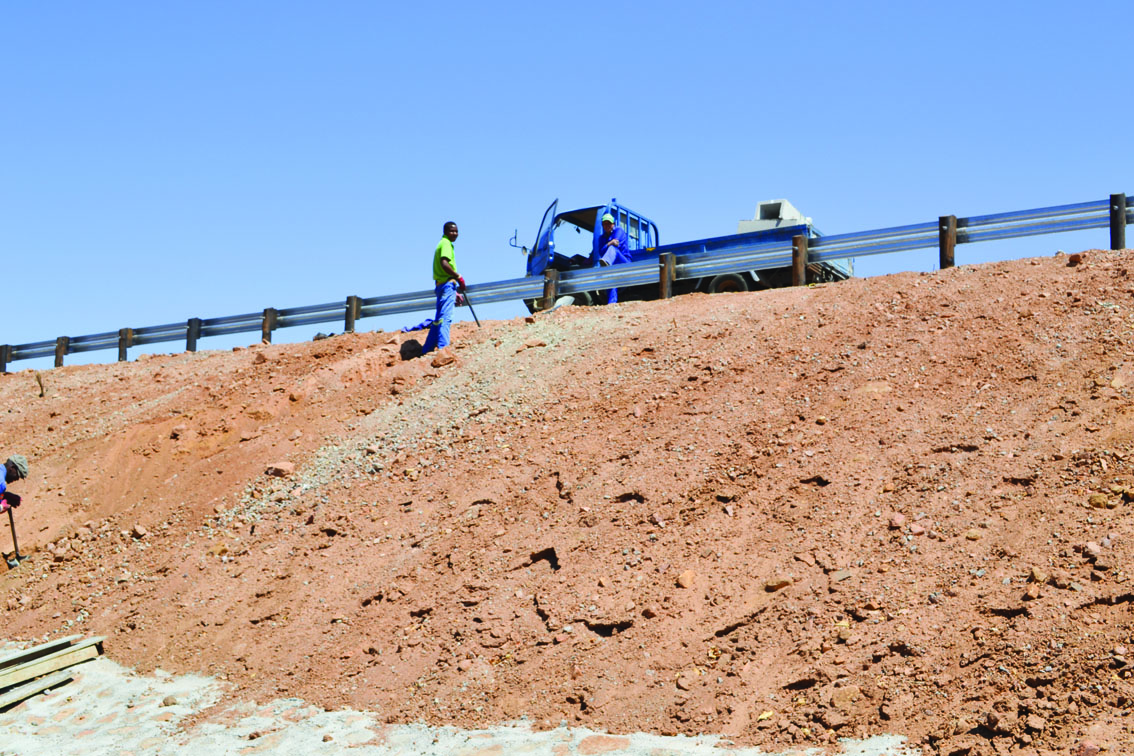
Less than ten kilometres west of Rasesa Village kgotla in the Kgatleng District, along the Letsweletau Road on a flood prone terrain during heavy rains, a cloud of dust covers the sky as dozens of tip-ton trucks, some recklessly make several daily trips on the road due to the on-going excavation and soil compacting work for the construction of the country`s largest and most expensive project in terms of oil storage. It is a project expected to be completed by December 2018. It is a project long thought of and whose design work started in the nineties. It is a project with two components, rail and road.
This is the Tshele Hill Bulk Strategic Fuel Storage Depot. Talked about in the board-rooms and political rallies for many years, it has finally got-off the ground.
It comes at a time when people in the area had begun dismissing mention of it as political gimmick. Now it is real.
It is a billion Pula project expected to cost about P1.8 billion. Upon its completion, the facility will store 161 litres of petrol and diesel. To feel the tanks with both petrol and diesel, the cost will be P1.6 billion.
The costs do not end there. There are other projects associated with the facility. Firstly, P3million was paid compensating 100 property owners who had to give way to the project.
There are many people behind the success of the project. However, Principal Energy Engineer, Mr Baruti Regoeng, Assistant Project Manager, Mr Tlhabane Linchwe, Energy Engineer, Mr Kabo Moruakgomo and the Public relations officer at the Department of Energy are in the driving seat. You see display of team-work when interviewing them.
One would answer but in case of doubt, the question would be referred to another. They admit that this is a massive project ever taken by the department in terms of oil storage.
It is the first of its magnitude in the Kgatleng District since the 2009 economic recession which stalled several projects country-wide.
Currently there are storage facilities in Gaborone and Francistown enough to store 62.5 million litres of petrol and diesel. In the event there being no supply from suppliers outside the country, this will last for 18 days only and the country will be dry.
So Tshele Hill facility is being developed to guard against that eventuality.
A lot of spade work was involved before Tshele Hill was chosen as the site for this project. Areas such as Mmakanke in the Kweneng District, Lose near Mahalapye and Thamaga were examined to determine their viability.
Also being looked at, was to determine the pattern of consumption of fuel in Botswana and it was found that the Southern part consumes much.
The place needed a high level of security against possible attacks by the enemy so there was no doubt that Tshele Hill met all those requirements.
The hill itself forms and strengthens the security of the facility. Also in the vicinity is a BDF camp who now shares the use of the Tshele Hill with the Department of Energy.
Other factors which worked in the favour of Tshele Hill are its proximity to general services such as rail, road and water.
It would have been too expensive to have built it at Thamaga or Mmakanke which are far away from the utilities.
Initially, the project was to be an underground facility on solid rocks. But after several review works, it was decided that Tshele Hill was both in terms of geology and hydrology it would still do better with the above surface facility.
Mr Regoeng said planners considered risks that could arise due to natural disasters such as earth tremor and decided that “let`s built the facility that we are used to”.
The Tshell Hill depot will comprise of storage tank farm, rail off-loading and loading, road loading and off-loading, facility for future pipeline supply terminal, administration offices, a large fire fighting facility and nine staff houses.
Local contractors and individuals have benefited immensely from the project.
For instance, excavation and compacting work was awarded to a local construction company which 100 percent citizen owned, roads services is 100 percent citizen owned as well as housing and building, says Mr Regoeng.
Concerning work package which involves tanks, mechanical and electrical, the services have been awarded an international contractor.
Labour has strictly been sourced from residents in the vicinity of the area.
This means that the projected has created employment opportunities to residents of Rasesa, Morwa, Pilane and Mochudi.
The access road linking Tshele Hill with the A1 road has been completed after 18 months of construction work.
It cost P130 million. This is where everybody who passes by will admire the hard time thinking that was involved in designing the road.
What catches the eye is provision for donkey cart passages, specially designed and beautifully painted.
Realising that the place was populated by donkey carts, planners found it necessary to provide donkey cart rails which will also be convenient for use by pedestrians crossing the A1 Highway.
Donkey carts will also be subjected to traffic lights control due to be installed. They will also be expected to drive on the right side of the road.
This was done for the safety of all. Mr Regoeng says the construction of the Tshele Hill project, has also necessitated expansion of the A1 high by two kilometres from the Razes/A1 road junction to deal with the heavy volume of traffic expected at the crossing point.
What is not in the project plan but may end up be done is the tarring of the remaining portion of the Rasesa/Lentsweletau Road.
That road is tarred from Lentsweletau up to Kgope and between Rasesa and Kgope. The remaining portion is gravel.
A year ago, President Lt.General Dr Ian Khama Seretse Khama promised the people of Rasesa during a kgotla meeting that should something remain from the funds being used in the development of Tshele Hill project; the remaining portion of the road will be tarred.
Speaking through the then District Commissioner for Mochudi, Ms Wame Samapipi, the president said it was proper that the road should not be left incomplete. The Rasesa/Lentsweletau Road is economically important for Kgatleng and Lentsweletau in man.
The nearest hospital to Lentsweletau is the Deborah Retief Memorial in Mochudi, nearest Mortuaries to that village is at Pilane, nearest shopping centres at Pialne and Mochudi and nearest feeling stations are at Pilane.
If the remaining portion of that road is tarred, people will prefer using it when going to Molepolole or Kang.
Construction of the other component, the rail line, started with the overhead bridge across the A1 Highway between Rasesa and Malotwana villages.
The railway line will be a 14 kilometre long track connecting from Malotwana to the storage facility at Tshele Hill.
The cost of this access rail facility is in the region of P230 million. Construction started last month and will last until February 2018.
In designing the rail project, architects did not limit their thinking only to the Tshele Hill development.
They extended their scope to the days when construction of the envisaged 1,000 kilometre long or so Transkgalagadi Railway Line starts, by making it possible for a two line rail track beginning at the overhead bridge.