


Volume 50 Issue 5 - May 2012 : Sports
The Ferguson brothers
Author : Kwapeng Modikwe
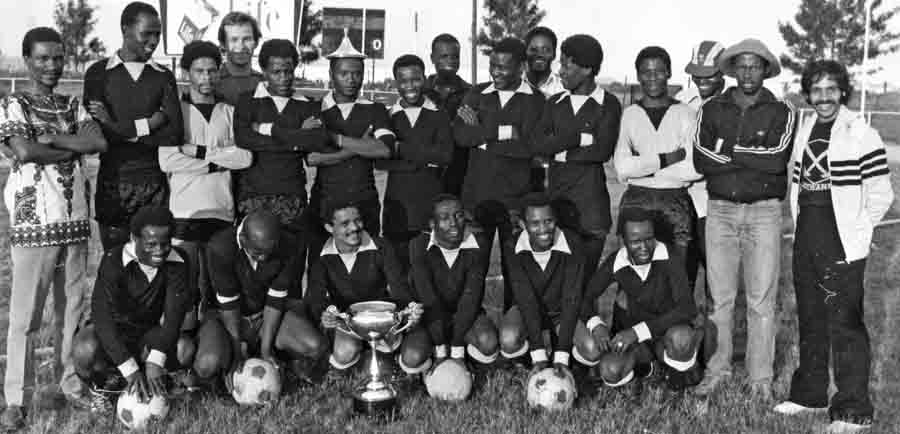
Whenever and wherever the name Ferguson is mentioned, football fans may automatically think of Sir Alex Ferguson, Manchester United boss - one of the dominant football clubs in the English Premier Soccer League.
Sir Alex is the famous coach who was knighted after his team became the first ever to win a treble during the 1998/99 English football season. Likewise, to a farming community, the name Ferguson may invoke memories of Massey Ferguson, a tractor that is rated for its high performance, resilience, and reliability in ploughing circles. Yet to the viewers of SABC soaps, Generations and Scandal, the name could conjure up pictures of the famous actress Connie Ferguson and her husband, Shona.
In fact, the name can mean different things to different people depending on their background of course. To come to the point before the reader is thrown into unnecessary speculation, Sir Alex reminds one of the Ferguson brothers of Mochudi village in Botswana who, like the English coach, are football legends.
Although it may sound improbable, Sir Alex could have relatives he has never heard of in Botswana. Coincidently, the Botswana Fergusons have roots in Scotland, just like the legendary Sir Alex. In any case, that the Mochudi Fergusons and Sir Alex could be relatives is beside the point. However, one thing for certain is that they all have one thing in common; they are all football legends.
They all played, coached, and managed football teams, though in different contexts. For instance, Sir Alex played football in Scotland where his football coaching career started before moving to England’s famous Manchester United as manager.
It was around 1900 when a man called Douglas Ferguson migrated to Botswana from Scotland, where he had been a prisoner of war. This was the time during which Europe was characterised by wars and therefore unsafe to live in.
Records show that, after settling in Mochudi, Douglas joined the Vickerman family, who were the owners of the then popular Bakgatla Store, now Maxi Safe situated in the centre of the village.Douglas, who was born in 1875 - the year the Bakgatla tribe arrived in Mochudi from South Africa, died in 1925 and was buried at the Village cemetery in Gaborone. Incidentally, the British soldiers who were killed during the Anglo-Boer War were also buried at the Village cemetery. While no one in the remaining Ferguson family remembers the year the old man fled Scotland, they believe that he fought in one of the European wars that preceded World War I.
By the time World War I broke out, Douglas had long settled in Mochudi and was already married to Mmasebaga Moreriwa whose parents had settled in Mochudi from Mookane village in the central district. That marriage produced two sons and a daughter; Harry, William, and Sina; In turn, the three siblings produced a set of very enterprising footballers the country had ever seen.
The elder, Andrew Ferguson started football at the age of 13 while attending school at St Theresa in Lobatse. After completing primary education, he went to St Joseph’s at Kgale where he captained the school team until he completed secondary education.
Andrew remembers the Dube Hostel in terms of the likes of Ponatshego “Haleluja” Kedikilwe, Lekoko Leburu, and Father Leonard Devitt, as some of his teammates at the college. Father Leonard was a penalty specialist while Andrew, nicknamed “Silver bullet” was a corner kick specialist. It was at Kgale that Andrew earned himself the nickname “Silver bullet” because, like the Massey Ferguson tractor, he was a top performer and a reliable striker.
When he left school, he played for a PWD soccer team under the mentorship of Van Vureen. Later he moved to Mafikeng where he palyed for the local Naughty Boys which he later captained. At the peak of his sporting career, Andrew joined Notwane Footbal Club in Botswana, the team he also later captained, coached as well as managed. His memorable game as manager is the 1974 nine-goal thriller which ended with Notwane beating town rivals, Township Rollers 5-4 in the Trade Fair Cup final at Rollers the National Stadium in Gaborone. Notwane were in the jaws of defeat when they produced the most amazing comeback of all time to score five goals in 15 minutes after they were down by four goals.
That squad included the likes of the Moffat brothers, Boyce and Temba, Rrennyane “Bomber” Dikole, Willie Dennison, Ratha Gareebine, Sam Makgalemele, Sylvester Smurts, Super Dinala and Israel “Tinto” Mogobe. Former cabinet minister and Member of Parliament, Archibald Mogwe was the club’s President. Nowadays several teams call themselves “Ezimnyama” or “Mafourteen” and this offends “Silver bullet” because he says everybody knows that such nicknames, including ‘Toronto’ belong to Notwane.
Likewise, he says some people think his team was named after the Notwane River that passes through the City of Gaborone when in fact the name means a hammer. While at Notwane Silver Bullet’s brother, Steven Ferguson was a striker at the then Mighty Terrors of Lobatse where he partnered with George Motshelanoka.
At that time, Terrors were the most successful team in Lobatse, having lined up with Maletamotse, Gaborone United, Township Rollers, Queen’s Happy Hearts, Mochudi Rovers, and Queen’s Park Rangers to form the Super League under the presidency of Ray Molomo in 1967.
Steve later joined Gaborone United. However, because of age, he only qualified to play for the team‘s reserve side, Murder. Three other members of the Ferguson brothers, Albert “Mashibiliki” Ferguson, Johannes Ferguson, and Geoffrey Ferguson chose to play for Mochudi Rovers.
“Mashibiliki” later moved to GU who had been vying for his signature. There he continued tormenting opposition defenders mercilessly. His dribbling, trapping, passing and shooting skills were marvelous. He was envied by everybody, in fact ‘Mashibiliki,’ who also played for Matshwane (a select team of secondary school players), was a complete player.
Comparatively, nobody among the present day Bakgatla footballers has arrived where Mashibiliki was during his time. If there was to be an award for the best player ever produced by Mochudi, it would certainly be scooped by “Mashibiliki” even if it meant doing it posthumously.
His move from Mochudi Rovers to Gaborone United caused controversy in the running of football in Botswana. That controversy was one of the factors which resulted with all super league teams except Township Rollers breaking away from the Botswana Football Association to form what came to be known as the Koporasi in 1972.
When it became clear that there was no hope of reconciliation between the Koporasi and the Botswana Football Association, President Sir Seretse Khama appointed a commission of enquiry into football in Botswana. Unsurprisingly, "Mashibiliki's" name features in the commission report.The sensational player had been registered by GU although he had not cleared from his former club, Mochudi Rovers.
Things fell apart when GU heroically beat Notwane in the Champion of Champion’s Cup. Notwane protested the inclusion of “Mashibiliki” in the GU team following which the cup was awarded to Notwane while “Mashibiliki” was suspended for playing for two teams in league games.
Paul Ferguson, though not a good player, played for the then Swallows football club of Mochudi. Also at Rovers was Macpheson “Bra Maputra”Ferguson who was both a player and manager.
“Bra Maputra” is a former Zebras player. He was in the first Zebras squad which was hammered 15-3 by Moroka Swallows when the country gained independence in 1966. He was so good that when Ray Molomo was headmaster at Lobatse Teachers Training College, he offered him a space to study at the college.
He declined the offer preferring to remain committed to playing for Rovers. At Rovers they also called him “Girls are willing” for obvious reasons. He had a short spell at Notwane having been recruited to the team by his brother. He later returned to Rovers where he completed his playing career by managing the team.
These Ferguson brothers had their nephews who were equally good. One of them was Sebataladi “Pile of rubbish” Pule. Pule made his name while at Moeding College where he was a regular for the school team.
While there, he and school-mate Sekopo “Topito” Tladi, were recruited by Township Rollers where they formed a terrifying partnership. His younger brother, Supang “Dollars” Palai was a regular at Molefhi Secondary School and Mochudi Big XV.
The other younger brother, Job “Jomo” Palai followed on Sebataladi’s footsteps by playing for Township Rollers as well. The brothers and nephews could actually form a strong team of theirs and win competitions. Surprisingly, all these football legends do not have children who play football.
For them, there is nothing such as like- father-like-son because their off springs are completely uninterested in playing football. They are the opposite of their parents. For instance, two of Andrew Ferguson’s children play softball. “Bra Maputra’s children are not interested in sports at all.
The same applies for Paul and Sebataladi’s children. Peter’s son, Shona and his wife Connie are television actors. He has never shown interest in playing football.