


Kutlwano : Art & Culture
Botswana need for a Constitutional Court
Author : Pako Lebanna
As Botswana turns 60 years of independence this year, across the nation a debate continues on the need for the establishment of a Constitutional Court, with varying viewpoints being expressed.
A constitutional court is set up as the highest court in a country, serving the purpose of dealing exclusively with constitutional matters; handling cases that raise questions about the application and interpretation of the constitution.
Around 85 countries worldwide, including 13 African states have the Constitutional Court.
These include South Africa, the Democratic Republic of Congo (DRC), Zambia and Zimbabwe in the Southern African Development Community (SADC) region.
Botswana came into existence after an exhaustive process of various legal frameworks enacted over differing periods of time leading to the 1966 constitution.
An Order in Council enacted by the British Parliament on May 9, 1891 established the legal basis for British authority over Bechuanaland Protectorate.
It empowered the British High Commissioner to the Cape Colony (thereafter the Union of South Africa after its creation in 1910) to act on behalf of the British crown, exercising jurisdiction, legislating by proclamation and appointing administrative officers (district commissioners) in Bechuanaland.
Another Bechuanaland Protectorate Constitution Order in Council of 1960 established an Executive and Legislative Council, which advanced the territory towards self-government.
The 1963 Lobatse Constitutional Conference, featured 20 delegates, among them the then Seretse Khama, Quett Ketumile Masire and Moutlakgola Nwako of the Botswana Democratic Party (BDP), Philip Matante, Kgalemang Motsete and Thari Motlhagodi of the Botswana Peoples Party (BPP), Motsamai Mpho joined by two other delegates of the BPP faction that later formed the Botswana Independence Party (BIP).
Three Paramount Chiefs, being Kgosi Bathoen II of the Bangwaketse, Kgosi Mokgosi III of the Balete and Kgosi Linchwe II of the Bakgatla were also present, as were six white representatives led by Resident Commissioner Peter Fawcus and AC Chand, of Asian descent.
The Lobatse Constitutional Conference produced a constitution that paved the way for self-government in 1965, proposing that the Legislative Council be replaced by a National Assembly of 32 Members of Parliament (MPs) elected through universal franchise and four specially elected MPs.
This Parliament would elect a Prime Minister who would be the head of government, while the British crown remained the head of state.
This provided the legal basis for the March 1, 1965 general elections, which ushered in a nominally self-governing period (1965-66) led by Prime Minister Khama, whose government worked towards creating a constitution and selecting national symbols; a flag, anthem and coat of arms for an independent Republic of Botswana.
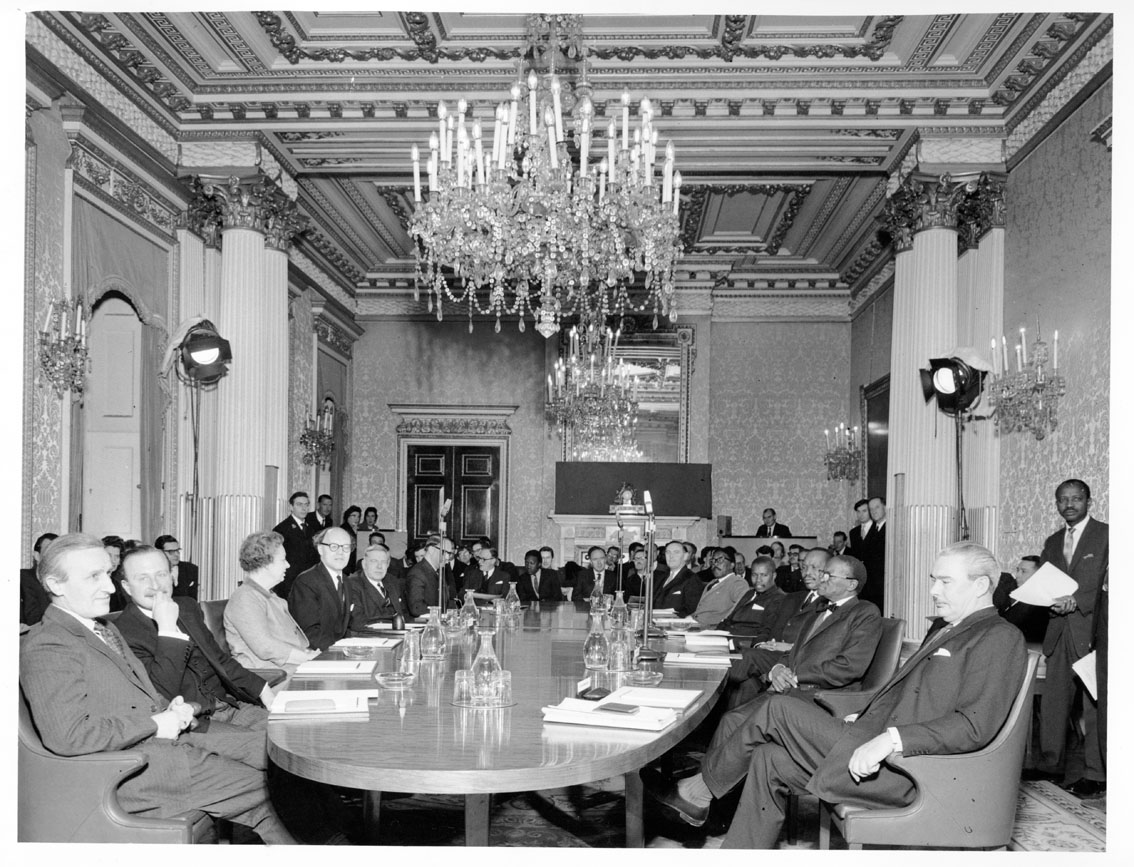
The Constitutional Talks took place in February 1966 at Marlborough House, London, with Prime Minister Khama, Deputy Prime Minister Masire, Leader of the Opposition Phillip Matante and royal representative Kgosi Bathoen II joining British authorities in deliberating on a constitution for the independent republic.
Botswana constitution is divided into nine chapters, the first, The Republic, declaring Botswana as a sovereign state and defining the public seal; the second chapter, a Bill of Rights titled “Protection of the Fundamental Rights and Freedoms of the Individual” covers Section 3 to 19 and confers personal liberties.
Among the rights accorded to each resident of Botswana is the right to life, personal liberty, protection from slavery and forced labour and from inhuman treatment (torture, degrading punishment), protection for privacy, freedom of conscience, expression, association.
Section 15 (3) offers protection from discrimination on the base of race, tribe, place of origin, political opinions, colour, creed or sex.
Other chapters deal with Citizenship, The Executive, Parliament, The Judicature, Public Service, Finance and Miscellaneous (resignations from public office, appointments and the interpretation of terms contained in the constitution).
A Botswana Independence Act of 1966 was passed by the British Parliament declaring that “on 30th September 1966 the territory, which immediately before that day constitutes the Bechuanaland Protectorate shall cease to be a protectorate and shall become an independent republic under the name of Botswana and on and after that day, Her Majesty shall have no jurisdiction over that territory.”
After independence, situations have arisen where constitutional matters have been presented before courts of law.
In the Citizenship Case, (Attorney General versus Unity Dow), the applicant, the then Unity Dow, a citizen of Botswana married to an American challenged the Citizenship Act of 1984, which stated that a person born in Botswana would be a citizen if their father was a Motswana, or if born out of wedlock, their mother was a Motswana.
This excluded Dow’s children who were born in the country, since their father was a foreigner, depriving them of citizenship.
Dow’s counsel had relied on Chapter II of the constitution to argue that the Citizenship Act was depriving her children of their constitutional rights.
Justice Martin Horwitz in his High Court ruling on the case, delivered on June 11, 1991 ruled in favour of Dow, stating that “Sections 4 and 5 of the Citizenship Act Cap 01:01 are declared ultra vires the Constitution of Botswana.”
Another case of citizenship involved John Modise, whose father was a Motswana who went to work in South Africa.
There, he married a South African woman and John Modise was born out of that union. He thus claimed Botswana citizenship by descent.
But on October 17, 1978, he was arrested and deported to South Africa, and was declared a prohibited immigrant on his third attempt to return to the country thereafter.
He then lived in the nominally independent homeland of Bophuthatswana for seven years before being deported there as well and proceeded to live in the no man’s land between Botswana and Bophuthatswana.
Modise was later readmitted to Botswana in 1995 on temporary humanitarian grounds.
The John K Modise versus Botswana case became a landmark human rights case where the African Commission on Human and People’s Rights ruled that Botswana had violated Modise’s rights by deporting him four times despite his claim to citizenship by descent.
The Commission found that Modise’s constitutional rights to freedom of movement, liberty and the rights of his family had been violated by the state, urging Botswana to recognise his citizenship and compensate him.
It is such cases that in other jurisdictions have prompted the enacting of a Constitutional Court as a statutory body that deals with constitutional law, to ensure that laws do not conflict with constitutionally established rules, rights and freedoms.
In debating at the National Assembly early December 2025, President Advocate Duma Boko stated that the establishment of a Constitutional Court would be an important step towards strengthening the judicial process and clearly delineate a legal route where constitutional matters are handled with urgency, consistency and authority. ENDS