


Vol 66 April-June 2026 : Social
Nation bids farewell to MOGAE
Author : Pako Lebanna
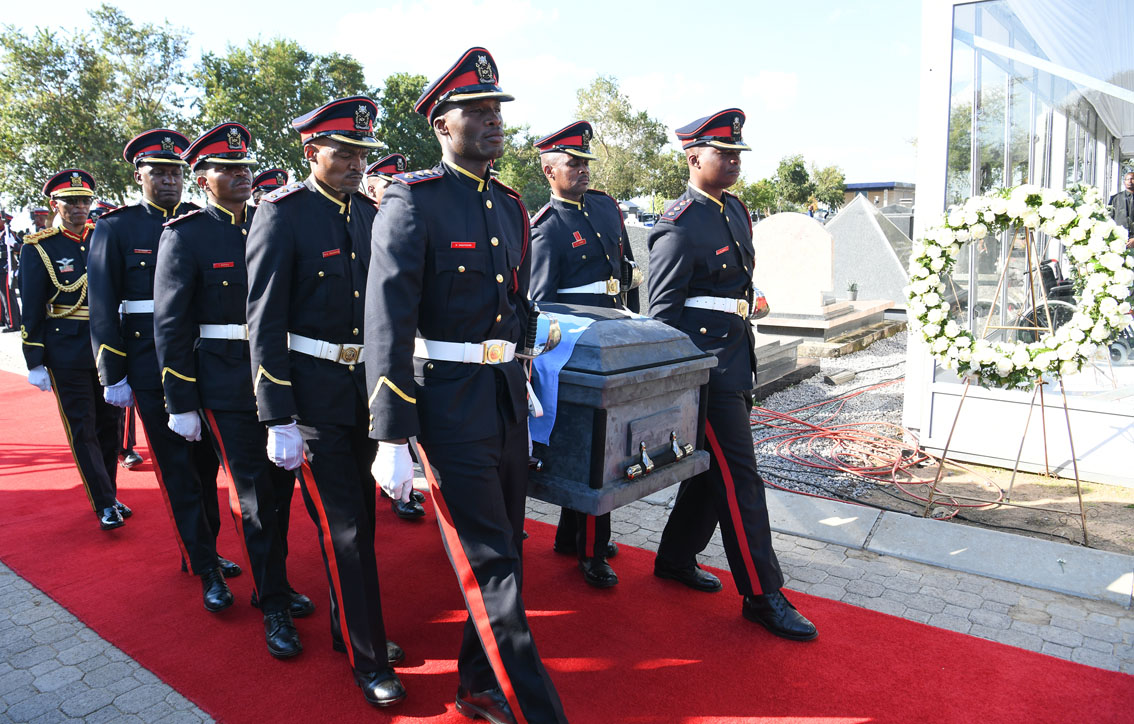
As Festus Gontebanye Mogae’s mortal remains were interred with full military honours at the Phomolong Memorial Park, the Botswana Defence Force (BDF) brass band serenaded mourners with the tune of hymn 444 of the United Congregational Church of Southern Africa (UCCSA) Setswana hymnal…
Robala jaaka ngwana yo mmonye;
Me ga o nka o tsoga o lela;
Boikhutso jwa ‘go bo itekantse;
O robale sentle.
A nation stood united in grief and in bidding farewell to the third president of the republic, a man who was one of the architects of the country’s macroeconomic and political stability.
Rising to the podium at the official State Funeral held at the University of Botswana (UB) Indoor Sports Arena, President Advocate Duma Boko cited Joseph Conrad’s 1899 novella “Heart of Darkness” in his eulogy to Mogae.
“He will not be forgotten. Whatever he was, he was not common.”
Delivering a stirring tribute before an attentive audience and a nation listening attentively on national radio, television and the online platform of our sister publication the Botswana Daily News, President Boko said Mogae came from humble beginnings and rose to be above the ordinary.
“A gentleman of the Oxbridge mould,” Advocate Boko said of Mogae, using the portmanteau (blend of words) that fuses the names of the United Kingdom’s two oldest and most prestigious institutions of higher learning- Cambridge University and Mogae’s alma matter Oxford- a term used to describe a scholarly climate, or an educated, sophisticated person or one of social privilege.
“Educated but neither snobbish. Down to earth and humble to a fault. His self-effacing humility seemed to render him unaware of his clout and gravitas. A leader of compelling authenticity. He was not common,” President Boko said.
President Boko noted that the country’s founding Vice President and Minister of Finance and Development Planning, Sir Ketumile Masire, was “drawn” to Mogae.
Former President and now late Masire appointed Mogae to senior positions at the Ministry of Finance, as Governor of the Bank of Botswana, Minister of Finance, Vice President, before ultimately making way for his protégé at the Office of the President.
He would lead Botswana in a battle against HIV/AIDS, ensured the country maintained solid macroeconomic fundamentals, with a stable balance of payments, minimal debt and savings in foreign exchange reserves.
In addition to ensuring a stable economy, Mogae believed in democracy, in ensuring a plurality of viewpoints flourished within society, President Boko said.
“He understood that democracy grew not in lockstep agreement, but in the rowdy, rebellious tug of war taking place in public discourse. In all these and more, he energised our democracy,” the President said.
Mogae’s successor at the State House, former President Dr Lt Gen Seretse Kham Ian Khama, now known as Kgosi Khama IV, who served as Vice President throughout Mogae’s 10-year tenure as President (1998-2008) said his predecessor invested in the country’s physical infrastructure during his term of office.
Khama cited eight major road projects that were either completed, developed or commissioned then; 130 villages being connected to the national electric grid and the water security improved through the construction of the Letsibogo and Ntimbale dams as well as the 400 km North-South Water Carrier pipeline.
Aviation was enhanced through the expansion of the Sir Seretse Khama International Airport and upgrade of the Maun and Kasane airports to international status.
The national television station, Btv, the second national university, Botswana International University of Science and Technology (BIUST) were the other essential projects under Dr Mogae’s leadership, Dr Lt Gen Khama stated.
He described Mogae as a fair leader who chose fairness and unity over dominance and strongly believed in democracy and human rights.
The fifth President of the Republic, Dr Mokgweetsi Masisi said “Rre Mogae led with quiet strength and moral clarity, leaving an enduring imprint on the nation he served with distinction-a life defined by humility, integrity and devoted public service.”
His legacy resides not only in the progress Botswana achieved under his stewardship, but in the values of discipline, compassion and principled leadership he exemplified.
Delivering a speech both in English and his native Sesotho-a language that shares historic origin, vocabulary and grammatical structure with Setswana, while evolving separate dialectal variations- former Lesotho Prime Minister Phakalitha Mosisili praised Mogae as a regional leader of note.
He reminded the audience that Mogae played a role in helping preserved peace and stability in Lesotho during the 1998 post-electoral violence there, and had worked through the Southern African Development Community (SADC) to promote democratic outcomes.
Former Tanzania President Jakaya Kikwete honoured Mogae as a principled statesman respected across the African continent, who promoted democracy, peace and political stability and successfully advanced the legacies of Botswana’s founding presidents, Seretse Khama and Ketumile Masire.
The ceremonial pomp and circumstance moved between Gaborone and Serowe, where Mogae was born on 21 August 1939, with the public lining up the major roads to see Mogae’s body filing past.
A nation mourned. A nation celebrated a life. Those who held the national symbol in their hands and hoisted at half-mast in official flagpoles waved the blue, black and white flag.
The nation stood united, from across the political, social and cultural divide. United behind the legacy of a man who gave his all for his nation.
As the casket dropped at Phomolong, they waved him goodbye, and sung the Christian hope of hymn 444…
Bosigo jwa loso bo tla heta
Letsatsi la tsogo le tla tlhaba
Baswi mo go Jesu ba tlaa raana.
“O dumele tsala.”