


Vol 66 Issue 26 October-December 2026 : Others
A LEGACY ETCHED IN STONE: Honouring the Kengalogile Family Gift to many
Author : Esther Mmolai
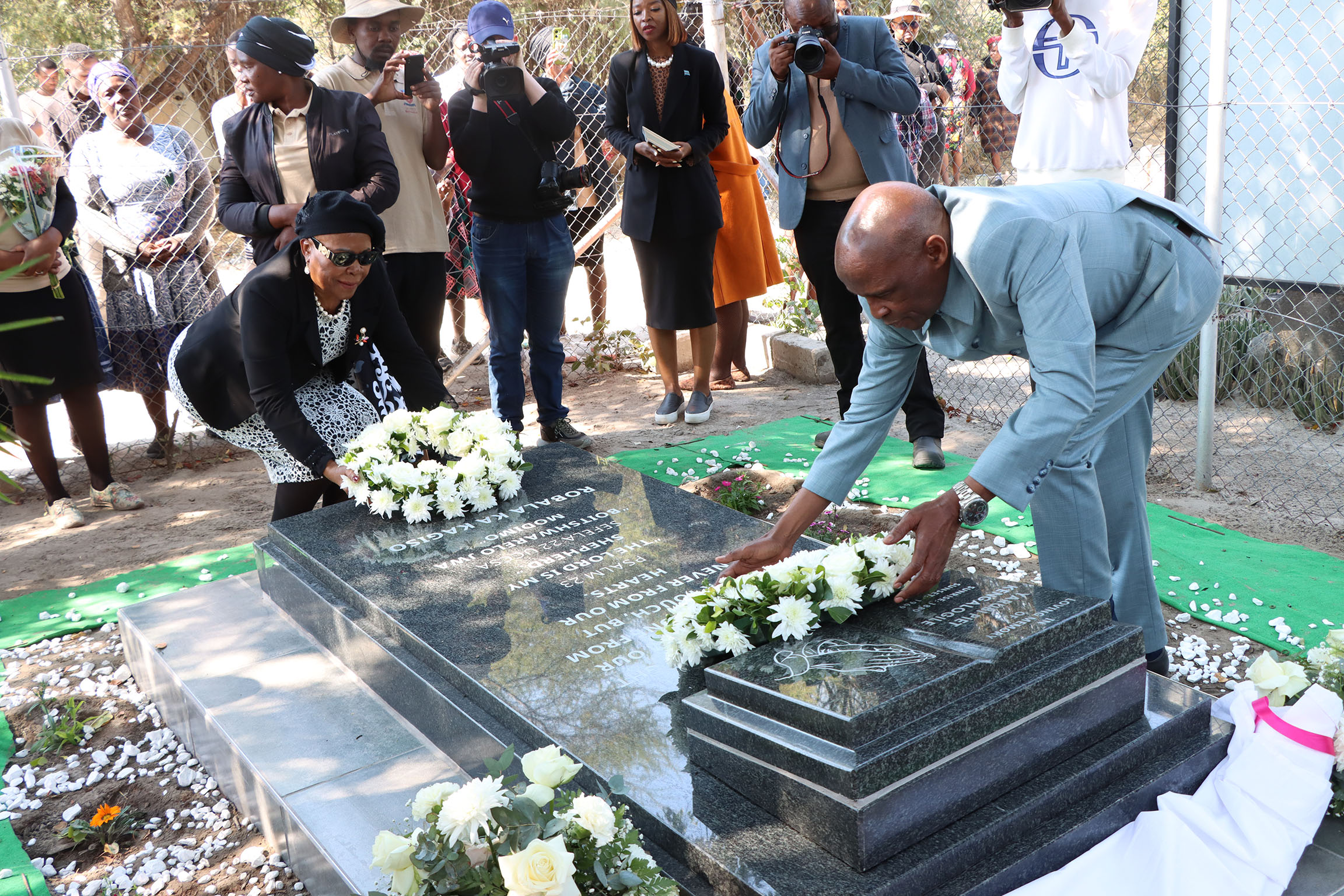
The unveiling of the Kengalogile family tombstone was a solemn and meaningful occasion that brought together family, friends, community members and the University of Botswana (UB) to honour a legacy of generosity, sacrifice and nation-building.
Beyond marking the lives of the late Mr Piet Rakeeku Kengalogile and Mrs Yarubi Piet Kengalogile, the ceremony celebrated their enduring contribution to Botswana’s knowledge landscape through their selfless decision to donate land for the establishment of the UB Okavango Research Institute (ORI).
The occasion served as a reminder that the growth and success of national institutions were often shaped by the generosity and commitment of individuals who see beyond themselves.
The Kengalogile family’s contribution reflected the same spirit of collective responsibility that inspired the Motho le Motho Kgomo campaign, a historic national effort through which, Batswana united to support the establishment of UB.
Their gesture demonstrated how individual acts of giving could become part of a much larger legacy of nation-building.
As the university paid tribute to the Kengalogile family, the unveiling became more than a moment of remembrance.
It was a celebration of a gift that continued to benefit generations. The land they donated provided the foundation for ORI, a globally recognised research institution advancing scientific understanding of the Okavango Delta and contributing to Botswana’s environmental sustainability. Their story stands as a powerful demonstration that true legacies were not only preserved in memory but in the lives transformed by acts of generosity.
Reflecting on the Kengalogile family’s profound sacrifice, Kgosi Tapoloso Mosika appreciated that their legacy has become permanently woven into the history of Botswana’s greatest institutions of research and learning.
As Batawana, he said they had always understood that land was more than property; it was an inheritance from those who came before them and a sacred trust to those who would come after.
“Our forefathers taught us land carries our history, our identity, our customs and our future. It is where our ancestors rest, where our children are raised and livelihoods are sustained and that is why today’s ceremony is deeply meaningful to our people. It reminds us that development should never erase history but rather honour it,” he said.
He also acknowledged that over the years, ORI has become a source of immense pride for Ngamiland as it has attracted scholars from across Botswana, Africa and the world to study the delta, deepen understanding of its unique ecosystems and generate knowledge that supported conservation, sustainable livelihoods and informed policy making.
Kgosi Mosika appreciated the university management for remembering the Kengalogile family and for recognising the importance of preserving their heritage while advancing scientific excellence. Kgosi Mosika also stated that Okavango delta is the lifeblood of Ngamiland and for generations, it has sustained communities through fishing, flood recession farming, livestock production, tourism and the rich biodiversity that has made their region one of the natural wonders of the world.
“When the Kengalogile family make an extraordinary sacrifice giving part of their inheritance, they were investing in knowledge that would benefit not only Ngamiland but the whole of Botswana and indeed the world. Such generosity reflects the values of Botho, selflessness, compassion and service to the common good that have always defined our communities,” he added.
Minister of Higher Education, Mr Prince Maele appreciated that it was more than the unveiling of two tombstones but about celebrating two remarkable individuals whose vision and selflessness continued to benefit Botswana many years after they departed this world.
He acknowledged that around the world, many of the world’s greatest universities owe part of their success to the generosity of ordinary citizens who believed that education was the most enduring investment they could make.
The family’s generosity, he said echoed one of the defining moments in Botswana’s own history recalling that following independence, Batswana responded to the historic ‘Motho le Motho Kgomo’ campaign by donating cattle and making personal sacrifices to establish this country’s first national university. He said it was a remarkable demonstration of collective patriotism founded on the belief that education would become Botswana’s greatest natural resource.
Reflecting on why ORI came into existence, its director, Dr Casper Bonyongo revealed that origins could be traced to a defining period in Botswana’s environmental history during the late 1980s and early 1990s. He said more than three decades ago, Botswana faced one of the most consequential environmental decisions in its history and at the time, the government was exploring opportunities to utilise the waters of the Okavango Delta to support national economic development.
Dr Bonyongo said the government sought ways of strengthening national water security while supporting economic development.
He noted that among the options considered was the proposed dredging of the Lower Boro Channel to increase water flows towards the Boteti River system and ultimately improve supplies to Mopipi Dam and the Orapa mining operations.
The proposal that generated the national controversy was formally advanced in 1989 as part of the Southern Okavango Integrated Water Development Project (SOIWDP).
Dr Bonyongo said the project was recommended in a feasibility study prepared by Snowy Mountains Engineering Consultants (SMEC) for the then Botswana’s Department of Water Affairs.
While the proposal was intended to support strategic national development, Dr Bonyongo narrated that the proposal sparked vigorous national debate as communities worried about their livelihoods, conservationists feared irreversible ecological damage, scientists called for evidence while policymakers searched for solutions.
Community leaders, led by veteran politician, the late Mr Motsamai Mpho, together with local and international conservation organisations, he said, strongly opposed the proposal while international advocacy groups, including Greenpeace, publicly expressed concerns regarding the potential ecological consequences of altering the hydrology of one of the world’s largest inland wetlands.
Dr Bonyongo said at one stage, implementation appeared imminent, with heavy machinery already mobilised to the project site. However, following extensive public opposition, the government suspended the proposed dredging project and the debate surrounding the proposal exposed a critical national challenge.
Dr Bonyongo, who was one of the veterans that championed the idea stated that the absence of rigorous scientific knowledge highlighted the urgent need for a permanent research institution dedicated to understanding the Okavango Delta and providing independent scientific evidence to support national decision-making.
Recognising this knowledge gap, the government directed the UB to establish a specialised research centre in Maun to generate the scientific information necessary for evidence-based environmental management and policy formulation.In response, he said the university established the Okavango Research Centre in 1994 and over the years, the centre expanded significantly in scope, capacity and international reputation, eventually evolving into today’s Okavango Research Institute, internationally recognised as a leading centre for wetland research, environmental science and sustainable natural resource management.
Following its establishment, the Okavango Research Centre initially operated from the university’s field station within the Maun Educational Park.
Dr Bonyongo said the university was subsequently allocated approximately four hectares of land next to the Botswana Wildlife Training Centre by the Tawana Land Board for future expansion. However, during a visit to the Institute in the late 1990s, the then Deputy Vice Chancellor (Academic Affairs), Professor Thabo Fako, was presented with the Institute’s long-term vision by the then Director of the Okavango Research Centre, Professor Johan Ramberg.
According to Dr Bonyongo, Prof Ramberg outlined an ambitious vision of developing a fully multidisciplinary research institute capable of serving Botswana, the Okavango Basin and the wider region through internationally recognised research and postgraduate training.
Professor Fako immediately recognised that the four-hectare site would be inadequate to accommodate such a vision. He therefore instructed Professor Ramberg to identify a substantially larger parcel of land capable of supporting the institute’s long-term growth. Subsequently, he engaged traditional and community leaders throughout Ngamiland in search of suitable land.
Among the most influential individuals was veteran community leader and former Member of Parliament, Mr Mpho, who immediately embraced the vision of establishing a world-class research institute in Maun. Following extensive consultations, Mr Mpho identified a suitable parcel of arable land belonging to the Kengalogile family, with whom he had already initiated discussions.
Negotiations between the UB and the Kengalogile family followed, culminating in an agreement through which, the family willingly made available more than 20 hectares of land to facilitate the development of what is today the Okavango Research Institute. ENDS