


Volume 52 Issue 09 - September 2014 : Feature
FROM THE PIT...a journalist’s odyssey
Author : Rebaone Tswiio
Article: Rebaone Tswiio
Photos: Phenyo Moalosi
The mine so far is the only underground diamond mine in Botswana, commissioned recently by President Lt Gen. Seretse Khama Ian Khama.
Given it is inside a game park, one undergoes a very onerous process to be allowed entry, and should the papers get misplaced between Gaborone and Ghaghoo, entry is simply disallowed.
The mind boggling journey deep inside nowhere, loosely starts from Lephephe, almost 200 kilometres from Gaborone.
This is where Gem Diamonds, the company that owns Ghaghoo mine, has established a staging camp where all their colossal equipment is dismantled into smaller loads for easier transportation to the mine. First line of gatekeeping also takes place here, you fail the test you go back!
Never mind the three hours arduous trip from Lephephe to Ghaghoo, network coverage beyond the staging camp remains a forlorn wish.
Without a four wheel drive vehicle, the journey is just impossible, not even for the first 10 kilometres.
Actually, the requirements are so strict that failure to comply with just one of them may render the trip an agony.
Without scientific assistance such as GPRS, it becomes extremely cumbersome to geographically locate or place the mine site. We were prepared, so we reached our destination on time, no worries. Crunch time came when we went for a pre tour briefing by mine officials. This is where they tell you about the intricacies underground, although they converse mostly in geography lingo, the message sinks deep even to the uninitiated in mining.
The briefing is very tense, more especially when the miners give you the Rescue Pack, whew! This is the pack that is used for supporting one`s respiration during an accident.
An accident a kilometer below surface level is no joke. One mistake death beckons. Common accidents in this regard are either a fire breakout or a rockfall, which is commonly called “go welwa ke tafole,” in the vernacular.
Mind you, those are life threatening occurrences. History is replete with fatalities resulting from such undesired events.
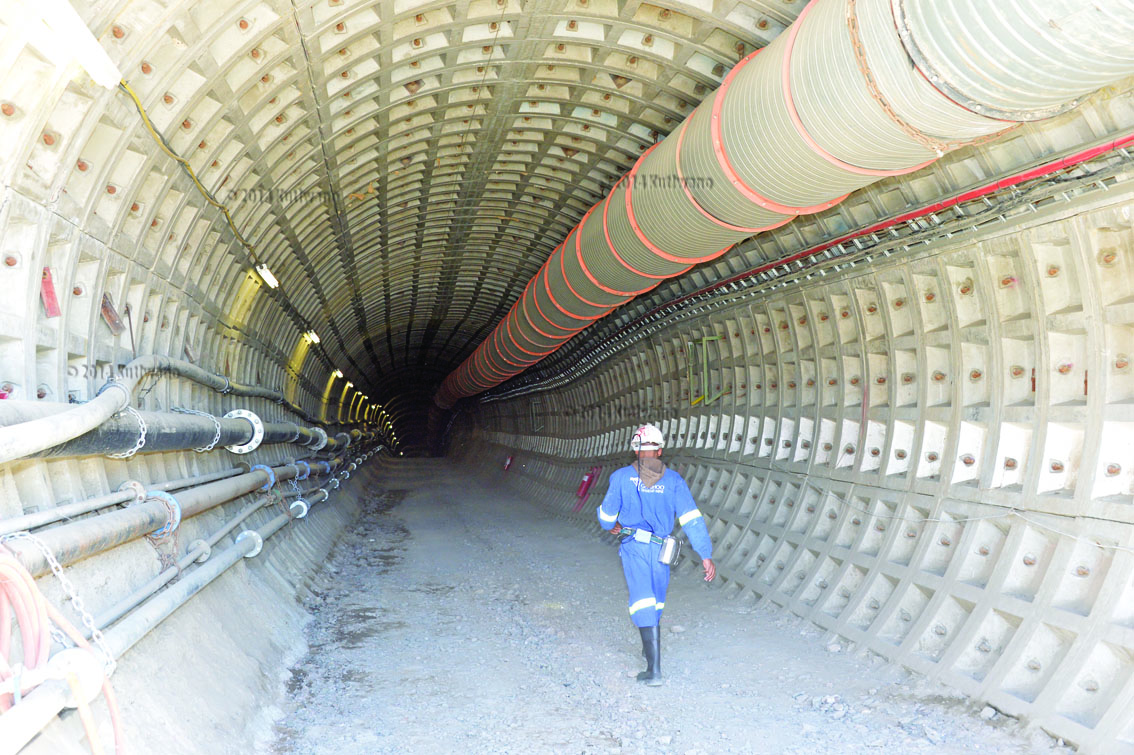
We entered the mine around 1830hrs, fully attired like men of the underground. The site is very much akin to ant holes, with several tributaries deviating from the main hall way. Water is pumped outside to ease movement, air is on the other hand pumped inside to allow normal respiration. Every other artificial object inside is reflective to the smallest amount of light. As we drive deep down, miners are meanwhile busy with their daily routines, drilling the kimberlite extracting the diamond. The officials continue to explain their processes as we sink deeper and deeper under the thick Kgalagadi sand. Adrenalin rushes but hey, it eventually takes a chill pill. We are here for a purpose, nothing else but the story below the ground. Click click, the camera shoots, we ask questions, simple and foolish ones, we touch the kimberlite, record the time, note the surroundings, observe the tension, admire the miners as they relax about their normal work, the story is done.
Outside the mine during the debriefing we agree that this was the most humbling experience we ever had. But given another chance we will take the challenge head on, besides journalism is a truth and bravado based undertaking.
Diamonds from the mine are expected to hit the market in December although the target, on paper, is early 2015.
General manager of the mine, Kavis Kario, explains in an interview that all processes are running smoothly to ensure that the first produce is ready by the festive season.
Information already available to geologists indicates that mine is projected to last at least 30 years.
Right now the mine is on transition from a project to a fully-fledged production plant and has in the process increased personnel from the initial 11 employees to around 120 to date.
Ghaghoo Diamond Mine is solely owned by Gem Diamonds who bought the rights to the Gope Retention License from diamond mining giant De Beers back in 2006. ENDS
In a previous interview, Gem Diamonds Chief Executive Officer, Haile Mphusu, revealed that the concession had two diamond pipes being GO 125 and GO 136.
“Data on the pipe up to the first 500 metres below surface shows that it contains 20 million carats and we want to produce 100 000 carats per year,” he said.