

Challenging The ÔÇÿHuman psycheÔÇÖ
Source : Kutlwano
Author : Mothusi Soloko
Location : Gaborone
Event : Social
If I told you that there were goats that behaved very much like humans, you would definitely dismiss me as one still living in the era of fables where animals could talk. And if I started talking of goats that did not only know road traffic rules but obeyed them as well, you would probably ask me to take stock of my senses.
Undoubtedly to many people, this might sound more like an ancient folktale- the kind that the elderly used narrate to scare children away from danger. For instance, they would warn their children against going to certain places because “there are dangerous creatures that look like goats.” The old saying that “be careful of what you wish, you might get it,” seems to come to play here. However, if anyone out there is wondering where on earth do goats behave like human beings, or think ke ‘bothodi fela’ (bad omen), the reality is that some of these creatures have narrowed the intelligence gap between man and animal. Amos Tlagane, Minkie Kaisara, and Oshale Dibotlhale, are some of the residents of Mogoditshane village who bear testimony to this fable-like observation.
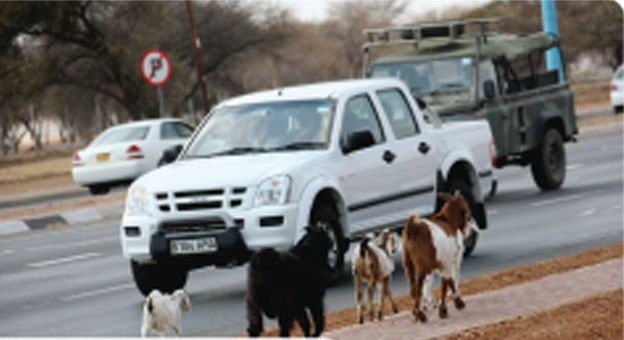
“These goats are amazing as they seem to have studied road rules. They usually ‘walk’ on the roadside until they reach a zebra crossing or traffic lights, where they then cross to the other side,” says Tlagane. Apparently obeying road signs and being human-like is a trait the goats have learnt and passed on from one generation to the next. This view seems credible given how several groups of goats in Mogoditshane appear to have grasped the art of behaving like humans in a manner that defies explanation. Talk about moving around town without being a nuisance to motorists; their feeding habits; and how they interact with people; and everything makes for an intriguing tale.
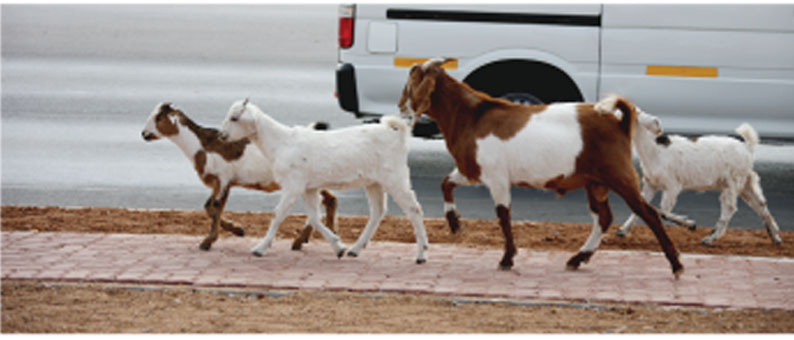
Every morning these goats trot alongside pedestrians in silent unison on road shoulders into various malls while the smooth flow of traffic continues unhindered. It is, however, their grasp of road traffic rules that intrigues the human mind, and there is no doubt that they will beat many people in so far as obeying the rules is concerned. It is strange, to say the least, for a goat to decode the colours of traffic lights, or know what a zebra crossing means, or a goat that waits for traffic to clear off before crossing to the other side of the road.
These are urbane goats. They are unlike your ordinary goats in rural areas which would run helter skelter whenever a vehicle approached. Strikingly, these goats enjoy play-fighting on vans and are fond of climbing on roof tops ostensibly to be on high ground. They are city goats and it would appear they have mastered the art of living in town. We do not want to break traffic rules, they seem to say.
The big question is; how and who taught them road rules. “It happened over a long period of time. Some got hit by motorists while crossing at undesignated points and somehow they learnt that the safest crossing points were at the zebra crossing and traffic lights,” says Tlagane. He says if by any chance they happened to cross where there are no crossing points, they wait like a group of standard-one pupils for traffic to clear off before they can rush to the other side of the road. These goats are able to climb and hold their balance in the most of precarious places; they are also highly inquisitive.
We hear that whenever there is something new or unfamiliar in their surrounding, they will explore it. “Since the introduction of three-lane highways, they seem to be confused but the traffic lights are still familiar to them,” adds Tlagane. Their diet mostly comprises fruits and vegetables. “They feed on perished fruits and vegetables from shops and supermarkets, and emptying dustbins is just a piece of cake to them. There are shrubs all over the area yet they overlook them as if they are not part of their traditional diet, preferring to bite on ‘succulent’ vegetables and fruits,” says Kaisara, another Mogoditshane resident.
Interestingly, the goats are not a nuisance to vendors who sell fruits and vegetables in Mogoditshane. In fact as Kaisara puts it, “they seem to know what has been disposed off and what is still in use. They are not the kind of goats that move about bleating frantically. They are calm and collected and radiate confidence in whatever they do,” she says. She says while in the past they used to trouble vegetable traders, the goats have since started behaving like trained dogs. “Since I started operating here, I have never heard anyone yell at them; they are well behaved,” she says.
Unfortunately, they appear to be stray goats as no one has been spotted escorting them to a kraal and instead they sleep on shop verandas and those who are in the know say one of their best sleeping places is the veranda of a Chinese restaurant at Bonnington shopping centre. ENDS
FACTS ABOUT GOATS:
1. Extremely curious and intelligent
2. Easily trained to pull carts and walk on leads
3. They will test fences, either intentionally or simply because they are handy to climb, and if a fence can be overcome, they will escape.
Teaser:
They know which side of the road to ‘walk’ on and where to cross, writes Kutlwano staffer, who spent the day observing them and disecting their behaviour...


